
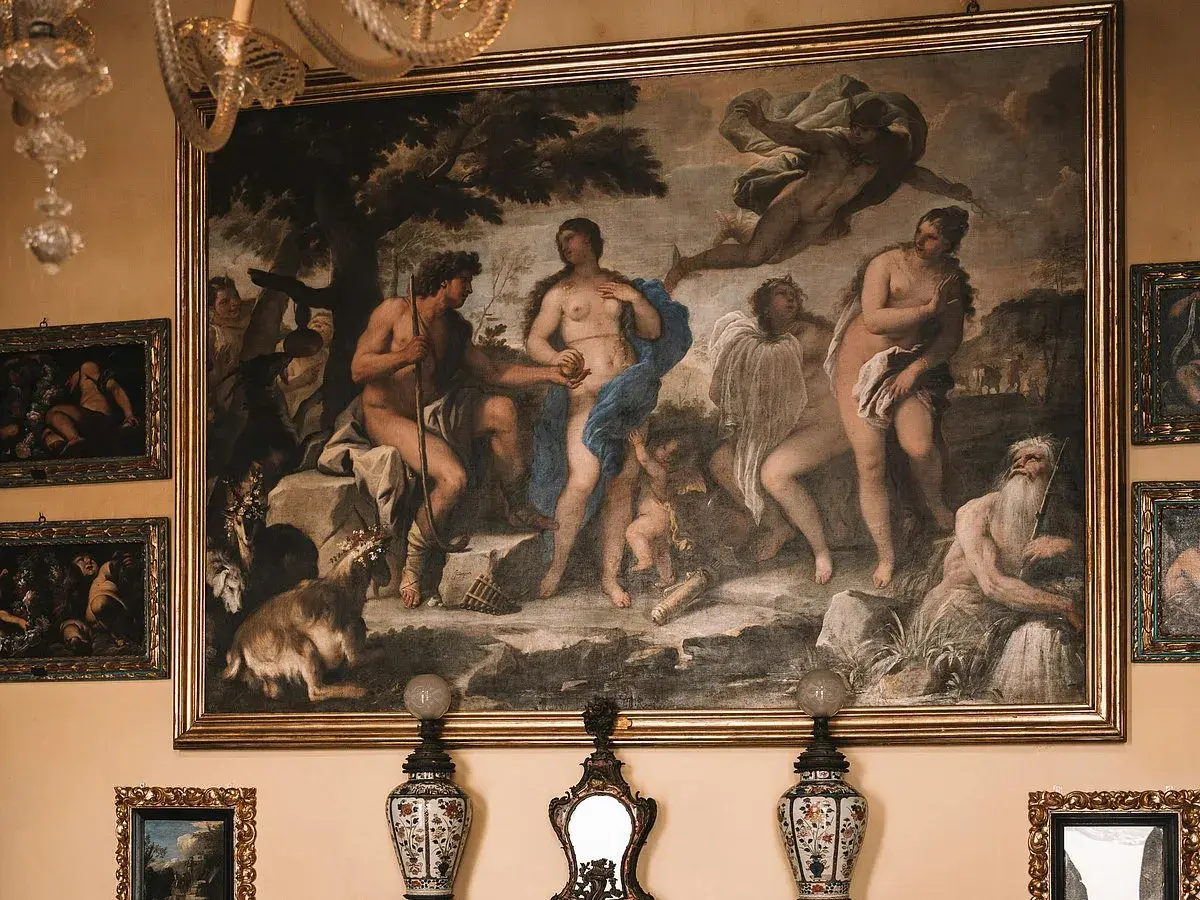
The core techniques at a glance
- Linear perspective gave painters a mathematical way to place architecture and figures in believable space.
- Oil paint and glazing let artists build richer color, softer transitions, and more convincing textures.
- Chiaroscuro, sfumato, and atmospheric perspective turned light and distance into active design tools.
- Anatomical study, contrapposto, and foreshortening made bodies look weight-bearing instead of symbolic.
- Printmaking allowed Renaissance images to circulate quickly and shape artistic exchange across Europe.
- Conservation clues such as underdrawing, pentimenti, and glaze layers still help specialists read how a work was made.

The central breakthrough was making space measurable
The single most important shift was the invention and spread of linear perspective, a method for constructing believable depth on a flat surface. Once artists understood that parallel lines appear to converge as they recede, they could organize streets, rooms, courts, and altars with mathematical discipline instead of guesswork. That is why Renaissance interiors feel so different from earlier medieval space: they are not just decorated backgrounds, they are constructed environments.
I usually think of this as the moment painting became architectural. A tiled floor, a colonnade, or a coffered ceiling could now anchor the entire composition around a vanishing point, which made figures look as if they occupied the same world as the viewer. Artists also used one-point, two-point, and three-point perspective depending on how complex the view needed to be. Even when the geometry was not perfect, the effect was persuasive enough to make the image feel internally consistent.
Atmospheric perspective worked alongside linear perspective. Distant forms became paler, cooler, and less detailed, so depth was reinforced not only by lines but also by color and clarity. That combination is why Renaissance landscapes began to feel like actual air rather than a symbolic backdrop. Once artists could map space this way, they still needed materials that could hold those subtleties, which is where paint handling and surface construction mattered.
Oil paint, glazing, and fresco gave artists new surfaces to control
Renaissance innovation was not only about geometry. It was also about what paint could do once it touched the surface. In the North, artists refined oil paint into a flexible medium that dried slowly enough for blending, corrections, and transparent glazes. Those layers made skin look translucent, metal look reflective, and fabric look tactile in a way that older media could not always match. Oil was not invented in the Renaissance, but its artistic potential was pushed much further than before.
Italy kept fresco at the center of major wall painting, especially for churches and public buildings. Fresco meant working with pigment on wet plaster, so the artist had to plan around the wall itself, often in daily sections called giornate. That limitation sounds restrictive, but it also encouraged strong composition and large-scale narrative clarity. In practical terms, fresco was durable and monumental, while oil was slower, more forgiving, and better suited to subtle effects.
| Medium | How it behaves | Why Renaissance artists valued it |
|---|---|---|
| Fresco | Pigment is applied to wet plaster and becomes part of the wall as it dries. | It is durable, monumental, and ideal for large narrative cycles. |
| Oil paint | It dries slowly and can be built in transparent or semi-transparent layers. | It supports blending, luminosity, and fine surface detail. |
| Tempera | It dries quickly and produces a more matte surface. | It can preserve precision, but it is less flexible for soft tonal transitions. |
That medium choice shaped the look of the work as much as subject matter did. A fresco can feel immediate and public, while an oil painting often feels more intimate and optically rich. The next step was to use light itself as a construction tool, not just a finishing touch.
Light and shadow became a structural language
Renaissance painters did not simply add shadows because they looked attractive. They used light to build form, separate planes, and direct attention. Chiaroscuro is the clearest example: strong contrasts between light and dark make volume read more convincingly. A face stops looking drawn and starts looking inhabited. Drapery stops looking patterned and starts looking folded.
Sfumato goes in the opposite direction. Instead of sharp edges, it softens transitions so forms seem to dissolve gently into one another. Leonardo made that effect famous, and the reason it matters is simple: the eye reads soft blending as air, distance, and subtle flesh. I think this is one of the most misunderstood Renaissance techniques, because it is easy to describe as “smoky” and hard to appreciate as a disciplined visual method. It is not blur for its own sake. It is controlled ambiguity.
The three methods below are easy to confuse, but they solve different problems:
| Technique | What it does | Typical result |
|---|---|---|
| Chiaroscuro | Uses strong light-dark contrast to model form. | More volume, drama, and visual focus. |
| Sfumato | Softens edges and transitions between tones. | Faces and contours feel atmospheric and lifelike. |
| Atmospheric perspective | Makes distant objects paler, bluer, and less detailed. | Backgrounds recede and space feels deep. |
When these effects are combined, the painting no longer relies on outline alone. It behaves like a world with air in it. That matters even more once the artist starts studying the human body as carefully as the surrounding space.
The body was studied with more observation than ever before
Renaissance artists wanted figures to sit inside space convincingly, so they studied anatomy, proportion, gesture, and weight. That often meant looking closely at the body from life and, in some cases, through anatomical dissection. The point was not to turn every figure into a medical illustration. The point was to understand how limbs bend, how muscles pull under the skin, and how weight transfers through a standing or seated body.
Anatomy and proportion
Measured proportion helped artists avoid the flat, symbol-driven bodies of earlier periods. A torso could twist, a shoulder could bear weight, and a neck could turn without breaking the underlying structure. This is why Renaissance figures often feel both idealized and believable. They are not literal copies of a person standing in front of the painter. They are constructed bodies that obey visual logic.
Read Also: Feminist Art - Beyond the Canvas: What You're Missing
Foreshortening and contrapposto
Foreshortening compresses forms that point toward the viewer, so an arm or leg can project into space without looking awkward. It is a demanding technique because the artist has to describe what the body is doing, not just what its outer contour looks like. Contrapposto, the relaxed shift of weight onto one leg, adds to that naturalism by keeping the body from appearing rigid. Together, those techniques make movement look lived rather than staged.
Preparatory drawing also became more important. Artists used studies, cartoons, and underdrawing to test the pose before committing paint or plaster. That extra planning is one reason Renaissance works often feel so confident: the final image is carrying a lot of invisible drawing beneath it. Once bodies could move naturally, the next innovation was making images themselves travel farther than a single workshop wall.
Printmaking let Renaissance images travel far beyond one studio
Another major technical change was the rise of printmaking. Woodcut, engraving, and later etching allowed artists to produce multiple impressions from a single matrix, which meant ideas could spread quickly and cheaply compared with painted originals. That mattered for motifs, compositions, devotional images, and even technical knowledge. An image no longer had to stay in one city or one patron’s collection to have influence.
| Print method | How it works | Why it mattered |
|---|---|---|
| Woodcut | The design is cut into a wood block and printed from the raised surface. | It produces bold shapes and can be reproduced relatively efficiently. |
| Engraving | Lines are incised into a metal plate with a burin. | It supports very fine detail and crisp linework. |
| Etching | Acid bites lines into a prepared metal plate after the artist draws through a ground. | It feels closer to drawing and was easier for many painters to adopt. |
I see printmaking as the Renaissance’s great multiplier. A composition by Dürer, Parmigianino, or Bruegel could be studied, copied, adapted, and remixed across borders. That did not replace painting, but it changed how painters learned from one another. It also created a practical limitation: prints preserve line beautifully, yet they flatten color and scale, so they are an incomplete record of a painter’s ambitions. Those limits are exactly why the physical object still matters.
How the surface still tells the story
For conservation and authentication, Renaissance technique leaves a trail. Under infrared imaging, specialists may see underdrawing beneath the painted surface. X-radiography can reveal pentimenti, the artist’s changes of mind. Cross-sections can show how a glaze was built, how thick a paint layer is, or whether later retouching has altered the original surface. In fresco, the seams of the giornate can still describe the painter’s working pace. In prints, plate wear and edition states can help identify chronology and originality.
That is why the answer is more than a list of techniques. Renaissance artists learned to think in layers: geometry underneath, drawing underneath that, and surface effects on top. If you are looking at a work from the period, the most revealing question is often not just what it shows, but how it was built. That physical evidence is where the history of the image, and sometimes its authenticity, becomes visible.
