
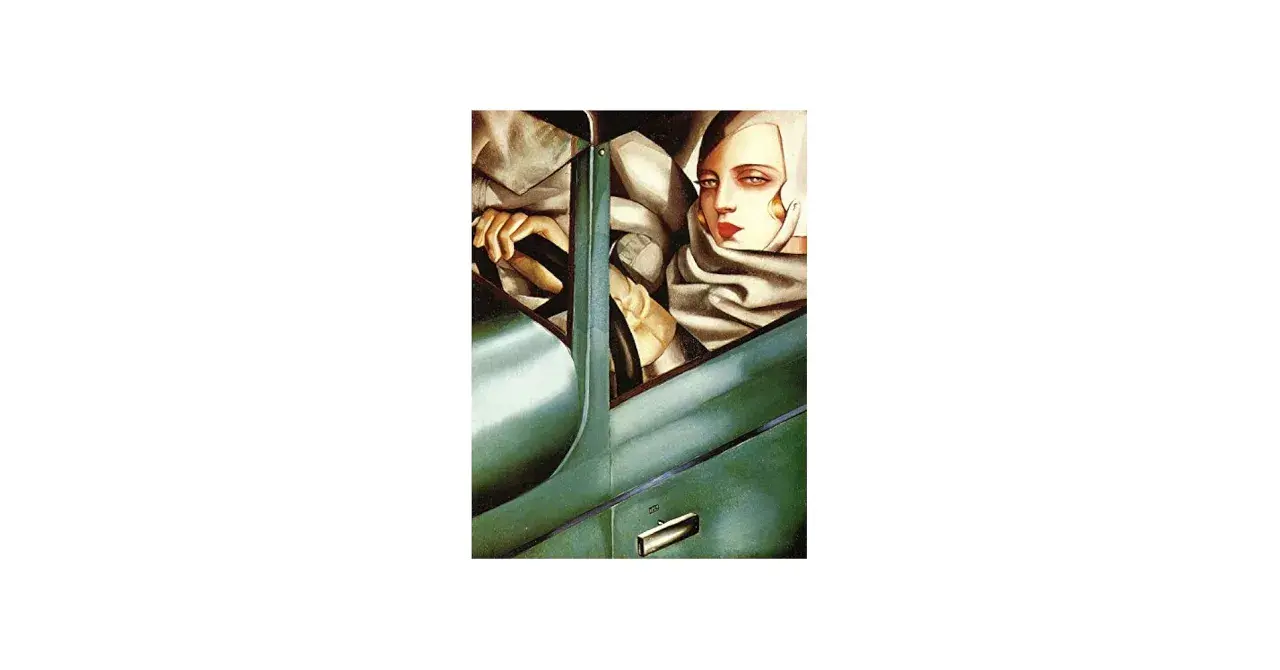
Tamara de Lempicka’s self-portrait in the green Bugatti is more than a glamorous Art Deco image. It is a controlled statement about modern identity, social status, speed, and the way a woman artist could stage herself for the public eye. Here I break down what the painting actually shows, why the car matters, how the title varies across records, and what to check if you are evaluating a reproduction or an attribution.
The essential facts you need first
- The work is generally dated 1929 and is an oil on panel measuring 35 x 27 cm.
- It is a self-portrait by Tamara de Lempicka, one of the defining painters of Art Deco.
- The green Bugatti is symbolic rather than purely documentary; it signals autonomy, glamour, and speed.
- The original is widely listed as being in a private collection, so most readers encounter the image through reproductions or catalog records.
- Title variants are common, and they matter when you are checking provenance or shopping for an authorized print.
- For preservation, the key issues are light control, stable humidity, and careful framing or storage.
What the portrait shows at first glance
At first glance, the composition is simple: the artist sits behind the wheel, bundled into gloves, a fitted helmet, and a scarf that seems to move even while the image is still. That is exactly why it works. The face is poised, the body is compressed into the car’s interior, and the whole image feels like a snapshot of motion that has been carefully composed rather than accidentally caught.
The catalog record most often associated with the work lists it as My Portrait (Tamara in the Green Bugatti), 1929, oil on panel, 35 x 27 cm, private collection. That basic line matters because it anchors the image in a real object with a support, size, and ownership history, not just a famous pose. I think that distinction is important for anyone who wants to understand the work beyond its poster life. Once you see that, the car stops being decoration and becomes the core of the argument.
Why the Bugatti matters more than the car itself
The Bugatti is not just a status object parked inside the portrait. It turns the image into a claim about modern life: speed, independence, luxury, and the right to occupy space on your own terms. In my reading, that is what makes the painting so durable. It is not describing a woman who owns a car; it is constructing a woman who looks like she belongs to a world of motion, precision, and wealth.
That distinction matters because many viewers assume the portrait is autobiographical in the literal sense. The stronger reading is symbolic. Even if the car is idealized rather than documentary, the choice is still revealing: Lempicka wanted the machine to enlarge the self, not hide it. The polished green bodywork, the metallic highlights, and the driver’s cool expression all work together to create a self-image that feels engineered, not improvised. From there, the next question is simple: why do the title and catalog records look slightly different depending on where you find them?
Why the title changes across catalogs and reproductions
There is a practical reason this painting is harder to name than it first appears. Different archives, shops, and essays use different titles, but they usually point to the same work. The estate catalog uses My Portrait (Tamara in the Green Bugatti), while older references often use Autoportrait or Self-Portrait.
| Title variant | What it usually signals | Why it matters |
|---|---|---|
| Autoportrait | French-language cataloging or older scholarly usage | Useful when searching European references or exhibition records |
| Self-Portrait | English-language shorthand | Common in museums, books, and online listings |
| My Portrait | Estate catalog title | Best for matching authorized reproductions and official records |
| Tamara in the Green Bugatti | Popular descriptive title | Helpful for readers, but less precise in catalog work |
For collectors and researchers, the point is not pedantry. Title drift often reveals whether a listing is copied from a reliable catalog entry or padded with vague language. When the title, date, medium, and size are all consistent, you are on firmer ground. When one of those elements is missing, I become cautious immediately. That caution becomes even more important once you look at the composition as Art Deco design rather than just a portrait.
How the painting turns Art Deco into a personality
The portrait is often described as glamorous, but that word is too soft for what is happening here. Lempicka is using the visual grammar of Art Deco to build a self-image: hard edges, smooth surfaces, compressed space, and a palette that feels deliberate rather than casual. The result is a portrait that reads almost like a manifesto.
Geometry makes the face feel sculpted
The face and hands are treated with an almost monumental clarity. Planes are simplified, contours are crisp, and shadows are used to model form without making it heavy. That sculptural treatment gives the sitter a sense of permanence, as if she were carved out of the same era that produced streamlined architecture and polished machinery.
Clothing becomes part of the machine
The gloves, helmet, and scarf are not accessories in the usual sense. They merge the body with the car and make the figure feel mechanically aligned with the vehicle. I read that as a visual strategy: the artist is not posing beside modernity, she is absorbed into it.
Read Also: Jackson Pollock Portrait - How to Find & Verify the Best Image
Color and reflection carry the mood
The green of the car does a lot of work. It is rich without being loud, and it gives the portrait an almost lacquered quality. Against that surface, the flesh tones look cool and controlled. The painting never feels noisy. It feels polished, and that polish is part of the message. When the image is that composed, the question of authenticity becomes more than an art-market issue, which is where I usually turn next.
What to check before you trust a reproduction or attribution
If you are cataloging, buying, or simply trying to identify a version of the image, I would not rely on the car alone. I would check the full description, the support, and the history around the object.
| Version | What should be documented | Common red flags |
|---|---|---|
| Original work | Provenance, exhibition or publication history, medium, dimensions, current location | Vague ownership history, wrong size, generic title, no source trail |
| Authorized reproduction | Estate or rights-holder permission, edition details, material description | Blurry credit line, missing edition info, inconsistent colors |
| Decorative copy | Usually nothing beyond seller language | Overconfident claims, copied text, altered proportions, mirrored details |
- Check the support. The original is oil on panel, not a loose canvas print.
- Check the proportions. The known dimensions are small and rectangular, about 35 x 27 cm.
- Check the naming. A serious listing should not improvise the title or date.
- Check the narrative. If the description sounds like marketing rather than documentation, slow down.
- Check the image itself. The pose, steering position, gloves, scarf, and helmet should all match the established composition.
In the US market, I would also treat missing provenance as a real warning sign, not a minor inconvenience. A high asking price does not prove legitimacy, and a stylish image does not prove authorship. This is a highly specific work with a traceable identity, and that traceability is part of its value. Once you are clear on what you are looking at, the preservation question becomes much easier to handle.
How to preserve the image without flattening the color
Whether you own an original, an authorized print, or a textile reproduction, the goal is the same: keep the surface and color relationships intact. With this image, that matters because the drama lives in subtle shifts of green, gray, skin tone, and metallic reflection. If those tones drift, the whole portrait loses its precision.
- Keep display areas stable, ideally around 18-21°C and 45-55% relative humidity.
- Avoid direct sunlight and unfiltered UV, which can fade pigments and yellow varnish or paper.
- Use archival framing materials for paper prints: acid-free matting, backing, and mount materials.
- For original panel works, avoid rapid temperature changes and never clean the surface with household products.
- If the reproduction is on textile, store it flat or rolled only according to the maker’s guidance, and keep it away from bright light.
I also tell people to be careful with digital versions. Screens often oversaturate the green and over-sharpen the chrome-like edges, which makes the painting feel more aggressive than it really is. The original has more restraint than most images online suggest. That restraint is one reason the portrait still feels modern, which brings me to the last point.
How I would describe the work today
If I were writing a catalogue label, I would keep the description clean and exact: Tamara de Lempicka, My Portrait (Tamara in the Green Bugatti), 1929, oil on panel, 35 x 27 cm, private collection. That formula respects the work’s documentation and makes it easier to trace later.
- Keep the date and medium.
- Use the estate title when possible.
- Reserve the shorthand “green Bugatti” for discussion, not formal cataloging.
What makes the portrait endure is that it understands self-portraiture as performance without losing seriousness. Lempicka turns fashion, machinery, and identity into one tightly controlled image, and that is why the painting still reads clearly in 2026. If you remember only one thing, remember this: the Bugatti is impressive, but the real subject is authorship.
