
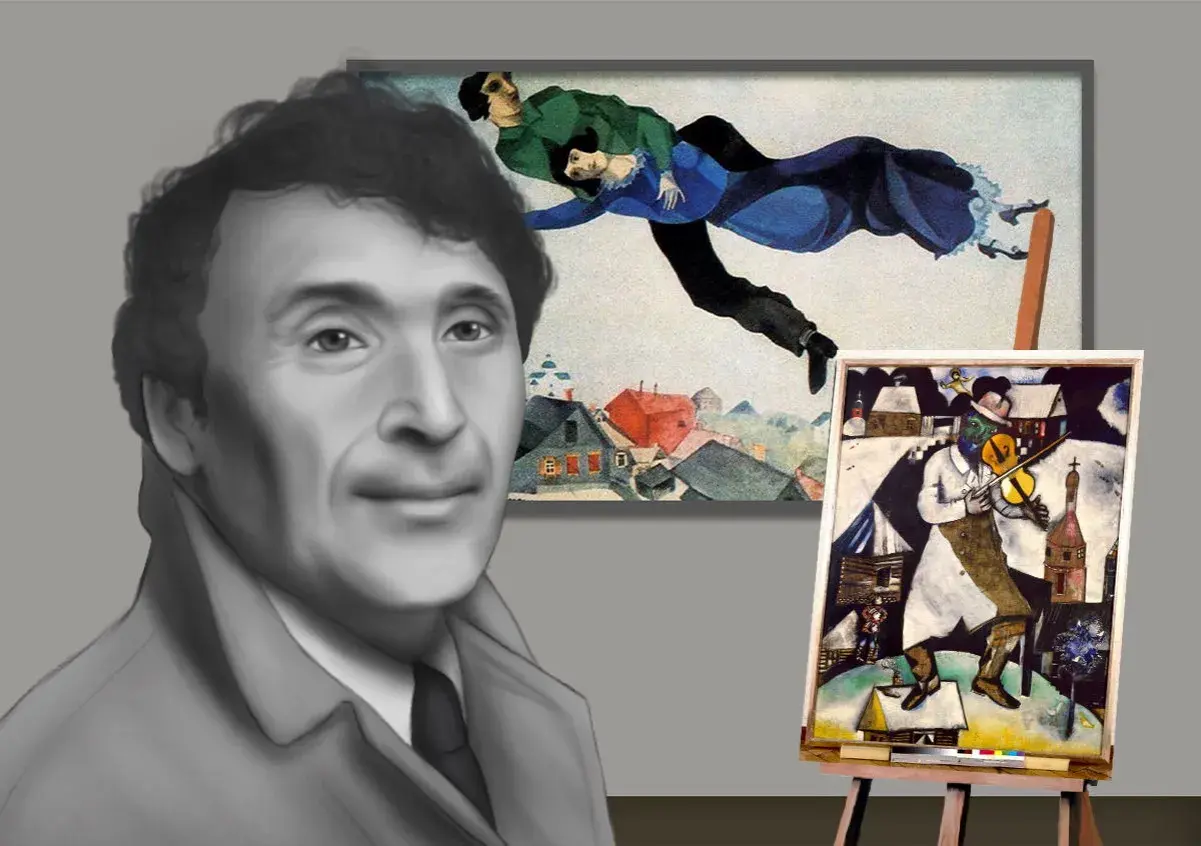
This article focuses on famous Marc Chagall works, especially the paintings and large cycles that define his visual language. I’ll walk through the key pieces, explain why they matter, and show what to look for when you encounter them in a museum, catalog, or reproduction. For readers of an art-history site, the useful question is not just which works are famous, but why they still read so clearly after more than a century.
Key facts at a glance
- I and the Village (1911) is the clearest early statement of Chagall’s memory-based imagery.
- Birthday (1915) distills his floating lovers motif into a private, emotionally direct scene.
- Paris Through the Window (1913) and The Fiddler (1912–13) show how he fused Parisian modernism with village folklore.
- White Crucifixion (1938) gives his work its strongest political and moral charge.
- The late Biblical Message cycle, painted between 1956 and 1966, turns Chagall’s language into monument-scale sacred art.
- For preservation and authentication, provenance, medium, and condition matter far more than a decorative image search.

The core works that define his reputation
If I had to introduce Chagall through a small set of works, I would choose the pieces below. They cover his most recognizable motifs and also show that his art is not a single mood; it moves from village memory to love, exile, religion, and large-scale biblical narration.
| Work | Date | Why it matters | What to notice |
|---|---|---|---|
| I and the Village | 1911 | The classic Chagall image of memory turned into dream logic. It is one of the earliest works where his personal vocabulary feels fully formed. | The linked eyes of the man and the cow, the layered village fragments, and the way folk memory meets Cubist fragmentation. |
| Paris Through the Window | 1913 | A sharp contrast between Paris and the artist’s birthplace. It helps explain why Chagall is modern without ever feeling cold. | The city seen as a tilted, uncanny stage rather than a literal view. |
| The Fiddler | 1912–13 | An early version of the musician motif that Chagall would return to for decades. | The figure’s role as a symbol of village tradition, continuity, and emotional survival. |
| Birthday | 1915 | One of the most intimate images in his career, and one of the best examples of his airborne lovers. | The couple’s levitation, the domestic interior, and the sense that joy can defy gravity. |
| Green Violinist | 1923–24 | A later, more iconic statement of the fiddler idea. It shows how Chagall refines a folk image into a nearly emblematic figure. | The exaggerated color, the sense of movement, and the balance between tradition and change. |
| White Crucifixion | 1938 | His most forceful public statement about persecution and Jewish identity. | Christ shown amid scenes of violence and displacement, which makes the painting both religious and historical. |
| Biblical Message cycle | 1956–1966 | Chagall’s late monumental cycle, created at a scale that shows how far his language could expand. | Seventeen large canvases centered on Genesis, Exodus, and the Song of Songs. |
That shortlist already shows the main pattern: Chagall’s famous paintings are not famous because they are formally tidy. They are famous because they make private memory feel universal. From there, the next question is why his imagery is so instantly identifiable even when the subject changes.
Why his imagery is easy to spot but hard to flatten
Chagall’s pictures can look whimsical at first glance, but that word only gets you halfway there. I usually think of his work as a system of recurring symbols rather than a style of decoration. Lovers float, musicians drift through streets, animals stare back at people, and villages appear as if they were remembered in a dream rather than observed from life.
Several motifs return often enough to form a visual grammar:
- Floating figures suggest love, memory, ecstasy, or displacement, depending on the work.
- Musicians connect the artist to Jewish village culture, ritual, and storytelling.
- Animals and humans looking at one another often imply shared life rather than hierarchy.
- Domestic interiors become unstable spaces, which lets emotion override perspective.
- Religious symbols appear without turning the work into doctrine; they stay poetic and human.
What keeps this from becoming predictable is the tension between folk memory and modernist structure. Chagall borrows from Cubism, but he does not submit to it. He uses fractured space, odd angles, and dislocated scale to serve narrative feeling, not to prove a theory. That distinction matters, because it explains why his paintings can seem simple from across the room and unusually layered once you stop in front of them.
That leads naturally to the bigger shift in his career: the difference between the early Paris years and the later, more monumental sacred works.
How his art shifts from memory to monument
Chagall did not stay in one mode, even when the motifs looked familiar. The emotional center changes over time, and the scale changes with it. If you want to read his famous works well, you need to see the early images, the wartime works, and the late biblical cycle as related but not identical chapters.
Early Paris works and village memory
Works such as I and the Village and Paris Through the Window belong to the phase where Parisian modernism meets Belarusian memory. He had arrived in Paris with a strong sense of place already formed, so the city did not erase the village; it made the village more symbolic. In that period, the paintings feel personal, experimental, and surprisingly tender. Even when the compositions are fractured, the emotional message stays legible.
War, exile, and sharper political meaning
By the 1930s, the mood darkens. White Crucifixion is the clearest example because it turns the Christian cross into a vehicle for Jewish suffering and historical alarm. The painting does not read like an isolated religious scene; it reads like an indictment. I think that is why it remains so widely discussed: it is not only beautiful or shocking, it is morally specific.
Read Also: Pompeii's "Inappropriate" Art - Beyond the Shock Value
The late biblical cycle and sacred scale
The Biblical Message cycle in Nice marks a different ambition. The museum there was built to house the cycle, which consists of seventeen large canvases painted between 1956 and 1966. These works do not abandon Chagall’s color or dream logic, but they give it room to breathe on a monumental scale. Instead of village interiors, you get vast scenes drawn from Genesis, Exodus, and the Song of Songs. The effect is less intimate, more architectural, and in many ways more ceremonial.Once you see that progression, the famous images stop looking like isolated hits and start reading as part of a long visual biography. The next step is learning how to look at a single painting without flattening it into a slogan.
How I would read a Chagall in the gallery
When I stand in front of a Chagall, I start with the obvious image and then work backward. That sounds simple, but it prevents a very common mistake: treating the work as merely decorative. His paintings reward slow looking because the first impression is usually emotional, while the second and third reveal structure.
- Identify the dominant motif first. Is it a lover, a musician, an animal, a crucifixion scene, or a village memory?
- Check how bodies are positioned in space. Floating is rarely just fantasy; it often signals joy, instability, or spiritual distance.
- Look for visual links such as connected gazes, repeated outlines, or mirrored figures. In I and the Village, those links are part of the meaning.
- Notice the color logic. Chagall uses color emotionally, not naturalistically, so green, blue, or red may be more symbolic than descriptive.
- Read the title against the image. Sometimes the title confirms the scene, and sometimes it quietly complicates it.
That method works especially well because Chagall rarely gives you only one level of meaning. A birthday scene can also be an image of transcendence. A fiddler can be a portrait of cultural continuity. A crucifixion can be both sacred symbol and political warning. If you keep that double reading in mind, the works stay alive instead of turning into posters.
From there, the practical question becomes different: how do you distinguish a genuine Chagall object, or a serious reproduction, from something that only borrows the look?
What matters when the work has to be preserved or authenticated
Chagall is heavily reproduced, which makes visual familiarity a poor authentication tool. In 2026, the safest reference points are still the museum record, provenance, and the artist’s catalogue raisonné, which is the scholarly inventory of authenticated works. Style matters, but it is never enough on its own.
| Medium | What to verify | Common mistake |
|---|---|---|
| Oil on canvas | Provenance, exhibition history, condition, and any restoration record. | Assuming bright color alone proves authenticity. |
| Prints and lithographs | Edition number, signature placement, publisher information, paper, and plate characteristics. | Confusing a later poster or reproduction with a period print. |
| Stained glass | Installation history, commission records, and conservation notes. | Treating every Chagall glass work as if it followed the same fabrication process. |
| Mosaic and tapestry | Site-specific documentation, studio collaboration records, and transport or reinstallation history. | Ignoring the fact that these works often depend on architecture, not just image quality. |
For paintings, the main conservation concern is usually not just age but surface sensitivity. Chagall’s layered color, varied textures, and delicate transitions can be damaged by aggressive cleaning or poor storage. For prints, the problem is usually the opposite: too many later impressions, too many decorative copies, and too little documentation. I would not trust a listing that cannot clearly explain medium, date, edition status, and ownership chain.
That practical filter is useful even for non-collectors, because it helps you separate the artwork itself from the mythology around it. If you want a sensible way to study Chagall now, I would start with a small, deliberate sequence rather than trying to absorb everything at once.
A practical order for studying Chagall today
If I were building a viewing list for a student, curator, or collector, I would begin with three anchors: I and the Village, Birthday, and White Crucifixion. Together, they show memory, intimacy, and moral urgency. After that, I would add Paris Through the Window and The Fiddler to see how the early modernist language develops, and then move to the Biblical Message cycle to understand the late monumental phase.
- Start with the village images to understand where Chagall’s visual world begins.
- Move to the lovers and musicians to see how he turns memory into recurring symbols.
- Study the crucifixion paintings to understand his political and spiritual seriousness.
- Finish with the biblical canvases to see how that language scales up without disappearing.
That sequence gives you a workable frame for the artist instead of a pile of famous titles. And that, in practice, is the best way to approach Chagall: begin with the images everyone knows, then keep going until you see how carefully they are built.
