
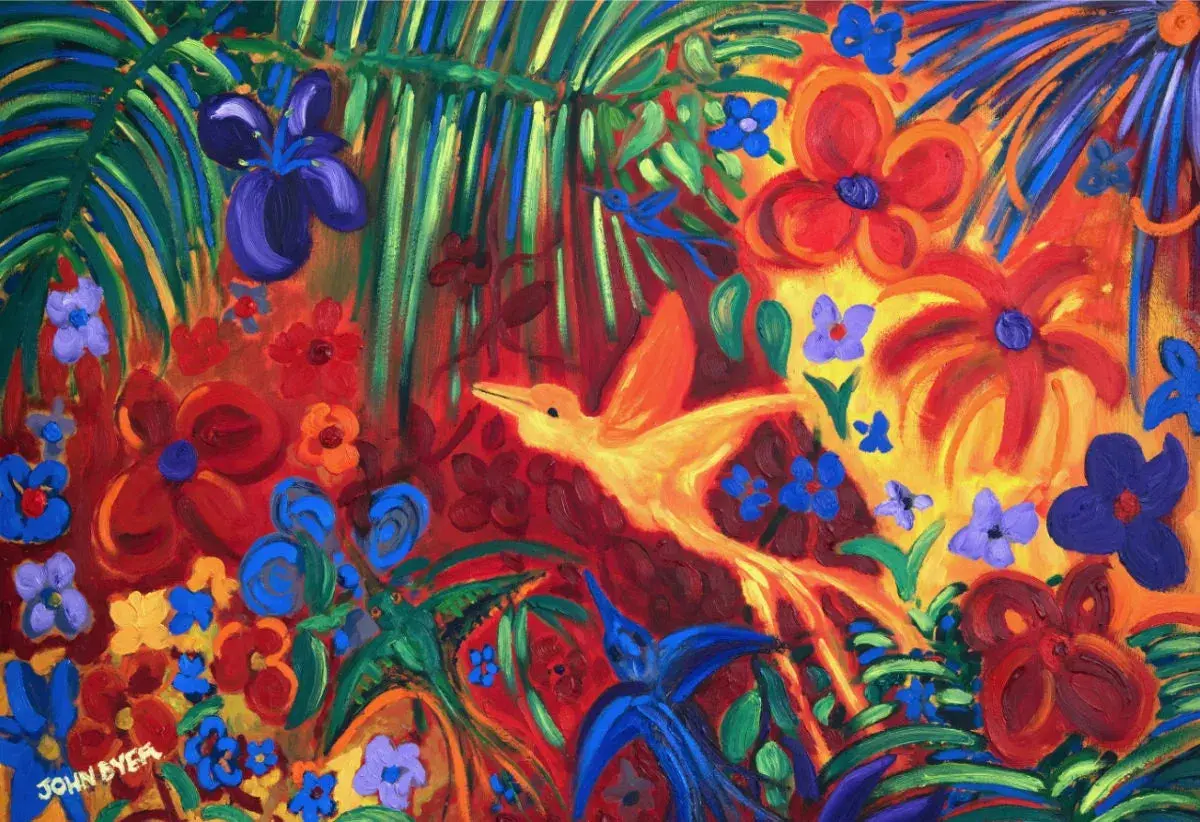
John Dyer's paintings work because they do two things at once: they celebrate place and they preserve memory. In the Welsh scenes, he often gives landscape a social pulse; in the Amazon work, he turns rainforest painting into environmental witness. This article breaks down who he is, what makes the Wales and Amazon bodies of work distinct, and what collectors should check before buying or preserving a piece.
What matters most about John Dyer's work
- He is a contemporary British landscape painter born in 1968, known for bright acrylic works on canvas and board.
- Wales and the Amazon show two sides of his practice: lived-in local scenes and expedition-based environmental painting.
- His images usually mix people, animals, and place, so the landscape feels active rather than empty.
- Recent listings place originals, signed limited editions, open prints, and posters at very different price points.
- For collectors, provenance, edition size, signature, and framing condition matter more than how a work looks online.
What defines his work at a glance
The John Dyer Gallery describes him as Cornwall's best-known contemporary artist, but I would frame him a little more broadly than that. He is a landscape painter who treats place as a living event, not just a view. That is why his paintings feel cheerful without becoming shallow, and why even his most colourful scenes still have structure and purpose.
He works in a way that suits immediate observation. In practice, that means an en plein air approach, or painting outdoors from direct experience, often supported by sketches, photography, and in some projects digital studies. The result is not polished distance. It is immediacy, with weather, movement, and human presence all left visible on the surface.
What I find most useful about his work is that it sits between landscape painting and visual storytelling. He is not trying to erase people from nature. He usually does the opposite, which makes his paintings easier to read and, frankly, more honest. That balance becomes especially clear when you compare the Wales and Amazon bodies of work.
Why Wales is more than a backdrop
In the Welsh paintings and travel-poster style works, Dyer leans into places that already carry a strong sense of use and memory. A good example is the Cardiff scene at Bute Park, where the Royal Welsh College of Music and Drama, a family walk by the river, birds, dogs, and musicians all share the same visual space. It is landscape as public life, not landscape as empty scenery.
That matters because it changes the emotional tone of the work. Instead of presenting Wales as something remote or solemn, he makes it feel inhabited, social, and slightly playful. The landscape still matters, but so do the people inside it. I read that as one of his strengths: he paints a place the way someone actually experiences it, not the way a brochure might flatten it.
For collectors and viewers, the Welsh works are often the easiest entry point into his practice. They are vivid, accessible, and immediately legible, but they also show his real concern with rhythm, figure placement, and atmosphere. Those are the details that stop a painting from becoming just a decorative scene. They also lead naturally into the much more ambitious Amazon material.
How the Amazon broadened his landscape vocabulary
The Amazon work pushes Dyer into a different register. In 2019 he travelled to the rainforest to paint with the Yawanawá tribe, and the resulting works include paintings and digital iPad drawings that are clearly tied to the expedition experience. Last Chance to Paint, the non-profit project he founded, uses that kind of field-based art to connect tribal culture, biodiversity, wildlife, and ethnobotany through creativity.
That project structure matters. It means the Amazon paintings are not just scenic images of trees, rivers, and wildlife. They are tied to lived knowledge, local culture, and the urgency of conservation. Works such as Yuxi Yuve - The Water Spirit of the Amazon Rainforest and Rare - Spiritual Rebirth show how he translates that experience into images that are both celebratory and alert.
I think the Amazon series is where his broader intentions become hardest to miss. He is not merely documenting a beautiful location. He is asking what a landscape means when it is shaped by ecology, ritual, and threat at the same time. That gives the work more weight than a standard travel painting, and it explains why the series has drawn attention beyond the usual landscape audience.
For anyone trying to understand his reputation, the Amazon material is essential. It shows the point where his colour sense, exploratory impulse, and environmental interests come together in one body of work, which leads straight into the visual language he uses to keep all of that readable.
How to read his colour, figures, and materials
Colour as emotional mapping
Dyer uses saturated colour as more than decoration. In his best work, colour tells you how a place feels before you have time to name what you are seeing. Hot greens, tropical blues, and strong sunset oranges are not just pretty choices. They set temperature, energy, and mood. I would call that emotional mapping, because the palette helps the viewer understand the place as an experience.
Figures keep the scene alive
Many landscape painters treat figures as afterthoughts. Dyer does the opposite. People, animals, boats, birds, musicians, and local details often anchor the composition. This keeps the image from becoming generic. It also gives the viewer a way to measure scale, which is especially important in the Amazon works where the density of the environment could otherwise swallow the whole picture.
Acrylic suits his pace
His current work is strongly associated with acrylic on canvas and board, and that makes practical sense. Acrylic dries faster than oil, handles bright colour well, and supports the kind of direct, layered painting that outdoor work demands. For preservation, that is not a trivial detail. Acrylic is generally stable, but the support, varnish, and framing still matter a great deal, especially if the work is meant to stay vivid over decades.
Read Also: Venus and Mars Painting - Uncover Hidden Meanings
Digital studies are part of the process, not a gimmick
In the Amazon project, he also used an iPad and Procreate alongside traditional materials. I would not treat that as a novelty. In the field, speed matters. A digital study can capture layout, colour relationships, and movement when weather, light, or logistics make a full studio setup unrealistic. In other words, the technology supports the observational discipline rather than replacing it.
Once you understand those choices, the market side of his work becomes much easier to navigate. The next question is not just what the paintings mean, but what exactly you are buying.
What collectors should check before buying
The safest way to approach his market is to separate originals, signed limited editions, open prints, and posters before you look at price. Recent listings show a wide spread: originals can sit around GBP 4,950 and higher, signed limited editions can start around GBP 100, and posters can begin around GBP 40. For a U.S. buyer, shipping, insurance, and customs can quickly change the real cost, so the sticker price is only part of the equation.
| Type | What it is | Indicative current price band | Best for | What to verify |
|---|---|---|---|---|
| Original painting | One-off work on canvas or board | From about GBP 4,950, depending on size and subject | Serious collecting and long-term value | Signature, medium, dimensions, provenance, condition report |
| Signed limited edition print | Numbered print signed by the artist | From about GBP 100 to GBP 165 in recent listings | Collectors who want authenticity at a lower entry point | Edition size, numbering, paper type, signature, framing |
| Open-edition print or poster | Reproduction for display rather than scarcity | From about GBP 40 | Decorative use and accessible gifting | Image quality, paper stock, seller reputation |
For preservation, I would keep the advice simple. Originals should be protected from direct sun, heat, and rapid humidity swings. Works on paper and prints benefit from UV-filtering glazing, acid-free mounts, and careful framing. Even if acrylic itself is relatively robust, the support and surface can still be damaged by bad storage or poor handling. That is where a lot of collectors lose value without noticing it.
Authentication is usually straightforward if the seller is disciplined, but you still need to check the boring details. Make sure the title, dimensions, medium, signature, and edition match the paperwork. If a seller is vague about those things, I would treat that as a warning sign rather than a minor omission. A good image is not enough; provenance is what protects the work later.
What his paintings reward in long-term viewing
What keeps Dyer relevant is that he never treats landscape as dead subject matter. His best paintings are alive with movement, but they also hold a clear memory of the place itself. Wales gives him social landscape, the Amazon gives him ecological and cultural urgency, and both together show how contemporary landscape painting can still feel immediate without becoming sentimental.
If I were advising a collector, I would look first for works that have a specific location, a clear visual rhythm, and enough narrative detail to keep revealing itself after the first glance. That is where Dyer is strongest. The pieces that matter most are usually the ones that feel specific enough to remember and spacious enough to return to, which is exactly what good landscape art should do.
For readers approaching his work for the first time, that is the most useful lens: look for place, but also look for the human and ecological life inside it. That is where the paintings become more than colourful scenes and start functioning as records of how a landscape is lived, seen, and valued.
