
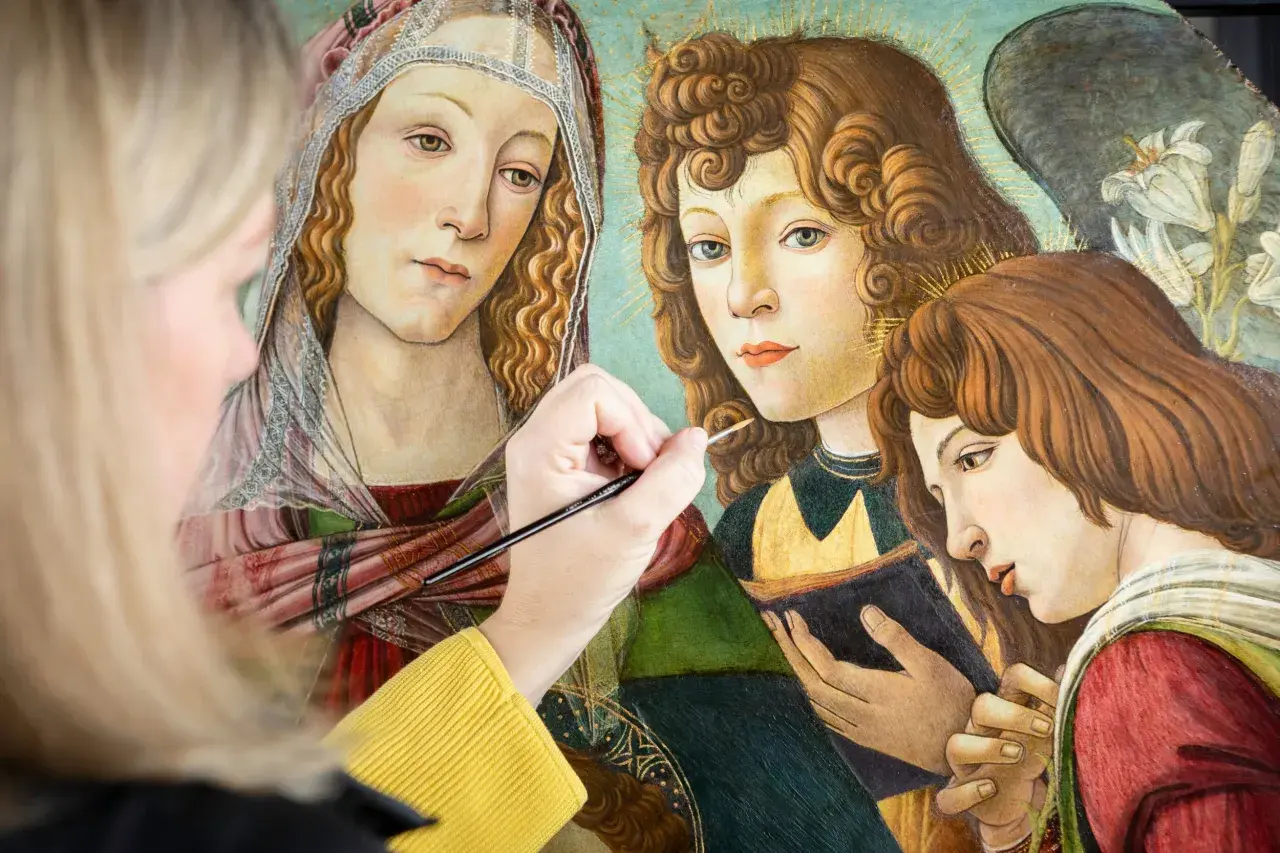
A Renaissance artist was rarely just a painter or sculptor. The strongest figures of the period worked like visual problem-solvers, using perspective, anatomy, classical references, and patronage to make art feel more human, more believable, and more intellectually ambitious than what came before. This article breaks down the main movements, the artists most closely associated with them, the visual traits that define the period, and the conservation and attribution questions that still matter today.
The essentials at a glance
- Renaissance art is defined by realism, balance, classical learning, and a stronger interest in the human body and mind.
- Italian and Northern Renaissance art share the same broad period but look and function differently.
- High Renaissance work is usually associated with harmony, ideal proportion, and compositional confidence.
- Materials matter: fresco, egg tempera, and oil paint each shape how a work looks and ages.
- For attribution, style alone is not enough. Provenance, technique, and condition carry real weight.
What defines Renaissance art in practice
I usually explain Renaissance art as a shift in how artists thought about reality, not just a change in how they drew it. Humanism pushed art toward classical learning, individual identity, the study of nature, and a more credible sense of space. The Met describes the period as giving art a more human face, and that is exactly what you see when devotional scenes start to feel inhabited by real bodies in real space.Four features appear again and again:
- Linear perspective, which organizes space so it feels measurable and stable.
- Anatomical attention, which gives bodies weight, proportion, and movement.
- Classical reference, from Roman architecture to mythological subjects and heroic poses.
- Natural light and shadow, used to model form instead of flattening it.
That combination is why the period still feels fresh. It is not just about beauty. It is about making image, idea, and observation work together, which leads directly to the visual clues I look for first.

How to recognize Renaissance works at a glance
When I look at a painting from this period, I start with composition and surface handling before I ever think about names. The fastest clues are the geometry of the space, the realism of hands and faces, and whether light is being used to build volume rather than simply illuminate a scene.
- Perspective lines often converge in a way that makes the space feel constructed and intentional.
- Balanced compositions frequently rely on triangles, arcs, or other stabilizing shapes.
- Careful anatomy shows in shoulders, hands, torsos, and drapery that respond to the body underneath.
- Chiaroscuro uses contrast between light and dark to create depth and drama.
- Classical details may appear in columns, arches, togas, statues, or mythological subjects.
- Medium-specific texture can hint at region and date, especially when comparing tempera, fresco, and oil.
I also pay attention to whether the work feels calm but deliberate or crowded but controlled. That tension is often a good sign that you are looking at Renaissance thinking rather than medieval patterning. Once that visual grammar is clear, the differences between the major movements become much easier to separate.
The main Renaissance movements and why they are not the same
People often compress the whole period into one style, but that flattens the real story. Italian art, Northern art, and later Mannerism share a Renaissance vocabulary while still solving different visual problems. The National Gallery places the High Renaissance in the short span from about 1500 to 1530, which helps explain why the peak feels so concentrated.
| Movement | Where and when | Visual signature | Why it matters |
|---|---|---|---|
| Early Italian Renaissance | Italy, roughly 1400-1490 | Perspective experiments, clearer anatomy, more believable architecture and space | Artists begin replacing medieval flatness with structured realism |
| High Renaissance | Italy, roughly 1500-1530 | Harmony, ideal proportion, confident composition, monumental figures | This is the period most people imagine when they think of Renaissance mastery |
| Northern Renaissance | Low Countries, Germany, England, 15th to early 16th century | Precise detail, oil glazing, textured surfaces, domestic interiors, dense symbolism | It gives us a different kind of realism, closer to observation than idealization |
| Mannerism | Italy and beyond, after about 1520 | Elongated bodies, unstable space, cool elegance, deliberate artifice | It shows what happens when Renaissance balance becomes self-aware and stylized |
That comparison is useful because it stops readers from assuming that all Renaissance art looks polished and calm. Some of it does. Some of it is intense, odd, or highly technical. The key is knowing which tradition you are standing in before you start judging the work on its own terms.
The names readers usually mean when they say Renaissance artist
When people use the term broadly, they are usually pointing to a few major figures. I think it helps to separate them by what each one changed, because that tells you more than a simple list of famous names ever will.
- Leonardo da Vinci made observation feel scientific. His drawings, portraits, and studies of motion show how closely art and inquiry could overlap.
- Michelangelo turned the body into a site of power and struggle. His figures are not passive decoration, they are engineered for drama.
- Raphael perfected balance and clarity. He is often the cleanest example of High Renaissance harmony.
- Sandro Botticelli bridges religious and mythological imagery with a lyrical line that feels refined rather than rigid.
- Titian demonstrates how color and surface can carry emotional weight, especially in Venetian painting.
- Jan van Eyck is essential for understanding Northern realism and the possibilities of oil paint.
- Albrecht Dürer shows how printmaking, drawing, and theory expanded the reach of Renaissance ideas.
- Hans Holbein the Younger is one of the sharpest portraitists of the era, especially if you care about likeness and court identity.
There are many more names, but these are the ones that most clearly map the period’s main concerns. If I want to understand the movement quickly, I start here and then branch outward into regional workshops, followers, and school attributions.
Materials and technique shaped the look
The medium is not a footnote in Renaissance art. It is part of the meaning. Fresco, egg tempera, and oil paint each push the artist toward different decisions, and those decisions affect both appearance and conservation.
- Fresco is painted into wet plaster, so the artist has to work fast and plan carefully. It suits large wall cycles and architectural settings.
- Egg tempera dries quickly and rewards precision. It produces crisp edges and a matte surface, which is one reason early panel paintings can feel so controlled.
- Oil paint allows blending, glazing, and subtle transitions. It became especially important in the north and later in Venice because it supports richer color and softer modeling.
- Gold leaf, gesso, and underdrawing can reveal how an image was built layer by layer, which matters when a work is being studied or restored.
This is where preservation and history meet. Different media age differently, and they also tell different stories under technical analysis. If a supposed Renaissance panel shows materials that do not fit the region, date, or workshop practice, I treat that as a serious warning, not a minor anomaly.
What collectors, curators, and conservators check first
In U.S. museums and the art market, style alone is never enough. Attribution usually depends on a stack of evidence: provenance, condition, technical study, workshop habits, and whether the object behaves the way a real work from that period should behave.
- Provenance tells the ownership story. A clean chain is helpful, but gaps are common and must be read carefully.
- Condition can change what the eye sees. Heavy cleaning, later overpainting, or old repairs may distort the original effect.
- Workshop practice matters because many Renaissance masters ran studios where assistants handled parts of the work.
- Scientific imaging can reveal underdrawing, pentimenti, and material choices that are invisible on the surface.
- Attribution language such as “school of,” “circle of,” or “after” is not filler. It is often the most honest way to describe uncertainty.
I keep coming back to one point: a visually convincing work can still be misdated, misattributed, or heavily altered. That is why conservation and authentication are not separate from art history. They are how you keep art history honest.
The checklist I use before I trust a Renaissance attribution
When I am deciding whether a work deserves serious attention, I run a simple check: subject, space, surface, provenance, and condition. If two of those point away from the supposed date or master, I slow down immediately.
- Does the composition rely on perspective and anatomical logic, or does it still feel structurally medieval?
- Do the figures match the regional style, especially in hands, drapery, and facial construction?
- Does the medium fit the period and geography, or does something feel technically out of place?
- Is there a credible ownership trail, exhibition history, or documentary reference?
- Has restoration changed the surface so much that the original hand is harder to judge?
If you train your eye to read style, materials, and history together, Renaissance art becomes much easier to understand and much harder to fake. That is the real advantage of looking beyond the famous names.
