
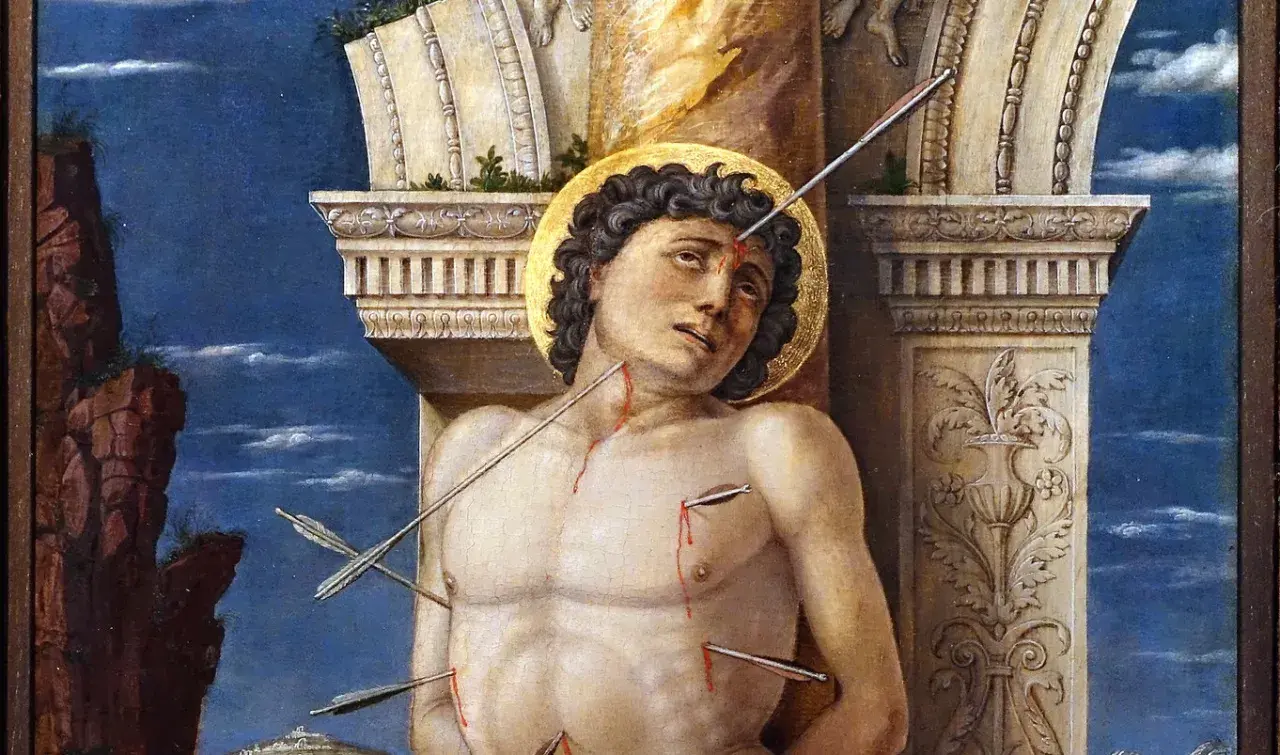
I read images of Saint Sebastian as compressed visual arguments: they show martyrdom, but they also speak about plague, endurance, beauty, and devotion. In this article I break down the main symbols, explain why the saint is usually shown with arrows or tied to a tree, and show how style changes from Renaissance restraint to Baroque drama. I also point out the details I would check when reading the subject in a museum or assessing whether an image has been altered over time.
The image works as a visual language of suffering, protection, and faith
- The core scene is Sebastian’s martyrdom by arrows, but the image usually carries more than one meaning at once.
- Arrows, ropes, trees, posts, and ruined settings are not decorative extras; they are the main iconographic clues.
- The saint’s calm face is intentional in many works, not a failure to show pain.
- Plague devotion helped turn Sebastian into one of the most recognizable protection saints in European art.
- Renaissance, Mannerist, and Baroque painters handle the subject differently, especially in pose, anatomy, and emotional pressure.
- When I assess one of these works, I look first at attributes, then at later additions, repainting, and the relationship between body and background.
What the image is really showing
The basic narrative is simple: Sebastian was a Roman soldier and Christian martyr who was condemned and shot with arrows. What makes the subject so durable in art is that the story supports two visual ideas at once. On one level, the image is about torture. On another, it is about steadfast belief, because the saint is often shown upright, composed, and strangely unbroken even while wounded.
I find that this double reading explains why the subject appears so often in altarpieces, devotional panels, and later easel paintings. The martyrdom gives the artist a body to work with; the sanctity gives the image its meaning. If the composition feels tense but not chaotic, that is usually deliberate. The artist is not simply illustrating pain. The artist is staging endurance.
This is also why Sebastian differs from many other martyrs. The scene can be stripped down to almost nothing, or it can be made highly theatrical, but the structure remains the same: the saint, the wounds, and the visual insistence that faith survives violence. Once that is clear, the iconography becomes much easier to read.
Why arrows, trees, and ropes matter
Arrows are the central attribute because they identify Sebastian immediately and because they do symbolic work beyond identification. They mark him as a victim of imperial persecution, but they also became linked to plague imagery. In medieval and early modern thought, arrows could stand in for sudden affliction: they arrive fast, strike the body, and leave visible damage. That visual logic made Sebastian especially powerful in communities living through epidemics.
The setting matters just as much. In many works he is tied to a tree, a post, or a column. I read that not only as a literal execution device but also as a compositional anchor. The vertical support keeps the body upright, which lets the painter contrast physical vulnerability with spiritual firmness. A rope tightens the pose; a tree introduces a rough, natural surface; a column can shift the scene toward classical or architectural order. Each choice changes the emotional temperature of the image.
| Iconographic element | What it usually means | What I would not assume too quickly |
|---|---|---|
| Arrows | Martyrdom, punishment, plague association, and the saint’s identity | That the work is only about physical suffering |
| Tree, post, or column | Execution site, compositional support, and a bridge between nature and architecture | That the background is merely descriptive |
| Loincloth or partial nudity | Classical idealization and emphasis on the body as a moral subject | That the nude body is only erotic or only anatomical |
| Calm expression | Patience, faith, transcendence, and refusal to collapse emotionally | That the artist failed to show agony |
| Ruins or classical architecture | The endurance of Christianity over a fallen pagan world | That the setting is accidental |
| Light or halo | Sanctity, revelation, and spiritual elevation | That light is only a technical solution |
The Metropolitan Museum of Art notes an especially useful clue for identification: sometimes a halo and arrow were added after the original portrait was painted, turning an ordinary youth into Sebastian. That detail matters because it shows how easily the saint’s visual code could be layered onto an existing image. Once you understand that, you start looking for additions, overpainting, and narrative retrofitting, not just for the obvious arrow motif. That leads directly to the question of why the saint became so useful in the first place.
Why plague made Sebastian a public saint
One of the strongest reasons Sebastian remained so visible is that he was widely invoked as a protector against plague. The connection is not arbitrary. Wounds from arrows resembled the marks of disease, and in devotional culture that resemblance mattered. Sebastian became a saint people could pray to when medicine had little to offer. His body, pierced but still upright, offered a visual model of survival under pressure.
That plague role changes how I read many paintings. They are not only private meditations on martyrdom. They can also be civic images, built for communities that had lived through fear, quarantine, and mortality. In that context, the saint’s body is not just a body. It becomes a screen onto which a whole society projects anxiety and hope. A painting made after a major epidemic is often less about literal history than about the emotional memory of disaster.
Some artists make that link explicit by placing Sebastian among other intercessory saints or by showing him in a public, almost ceremonial setting. Others keep the plague reference implicit and let the arrows carry the burden. Either way, the devotional logic is the same: the saint’s suffering is asked to stand between the viewer and the threat of illness. Once that historical function is clear, the saint’s unusually peaceful face makes more sense too.
Why he often looks calm, youthful, or idealized
Many viewers expect a martyrdom scene to be visibly anguished, but Saint Sebastian is often the opposite. The body may be wounded, yet the face remains still. The National Gallery points out this striking calm in Cima da Conegliano’s Sebastian, where the saint is pierced by multiple arrows but remains almost serene. I think that serenity is one of the most important interpretive keys in the whole subject.
There are at least three reasons for it. First, serenity signals faith stronger than pain. Second, Renaissance artists were deeply interested in the beautiful male body as a carrier of meaning, so suffering had to coexist with proportion and control. Third, the calm face keeps the image devotional rather than merely grotesque. If the expression becomes too theatrical, the picture risks losing the contemplative quality that made it useful for prayer.
This is where the recurring youthful, athletic body matters. It is not just a visual convention. It ties Sebastian to ideals of classical beauty and to a broader artistic habit of linking physical perfection with spiritual intensity. That tension between beauty and violence is exactly what keeps these paintings memorable. The next step is to see how different periods solve that tension in different ways.
How Renaissance and Baroque versions diverge
Artists do not treat Sebastian in one fixed way. The motif changes noticeably from the early Renaissance to the Baroque period, and those shifts tell you a lot about what each era wanted from religious art. I would read the differences less as style alone and more as changes in emotional strategy.
| Period | Common visual traits | What the style is trying to do | Useful examples |
|---|---|---|---|
| Early Renaissance | Balanced composition, clear outline, calm stance, architectural or open-air settings | Make the martyrdom legible, ordered, and meditative | Antonello da Messina, Matteo di Giovanni |
| High Renaissance | More idealized anatomy, smoother surfaces, stronger classicizing feel | Fuse sacred meaning with bodily perfection | Raphael and related courtly interpretations |
| Mannerism | Longer limbs, more tension in pose, heightened elegance, sometimes a stranger emotional register | Make the body feel refined, unstable, or charged | Works influenced by late-sixteenth-century taste |
| Baroque | Sharper light, stronger contrast, theatrical emotion, more physical immediacy | Push the viewer toward empathy and dramatic engagement | Jusepe de Ribera, Hendrick ter Brugghen |
The real value of that comparison is practical. If I see a Sebastian that is quietly balanced and almost architectural, I think early Renaissance or a classicizing solution. If the figure is physically stretched, emotionally tense, or carved out by strong shadow, I think later expressive strategies. The iconography stays recognizably the same, but the viewer’s experience changes quite a bit. That makes the work of identification and assessment much more precise.
How I read one in a museum or studio
When I evaluate a Saint Sebastian image, I start with a short checklist rather than with style labels. The subject is often clear, but the details tell you whether you are looking at an original devotional work, a later reinterpretation, or a composition that has been altered. A few small things matter a great deal.
- I look first for the attribute set: arrows, tree or post, loincloth, and a controlled facial expression.
- I check whether the body and the wounds belong together visually, or whether the arrows feel added on top of an older figure.
- I look for halos, inscriptions, or secondary marks that may have been added later.
- I compare the saint’s pose with the surrounding space to see whether the composition is devotional, theatrical, or portrait-like.
- I pay attention to condition issues such as abrasion, overpainting, and darkened varnish, because these can flatten the distinction between flesh, arrow shafts, and background.
That last point is especially important for preservation work. Sebastian images are highly vulnerable to misreading because the iconography is so repetitive. A missing arrow, a repainted hand, or a softened facial contour can change the perceived subject or the emotional tone. The image can still “look right” at a glance while losing part of its original meaning. Once you start treating the painting as both an iconographic object and a physical artifact, the reading becomes much more reliable.
For that reason, I rarely treat a Sebastian image as merely a devotional picture. I treat it as a record of how a community imagined suffering, beauty, and protection at a specific moment. That is why the subject still rewards close looking rather than quick recognition.
What I keep in mind when the image comes up again
When I return to these paintings, I do not ask only, “What scene is this?” I ask what kind of spiritual argument the artist is making through body, wound, and expression. A severe, sparse image and a lush, highly finished image can both tell the same story, but they ask the viewer for different kinds of attention.
If you want to read the motif well, the most useful habit is simple: separate identification from interpretation. First identify the saint through his attributes. Then ask what the artist is doing with those attributes. Is the work emphasizing plague protection, classical beauty, bodily suffering, or meditative endurance? In most strong examples, the answer is not one of those alone. The best images let several of them work at once.
That layered meaning is exactly why Saint Sebastian remains one of the most revealing figures in Christian art: he turns martyrdom into a visual language, and the language is still legible if you know where to look.
