
Landseer turns animals into character studies and cultural symbols
- His strongest works use dogs, stags, and horses as stand-ins for human emotion and social behavior.
- He made animal painting feel theatrical without losing observational detail.
- His images spread widely through prints, which is one reason they remain so familiar.
- The most important works are tied to rescue, satire, Highland identity, and portrait-like dignity.
- For authentication, provenance and medium matter as much as subject matter.
What makes edwin landseer paintings distinctive
I read Landseer as a painter of character first and species second. His animals are recognizable as real animals, but they are also performers: a dog can look thoughtful, a stag can look sovereign, and a horse can look stubborn in a way that feels almost human. That tension between observation and drama is the core of his appeal.
He also worked with a level of finish that helped the emotion land cleanly. Fur, wet eyes, metal harnesses, weathered stone, and Highland mist are all handled with enough specificity to convince the eye, but not so much detail that the scene loses its emotional shape. The result is easy to underestimate. At a glance, the pictures can seem sentimental; on closer viewing, they are tightly built compositions with a clear visual hierarchy.
That is why the phrase “animal painter” only partly fits him. He used animals the way history painters used kings and generals: as carriers of feeling, rank, and narrative. Once you see that, the rest of his output starts to make more sense.
And once the method is clear, the recurring subjects become easier to read as a system rather than a series of attractive subjects.
The subjects he kept returning to
Landseer kept circling back to a small set of motifs, and that repetition is one reason his body of work feels coherent rather than merely prolific. The strongest groupings are dogs, stags, horses, and Highland scenes, with each subject carrying a slightly different emotional weight.
Dogs as moral actors
His dogs are never just pets. They are companions, rescuers, witnesses, or comic commentators. In many of the best-known works, the dog is asked to hold a moral position for the viewer: loyal, brave, affectionate, or slyly intelligent. At Tate, Dignity and Impudence is treated as one of his most popular dog pictures, and that makes sense because the pair of animals works like a social portrait, not a mere animal study.
Stags and the idea of Scotland
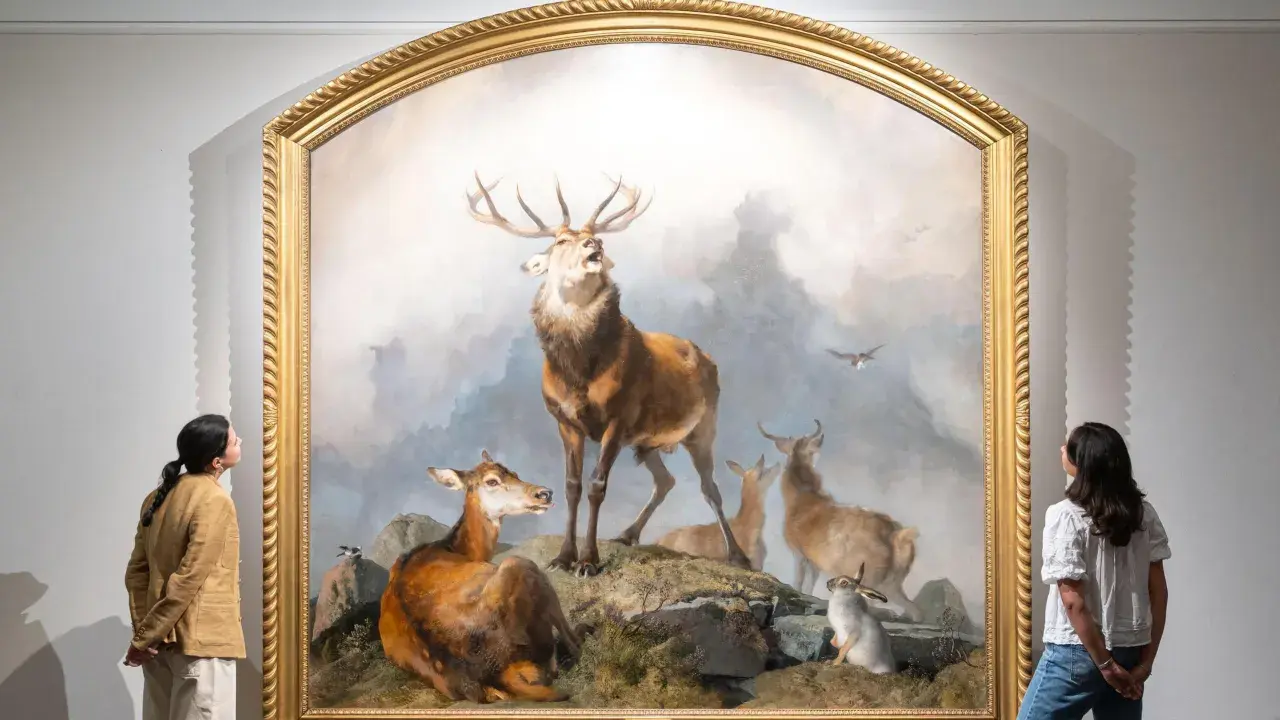
His Highland pictures are different in tone. The stag becomes less domestic and more emblematic, almost royal. The animal stands for wilderness, sovereignty, and a romantic version of the Scottish landscape. This is where Landseer’s talent for symbolic clarity becomes especially useful: one animal, placed precisely, can carry an entire national mood.
Read Also: John Dyer Paintings - Wales & Amazon Art Explained
Horses and theatrical movement
Horses let him show force, tension, and performance in motion. They also widen his range beyond the gentler canine pictures. In equestrian works, Landseer is less about affection and more about control, posture, and physical presence. That helps balance the public image of him as simply a sentimental animal painter.
These subjects matter because they are not random. They tell you what kind of visual drama Landseer thought animals could carry, and they prepare you for the works that made his name.

The paintings that define his reputation
The easiest way to understand Landseer’s range is to look at a few key works side by side. I would not start with the most reproduced image alone. I would start with a rescue scene, a canine portrait, a satirical dog painting, and then the famous Highland stag. That sequence shows how flexible his formula really was.
| Work | Date | Why it matters | What to notice |
|---|---|---|---|
| Alpine Mastiffs Reanimating a Distressed Traveler | 1820 | An early example of rescue drama and animal heroism | The dogs are active agents, not decorative accessories |
| A Distinguished Member of the Humane Society | 1838 | One of his clearest statements about canine nobility and public virtue | The dog is treated with the seriousness of a portrait sitter |
| Dignity and Impudence | 1839 | A masterpiece of canine contrast and social wit | Scale difference, posture, and gaze do most of the storytelling |
| Laying Down the Law | c. 1840 | A witty satire that turns dogs into legal personalities | The joke works because each animal is drawn with real individuality |
| The Monarch of the Glen | c. 1851 | The emblematic Highland image, still one of his most famous works | The stag reads as both animal and symbol |
At the National Galleries of Scotland, The Monarch of the Glen is treated as one of Landseer’s defining pictures, and I think that status is deserved. The painting is simple in structure but rich in implication: a single stag, poised and alert, in a landscape that feels both specific and mythic. That combination is the trick Landseer kept perfecting.
What these works share is not subject matter alone but a stable artistic logic: each animal is assigned a role, and each role is made legible through composition. That leads naturally to the question of how the pictures actually work on the surface.
How to read the surface, not just the subject
When I look closely at Landseer, I focus on four things. First, the direction of the gaze. He uses eye contact strategically, whether the animal is looking at us, at another figure, or off into the scene. That decision controls the emotional temperature of the picture. Second, the body language. A lowered head, a stiff leg, or a slightly turned shoulder can do more work than an elaborate background.
Third, the setting is never neutral. A kennel, a court-like interior, a stormy shore, or a Highland slope changes the meaning of the animal inside it. Fourth, he likes contrast: polished fur against rough stone, dark coat against pale mist, or a large body against a compressed pictorial space. Those contrasts keep the image from becoming static.
For me, that is where Landseer becomes more interesting than his reputation sometimes suggests. The sentiment is real, but it is engineered. The pictures do not simply ask to be admired; they ask to be read.
Once you know how the images are constructed, the practical question becomes whether you are looking at an original oil, a later copy, or one of the many reproductions that circulated so widely.
What collectors and conservators should check first
Landseer’s popularity created a very specific problem: the compositions became famous fast, and the print culture around them was enormous. That means a familiar image is not enough to prove authorship. A lot of objects associated with him are later prints, reproductions, or works after Landseer rather than autograph paintings.
| Object type | What it usually tells you | Main risk |
|---|---|---|
| Autograph oil painting | Direct handling, period materials, and stronger provenance potential | Condition issues such as yellowed varnish, relining, and old retouching |
| Later print after Landseer | Wider circulation of a known composition | It can be mistaken for an original if the medium is not checked carefully |
| Later copy or pastiche | Confirms the popularity of the image | Brushwork and materials may imitate the look of the original without matching it |
I would always start with provenance, medium, and condition before subject matter. Provenance should show where the work has been, who owned it, and whether it appears in exhibition or sale records. Medium matters because Landseer’s paintings have a different material presence from printed images, even when the image itself is well known. Condition matters because heavy cleaning can flatten the carefully modeled fur and atmosphere that give the work its character.
A further point is that emotional familiarity can mislead. If a picture looks exactly like the famous version you already know, that may be because it is a reproduction, not because it is autograph. That is a basic but important distinction, and it is one that saves time, money, and bad attribution decisions.
Landseer’s legacy is wider than the stag everyone knows
Landseer endures because he solved a difficult problem: he made animal painting carry the weight of portraiture, satire, and national symbolism without losing public appeal. That is a rare combination. He can look sugary in reproduction, but in the best originals he is disciplined, clever, and far more exact than the popular image suggests.
If I were building a small viewing list, I would choose one rescue painting, one dog portrait, and one Highland picture. That trio shows the range fast and prevents the stag from swallowing the rest of his career. The broader lesson is simple: his reputation rests on images that feel instantly legible, but the best of them reward slow looking. That is usually the mark of a painter worth returning to.
