
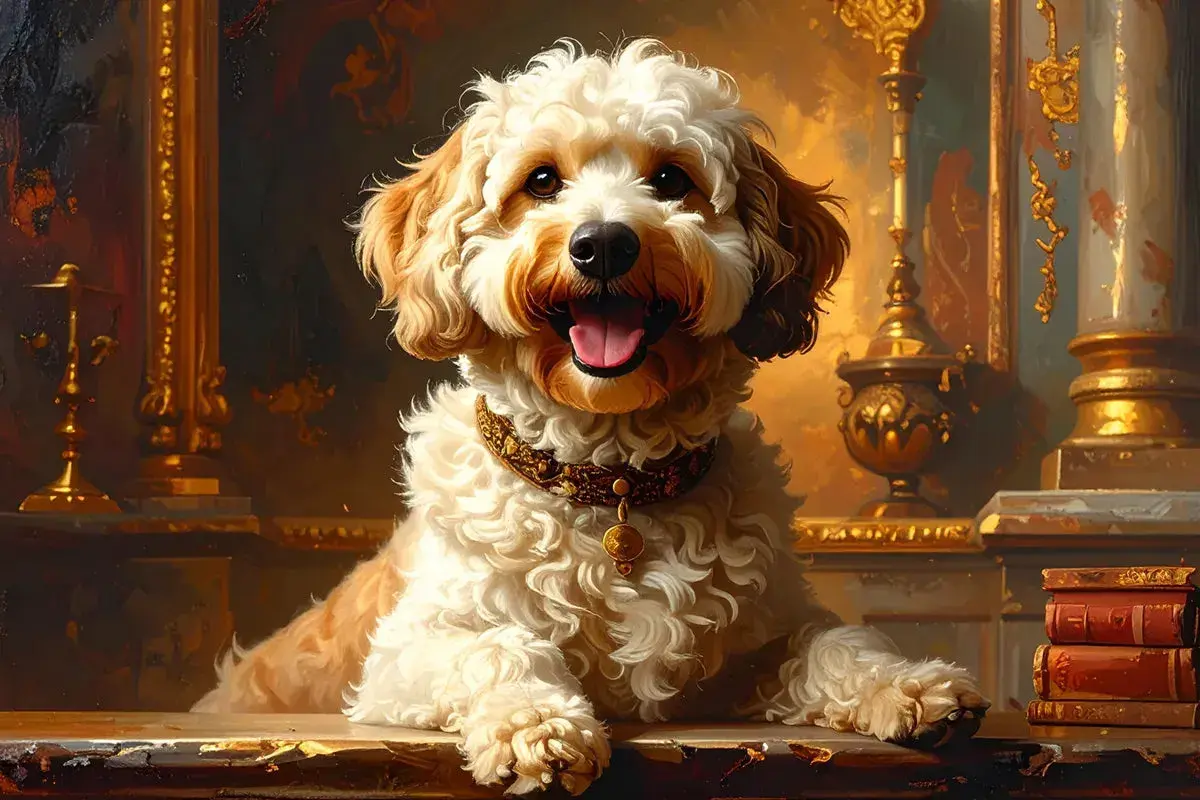
The charm of dogs in Renaissance paintings lies in how much they can say with almost no space. A lapdog can quietly confirm fidelity, a hound can announce rank, and a saint’s companion can redirect an entire narrative. What I want to unpack here is the real reading of the motif: where it appears, what it usually means, and how to tell when a canine detail is symbolic, compositional, or technically revealing.
Key things to know before reading canine imagery in Renaissance art
- Dog figures were rarely accidental; they often signal fidelity, status, guidance, or devotion.
- Marriage portraits tend to use a small dog to reinforce loyalty and domestic legitimacy.
- Hunting and court scenes use hounds to point to aristocratic privilege and control.
- Religious and mythological scenes give dogs narrative jobs, not just decorative ones.
- Condition issues such as abrasion, overpaint, and yellowed varnish often affect small dogs first.
- For authentication, the handling of the dog can be as revealing as the face of the sitter.
Why dogs kept appearing in Renaissance painting
In the Renaissance, painters were not just trying to make pictures look believable. They were building images that had to carry social, moral, and sometimes theological meaning at the same time. That is why dogs appear so often: they are familiar enough to feel natural, but loaded enough to do real iconographic work. I usually think of them as one of the period’s most efficient visual shorthand devices.
Across Italian and Northern Renaissance art, the dog could stand for marital fidelity, noble hunting culture, devotion, vigilance, charity, or simple companionship. The exact meaning depends on the setting, but the broader pattern is consistent. Artists liked dogs because viewers already knew how to read them, and patrons liked them because the symbol was flexible without being vague.
There is also a technical reason they mattered. Fur, eyes, paws, and collars gave painters a chance to show control over texture and light. A convincing dog could prove skill; a meaningful one could prove intelligence. That combination made the motif especially useful in portraiture, sacred narrative, and courtly scenes, which leads directly to the specific readings most viewers are actually looking for.
What a dog usually meant in a Renaissance scene
When I read a dog in this period, I start by asking whether it is there to describe a relationship, a social rank, or a story event. That single question usually narrows the interpretation quickly.
| Scene type | What the dog tends to signal | Visual clues I look for | Why it matters |
|---|---|---|---|
| Marriage portrait | Fidelity, domestic order, sanctioned intimacy | Small breed, calm posture, placement near the couple or the sitter’s feet | The dog validates the relationship and makes the portrait read as morally ordered, not merely luxurious |
| Courtly or hunting scene | Rank, control, aristocratic leisure | Hounds, leashes, collars, chase dynamics | The animal points to land, ownership, and privilege, which are never far from hunting imagery |
| Mythological scene | Desire, pursuit, punishment, vigilance | Alert posture, barking, running, or reacting to another figure | The dog helps turn the story into moral drama instead of a decorative classical tableau |
| Religious scene | Guidance, healing, charity, devotion | Dog beside a pilgrim, saint, or traveler, often near symbolic props | The animal reinforces the saint’s legend and softens the scene emotionally |
The National Gallery describes the dog in The Arnolfini Portrait as a common sign of faithfulness in marriage, and that is exactly the kind of reading that holds up across many portraits. The detail is small, but the social message is not. Once you start seeing the recurring roles, the motif becomes less mysterious and much more precise.
Renaissance paintings that make the motif unmistakable
Some works are useful because they show just one role clearly; others matter because they let you compare several roles side by side. These are the examples I reach for when I want the motif to stop being abstract and start being legible.
Jan van Eyck’s The Arnolfini Portrait
The small brown dog between the couple is one of the best-known canine figures in early Renaissance painting. It does not just decorate the floor space. It anchors the composition, faces outward toward the viewer, and turns the private room into a public statement of fidelity, status, and marital seriousness. The fur is painted with almost microscopic care, which makes the symbol feel as real as the people around it.
Titian’s Venus of Urbino
This is a different kind of dog entirely. The animal lies quietly on the bed, which helps settle the scene into domestic intimacy even while the painting remains charged with erotic tension. The Met’s discussion of the work treats the dog as part of the painting’s marriage imagery, and that is the right way to read it: the dog does not cancel the sensuality, but it frames it inside social order. Titian often does this well. He lets one detail keep another from tipping too far.
Perugino’s The Archangel Raphael with Tobias
Here the dog is not symbolic first and physical second; it is both. Tobias’s dog is part of the journey, part of the sacred narrative, and part of the image’s emotional architecture. The animal is small, but it matters because it makes the pilgrimage feel lived-in rather than purely emblematic. In scenes like this, dogs can be companions without ceasing to be signs.
Read Also: Medieval Tapestries - Uncover Their Hidden Stories & Secrets
Titian’s The Death of Actaeon
Mythological scenes often use dogs to shift from obedience to violence in a single beat. Actaeon’s own hounds, once hunting companions, become executioners after his transformation. That reversal is powerful because it is so cruelly logical: the animal that once served the hunt now completes the punishment. It is one of the clearest reminders that Renaissance dogs are not always comforting or domestic. Sometimes they are the mechanism of fate.
Seen together, these examples show the range of the motif. A dog can certify marriage, smooth a sensual scene, guide a sacred journey, or intensify mythic punishment. The next question is how painters made all of that visually convincing in the first place.
How painters made dogs feel alive on the surface
Good Renaissance dog painting depends on three things: anatomy, texture, and placement. The anatomy does not need to be zoologically perfect, but it needs to be believable enough that the viewer accepts the animal as present in the same space as the humans. Texture is where the painter proves control. Short strokes for fur, a soft highlight on the eye, and a careful edge along the muzzle can make a tiny figure feel alert and dimensional.
I also pay close attention to placement. A dog at a sitter’s feet does not just fill empty floor. It creates a visual link between body, costume, and status. A dog that faces the viewer can serve as a surrogate witness. A dog that turns away can push depth into the scene or redirect attention toward the figure it is meant to support. These are compositional decisions, not afterthoughts.
There is a useful technical term here: pentimento, meaning a revision left visible beneath the finished paint layer. When a dog’s position seems unusually exact, or slightly awkward in relation to surrounding objects, it may be because the artist adjusted it during the painting process. That kind of change can tell you more about composition than about symbolism, and both readings matter.
Broadly speaking, Northern painters often lean toward crisp detail and close observation, while Venetian painters frequently let color, atmosphere, and gesture carry more of the burden. I would not make that split too rigid, but it helps explain why some Renaissance dogs look almost tactile while others feel folded into the light of the whole scene. That difference becomes especially important when the picture is damaged or retouched.
What conservators and attribution specialists check first
From a conservation standpoint, dogs are often vulnerable. Dark fur can lose contrast through abrasion; small paws and collars are easy to damage in old cleanings; and yellowed varnish can flatten the tonal range until the animal looks heavier or less defined than the artist intended. If the canine detail feels strangely dead, the problem may be condition rather than style.
That is why technical imaging matters. Infrared reflectography can reveal underdrawing, showing whether the dog was planned carefully or altered mid-process. X-radiography can expose earlier forms beneath the surface. Microscopic inspection may show whether a muzzle, eye highlight, or collar has been repainted. In practice, the dog is often one of the first places where later intervention becomes visible, simply because small forms are easier to disturb than large ones.
For attribution, I ask whether the handling of the dog matches the rest of the painting. Is the fur brushed with the same confidence as the drapery? Does the animal share the same light logic as the sitter? Does the collar, if present, feel structurally integrated or merely pasted on? A workshop copy often simplifies the dog before it simplifies the face, because convincing animal texture is harder than copying a profile.
That does not mean a weakly painted dog automatically signals a problem. It may simply mean a less finished passage, a damaged area, or a later restoration. But in a field where small visual choices matter, canine details are too useful to ignore. They can support provenance research, reveal workshop habits, and sometimes expose a painting’s physical history more cleanly than the main subject does.
How to read the canine detail without overreading it
- Start with placement: is the dog central, hidden, or nearly peripheral?
- Check the gaze: does it look at the viewer, at a sitter, or toward another action in the scene?
- Ask about context: is this a marriage portrait, a hunt, a sacred narrative, or a mythological transformation?
- Look for social markers such as collars, leashes, or a prized breed type.
- Compare surface quality: does the dog receive the same level of finish as the rest of the painting?
The safest reading is the most specific one. I do not ask what dogs mean in general; I ask what this dog is doing in this image, at this scale, for this patron, in this style. That habit keeps the interpretation grounded and also makes the painting more interesting, because the animal stops being a decorative extra and becomes part of the work’s structure. In Renaissance art, that is usually where the best evidence lives.
