
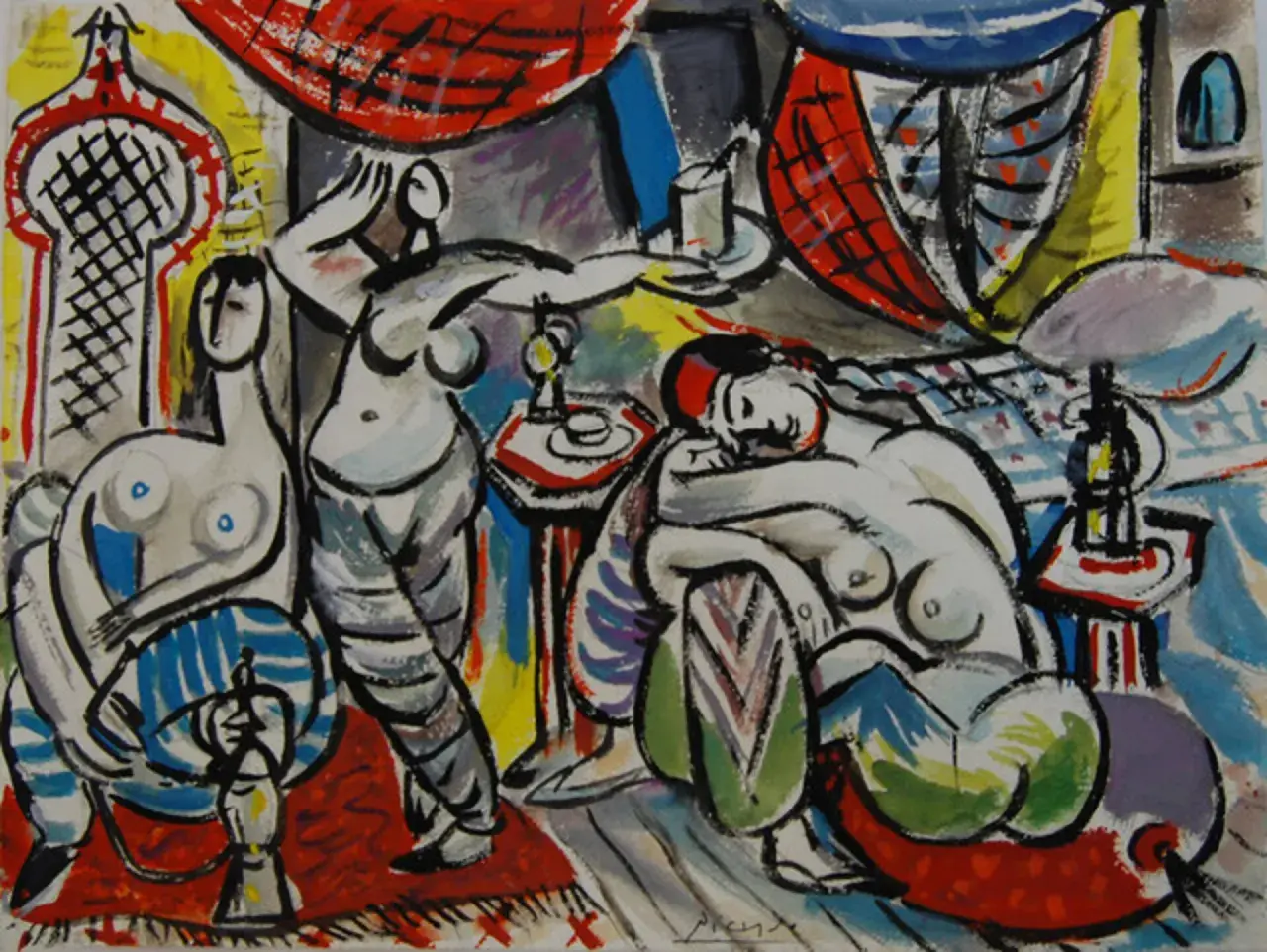
Picasso’s Women of Algiers cycle is one of those bodies of work that rewards slow looking. It begins as a conversation with Delacroix, then turns into a compressed study of color, space, desire, and modern painting itself. In this article, I break down where the series came from, how the fifteen versions evolve, why the final canvas became so famous, and what matters most when you study or authenticate a work from the group.
The key facts behind Picasso’s women of Algiers cycle
- Picasso painted 15 oil variations between 13 December 1954 and 14 February 1955 in his Paris studio.
- The series is based on Eugene Delacroix’s 19th-century vision of women in an Algerian interior, which Picasso had studied at the Louvre.
- Ten canvases are in full color and five are in grisaille, so the cycle moves between painterly richness and stark tonal analysis.
- The best-known work is Version O, the final painting, which sold at Christie's in 2015 for $179,365,000.
- For art-history and authentication purposes, the most useful clues are chronology, lettered version, provenance, size, and the internal logic of the sequence.

Why Picasso turned Delacroix into a modern series
The starting point is not just a famous image, but a famous problem: how do you repaint a canonical work without flattening it into homage? Delacroix’s Women of Algiers offered Picasso a loaded subject, one already tied to Orientalism, interior space, and the act of looking, and he had studied it at the Louvre before returning to it in 1954.
What matters here is the scale of the response. In a little over two months, Picasso produced 15 oil paintings plus more than 100 drawings and prints. That is not the pace of a casual tribute; it is a research project in paint. He worked in his Paris studio at 7, rue des Grands-Augustins, using the old motif to test how much a picture can change while still remaining recognizably itself.
I read that as one of Picasso’s clearest statements about modernism: a painting does not have to settle on one final answer. It can think aloud. That idea becomes easier to see once you follow the sequence version by version.
How the fifteen versions change across the cycle
The cycle is easiest to understand when you stop looking for a single masterpiece and start reading it as a sequence of decisions. Picasso moves from legibility to compression, from descriptive space to fractured space, and from relatively stable figure arrangement to near-abstract intensity.
| Phase | Visual character | What changes | Why it matters |
|---|---|---|---|
| Versions A and B | Three figures remain relatively readable: a smoker, a sleeper, and a standing servant-like figure in the background. | The composition still holds onto the basic narrative structure. | This is the clearest point of departure, where Picasso keeps Delacroix closest at hand. |
| Middle versions | The palette becomes more assertive, forms sharpen, and the room begins to feel less stable. | Picasso alternates between color and grisaille, testing both painterly richness and linear restraint. | This phase shows the work shifting from quotation to analysis. |
| Version F as a bridge | More resolved than the early canvases, but not yet fully unleashed. | The image becomes a pivot point between the first phase and the more expansive later works. | It is useful because it shows Picasso finding a more complete structural balance before pushing further. |
| Late versions, ending with O | Color, distortion, and flattened depth become increasingly pronounced. | Figure and room are pushed into a more overtly Cubist, more aggressively synthetic language. | These works show Picasso at maximum speed and confidence, with the original subject almost dissolved into painterly syntax. |
That progression is important because it explains why the series is not just a set of variants for collectors to compare. It is a visible record of how Picasso turns a single source image into multiple pictorial arguments. And once you see that, the final canvas becomes much easier to place in context.
Why version O became the best-known canvas
Version O is the final painting in the cycle, completed on 14 February 1955. It is an oil on canvas measuring 114 x 146.4 cm, and it carries Picasso’s signature with the date on the reverse. Those details matter because they anchor the work materially, not just conceptually: this is a finished canvas with a specific place in the sequence, not an interchangeable image.
Its fame comes partly from the market record it set in 2015, when Christie's sold it in New York for $179,365,000. At the time, that made it the most valuable artwork ever sold at auction. Even in 2026, that sale remains one of the defining price points in modern-art market history, but I would not let the number do too much interpretive work on its own.
What gives the canvas its staying power is the way it concentrates the whole cycle. The color is bright, the forms are fractured but controlled, and the composition feels like a climax rather than an endpoint. It is the version where Picasso seems to fuse homage, rivalry, and invention into one image. Price made it famous; structure made it durable.
What the series says about homage, rivalry, and modernism
This is where the work becomes richer than its auction history. Delacroix’s original belongs to 19th-century Orientalism, which means the image already carries the assumptions of a European painter looking at North Africa through a romantic and colonial lens. Picasso does not escape that history. He reworks it, complicates it, and in some ways intensifies its ambiguity.
That is why the series still feels unstable in the best possible way. On one level, it is a tribute to a master Picasso admired. On another, it is a competition with that master, a demonstration that the old image can be broken apart and rebuilt by a different visual logic. The women are no longer simply described; they are translated into planes, cuts, curves, and interruptions.
I think the series also helps explain why Picasso mattered so much to postwar painting. He did not treat the past as something to preserve intact. He treated it as material to be tested. That is a useful distinction for anyone studying artists who work through quotation rather than pure invention, because it tells you where the real energy often sits: in transformation, not repetition. Once that is clear, the practical question becomes how to study a canvas from the cycle without confusing narrative fame for material fact.
What to check when studying or authenticating a canvas from the cycle
If I were evaluating a painting connected to this series, I would start with the basics and stay disciplined about them. The internal chronology of the cycle is unusually well documented, so a claim should line up with a specific version letter, a precise date, a known medium, and believable dimensions. That sounds simple, but it is exactly where bad attributions start to unravel.
- Version letter - The A-to-O sequence is part of the work’s identity. If a work is presented as a specific version, the chronology must make sense.
- Medium and surface - The series consists of oil paintings, while the broader development includes drawings and prints. A reproduction or later study is not the same thing.
- Measurements - Size is not a minor detail here. The canvases vary, and dimensions help separate one documented version from another.
- Signature and date - These should be checked in relation to the known object history, not treated as standalone proof.
- Provenance - Ownership history, exhibition history, and prior sales all help confirm that a work sits where it should inside the cycle.
The other practical point is conservation. Because the paintings shift between dense color, grisaille, and heavily worked passages, surface condition can change how a version reads. Cleaning, lining, and restoration history all matter, especially when the goal is to compare one canvas against another in the sequence rather than admire it in isolation. That is the kind of detail curators and conservators care about, and it is also the kind of detail that keeps the series legible for future study.
Why this cycle still matters to museums, collectors, and readers
What keeps the series alive is not just its record price or its famous final image. Museums use it to teach how variation works; collectors use it to understand the differences between iconic and merely derivative Picasso works; readers use it because the sequence shows modern art thinking in real time. That combination is rare.
For a quick mental checklist, I would remember three things. First, the series is a dialogue with Delacroix, not a remake. Second, the strongest readings come from comparing versions, not from staring at a single canvas in isolation. Third, the best way to understand the work is to follow the movement from legible scene to radical transformation.
That is why Les Femmes d’Alger still earns close attention in 2026: it is a major Picasso series, a case study in modernist variation, and a useful test for anyone trying to separate art-historical significance from market mythology.
