
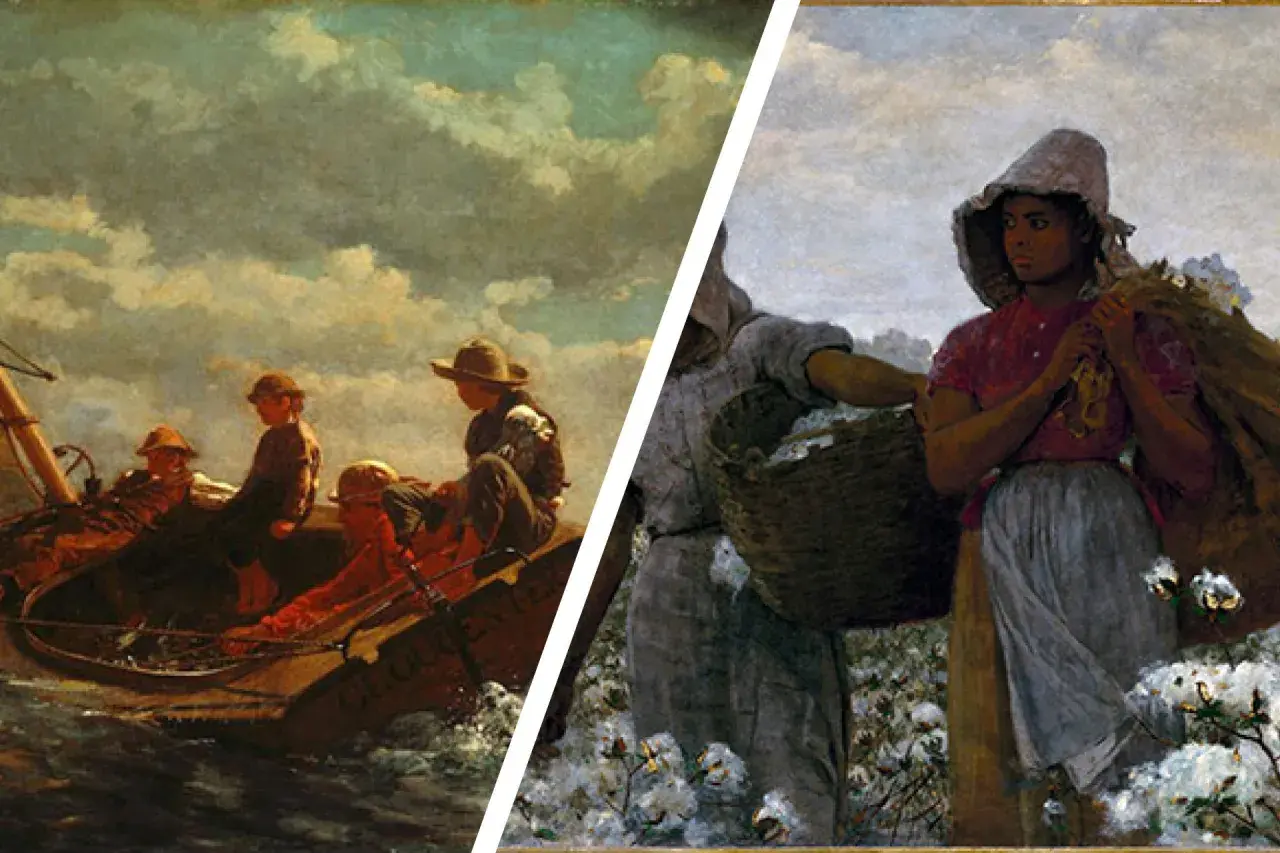
American realism art captures ordinary life without polishing away its rough edges, and that makes it one of the most revealing movements in U.S. art history. In practical terms, this guide shows how the style developed, what distinguishes it from neighboring traditions, which artists matter most, and how to read or evaluate a realist work with a more informed eye.
Key points that define the movement
- American realism is not one fixed formula; it stretches from Thomas Eakins and Winslow Homer to the Ashcan School, Edward Hopper, and later figurative realists.
- The movement focuses on everyday subjects, but the strongest works are never neutral. They carry social tension, psychological depth, or a sharp sense of place.
- Realism does not mean photorealism. Brushwork, cropping, and light often matter more than perfect imitation.
- If you are identifying a work, look first at subject matter, then at how the artist handles light, space, and human presence.
- For collecting or authentication, provenance, period materials, and conservation history matter as much as style.
What the movement actually covers
In the American context, realism is best understood as an attitude toward looking rather than a rigid set of rules. The artist stays close to observable life, but that still leaves room for interpretation, restraint, and sometimes a great deal of psychological feeling. I usually think of the movement as a broad family of approaches that value ordinary people, ordinary places, and ordinary actions enough to make them worthy of serious art.
That family includes urban scenes, portraits, interiors, labor, leisure, seascapes, and quiet domestic moments. It also includes artists who are often grouped separately in textbooks, because the label is flexible. Some works are direct and socially alert, others are sparse and introspective, and some are almost cinematic in how they frame a single figure. The common thread is that the artist resists idealization and lets lived experience stay visible.
This is why the phrase can feel slippery in museum labels. It does not always point to one school or one decade; it often points to a shared commitment to truthful observation. That historical flexibility matters, because it explains why the movement keeps expanding into new periods and why the next step is chronology, not just definition.
How it developed in the United States
The roots of the movement go back to the late 19th century, when painters such as Thomas Eakins and Winslow Homer pushed American art toward closer observation of the body, nature, and everyday experience. Eakins, for example, treated anatomy, motion, and human presence with unusual seriousness, while Homer showed that realism could be spare, elemental, and emotionally charged at the same time. Their work helped establish a standard that valued direct looking over decoration.
Around 1900, the center of gravity shifted into the city. Robert Henri and the painters later associated with the Ashcan School turned to New York streets, docks, boxing rings, tenements, and working-class leisure. Their subject matter was not chosen to flatter a city’s self-image. It was chosen because modern American life was noisy, crowded, unequal, and visually compelling. That urban turn gave realism a tougher edge and made it feel more socially immediate.
By the mid-20th century, the movement had expanded again. Edward Hopper made realism quieter and more interior, using architecture, windows, and isolated figures to create a sense of stillness that is almost theatrical. Later figurative realists and photorealists kept the emphasis on observation, but they pushed it in different directions, from social commentary to technical precision. The point is that the movement did not stand still; it adapted to each period’s idea of what counted as truth.
That chronology makes the style easier to recognize, because once you see the shifts in subject and tone, the distinctions from other realistic traditions become much clearer.
How it differs from impressionism, Europe, and photorealism
I find it useful to compare realism with nearby styles, because the differences are often subtle on the surface. A painting can look "realistic" and still belong to very different visual traditions depending on its purpose, handling, and context.
| Tradition | Typical subjects | Visual signature | What it is really after |
|---|---|---|---|
| Ashcan School, c. 1900 to 1915 | Street life, boxing, tenements, theaters, working-class leisure | Loose, immediate, energetic | The rough pulse of city life, not polish |
| Mid-century figurative realism, 1910s to 1950s | Interiors, lone figures, storefronts, domestic scenes | Cleaner edges, stronger silence, more restraint | Psychology and atmosphere as much as observation |
| Photorealism, late 1960s onward | Cars, signs, portraits, reflective surfaces, urban detail | Camera-like precision and hard detail | Exactness, often mediated through photography |
| European realism, mid-19th century onward | Workers, rural life, modern scenes, social labor | Varies widely by country and artist | A broader origin point for the American version |
The useful distinction is this: realism is not the same as literal copying. A realist painting may simplify forms, flatten space, or crop a scene in a way that feels almost accidental, but those choices usually sharpen the meaning rather than weaken it. Even trompe l’oeil, the illusionistic trick of fooling the eye, is a different goal altogether. Realism is usually less about deception and more about credibility.
Once you make that distinction, the major artists start to look less like isolated names and more like distinct answers to the same question: how honest can a painting be while still being composed, selective, and artful?

The artists and works that shaped its reputation
Thomas Eakins and Winslow Homer
Eakins and Homer are essential because they show two different kinds of seriousness. Eakins often focused on bodies in motion, scientific observation, and psychologically direct portraiture, which gives his work a grounded, almost analytical quality. Homer, by contrast, could make a fishing scene, a child at play, or a seacoast moment feel unsentimental and deeply human at the same time. Together, they prove that realism in American art is not limited to city streets.
What matters here is not just subject matter but discipline. Eakins makes the viewer aware of structure, anatomy, and bodily presence, while Homer strips away anything unnecessary until the scene feels concentrated and alive. If you only remember one lesson from them, make it this: realism can be exact without being cold.
Robert Henri and the Ashcan painters
Robert Henri gave the movement a tougher urban identity, and the painters around him broadened the social range of American art. John Sloan and George Bellows, for example, treated workers, crowds, and athletic spectacle as worthy subjects, not minor ones. Their paintings often feel immediate because they refuse to romanticize the city. The grit is the point.
The Ashcan painters matter because they redefined what modern American subject matter could look like. They were interested in street corners, tenements, saloons, and public life, but not as social theater alone. They were after the textures of daily existence. That makes their work especially useful if you want to understand how realism can carry both documentary force and painterly energy.
Read Also: Feminist Art - Beyond the Canvas: What You're Missing
Edward Hopper and later figurative realism
Hopper is the artist many readers think of first, and for good reason. He turned everyday architecture, highways, cafeterias, and interiors into scenes of suspended feeling. His figures often appear alone, or almost alone, and that solitude is not decorative. It gives the work its emotional charge. Hopper shows how realism can be quiet and still make a strong psychological impact.
Later figurative realists and related painters kept that attention to the visible world but often refined the mood further, shifting toward stillness, social observation, or urban anonymity. That longer arc matters because it explains why the style never became a closed chapter. It keeps changing shape, which is exactly why a careful viewer needs a method for reading it.
How to read a realist painting in a museum
When I stand in front of a realist work, I usually look at five things in order: subject, light, space, brushwork, and social context. That sequence helps me avoid the common mistake of treating realism as if it were only a matter of likeness. The best works are constructed, not merely recorded.
- Subject tells you what the artist considered worth painting. A boxing ring, a lunch counter, or a bedroom scene says a lot about the era’s priorities.
- Light often carries the mood. Hard daylight can make a scene blunt and factual, while muted interior light can make it reflective or uneasy.
- Space shows whether the artist wants closeness, distance, or emotional isolation. Hopper uses space almost like a character.
- Brushwork reveals how direct the image really is. Loose handling can still be highly intentional, and smooth surfaces can still feel tense.
- Context matters because a realist painting often responds to urbanization, labor, migration, class, or changing ideas of public life.
These cues are useful because they help you move beyond "it looks realistic" and ask a better question: what kind of truth is the artist trying to construct? That is the point at which visual analysis becomes genuinely useful, especially if you are comparing works across periods or judging whether a piece belongs in the realist tradition at all.
What collectors and conservators should check first
From a preservation and authentication perspective, realist paintings can be deceptively difficult. A work that looks straightforward may still involve revisions, glazing layers, later varnish, or a restoration history that changes how the surface reads. In other words, the apparent simplicity of the image does not make the object simple.
I would always start with provenance, exhibition history, and documentation. If those are weak, the visual argument alone is not enough. The same subject, handled in the same general style, can be copied convincingly, so attribution depends on more than atmosphere. Technical study helps too: ultraviolet light can reveal later retouching, infrared can expose underdrawing, and x-radiography can show structural changes beneath the paint layer.
This is also where realism can fool people. Because the style values ordinary life, viewers sometimes assume it is automatically transparent or unmanipulated. It is not. A painter can be highly selective while still looking natural, and that is precisely why connoisseurship, condition reporting, and material analysis matter so much for this category of work.
If you are buying, cataloguing, or conserving a realist work, the safest approach is to treat the image, the materials, and the paper trail as three separate forms of evidence. When they line up, confidence rises quickly. When they do not, the painting deserves a closer look before any judgment is made.
Why the movement still feels relevant now
The strongest reason the movement endures is simple: it never stopped asking viewers to pay attention to ordinary life. Cities still change, interiors still shape behavior, and the public still responds to images that feel grounded in lived experience. That is why the tradition continues to matter for museums, collectors, and anyone trying to read American visual culture with precision.
- It shows that realism can be selective, not bland.
- It proves that everyday subjects can carry major historical weight.
- It reminds viewers that technical skill and social observation are not opposites.
If you want the clearest entry point, I would begin with one work by Eakins, one by an Ashcan painter, and one by Hopper. That trio gives you body, city, and silence, which is a useful shorthand for the whole tradition. American realism art still matters because it asks the same hard question every serious painter eventually faces: what does it mean to show life honestly, and what does the artist choose to leave out?
