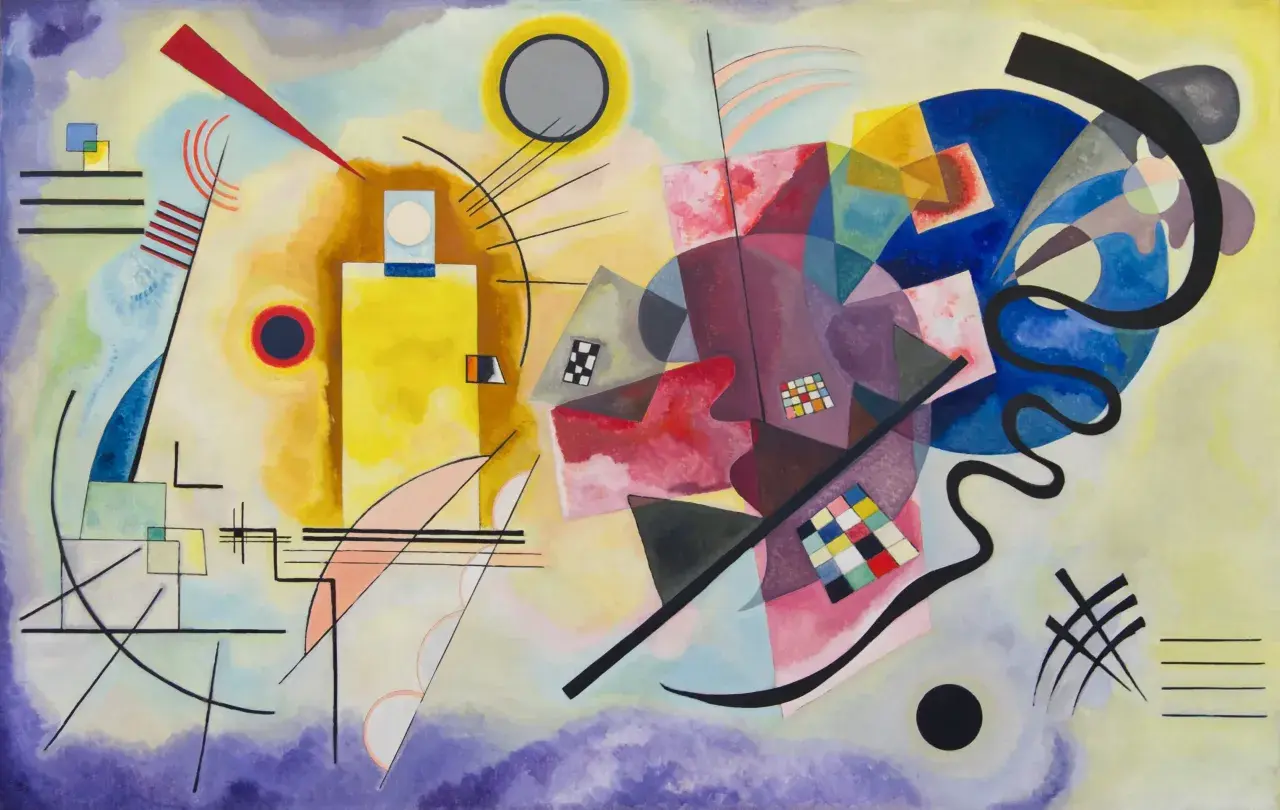
Abstract art in the 20th century is not one story but several: early geometric systems, spiritual experiments, postwar gesture, color fields, and later reductions that made line, surface, and scale carry the whole load. The best-known 20th century abstract artists did more than reject representation; they changed how painting could think, feel, and organize space. In this guide, I map the names that matter, the movements they shaped, and the practical cues I use when I want to read or evaluate an abstract work.
Key points at a glance
- Abstract art is a family of approaches, not a single style.
- Early pioneers include Wassily Kandinsky, Kazimir Malevich, Piet Mondrian, and Hilma af Klint.
- Mid-century New York shifted the center of gravity toward Abstract Expressionism, especially action painting and color field work.
- Later artists such as Agnes Martin and Helen Frankenthaler proved abstraction could be restrained, luminous, and highly structured.
- When identifying or assessing an abstract work, I look first at composition, surface, materials, and provenance, not just the signature.
Where 20th-century abstraction really starts
The first thing I tell readers is simple: abstraction did not arrive fully formed. It emerged from several nearly parallel experiments in Europe and, later, the United States. Wassily Kandinsky pushed painting toward color, rhythm, and spiritual intensity; Kazimir Malevich stripped form down to near-total geometry with Suprematism; Piet Mondrian reduced the visual language to grids, primary colors, and black lines; and Hilma af Klint created visionary non-representational works that are now essential to any honest history of the field.
That early period matters because it shows the two big paths abstraction would keep taking for the rest of the century. One path is geometric and ordered, built from structure, balance, and visual discipline. The other is expressive and intuitive, built from gesture, layering, and the sense that paint itself can carry meaning. Once you understand that split, the rest of the century becomes much easier to read. It also explains why later artists could be so different from one another and still belong to the same larger story.
The artists most people mean when they talk about abstraction
When I narrow this topic for a general reader, I start with a small set of artists because each one represents a distinct solution to the same problem: how to make painting powerful without depicting recognizable things.
| Artist | Movement or language | Why they matter |
|---|---|---|
| Wassily Kandinsky | Early abstraction, spiritual and compositional painting | He helped establish abstraction as a serious modern language rather than a novelty. |
| Hilma af Klint | Visionary, symbolic abstraction | Her early non-objective works broaden the timeline and challenge the old origin story. |
| Kazimir Malevich | Suprematism | He reduced painting to geometry and pure visual force, influencing later minimal and conceptual thinking. |
| Piet Mondrian | De Stijl, Neo-Plasticism | His grids and primary-color systems became a lasting model for order, clarity, and visual balance. |
| Jackson Pollock | Action painting | He turned process itself into the subject, making the act of painting visible on the surface. |
| Mark Rothko | Color field painting | He used floating color relationships to create scale, atmosphere, and emotional tension. |
| Lee Krasner | Abstract Expressionism | Her work is a reminder that gesture and structure can coexist in a single painting. |
| Helen Frankenthaler | Color field, soak-stain technique | She opened a more fluid, stained, and atmospheric direction for postwar abstraction. |
| Joan Mitchell | Lyrical abstraction | Her paintings show that abstraction can be deeply expressive without collapsing into chaos. |
| Agnes Martin | Minimal, grid-based abstraction | She proved that quiet repetition can feel as charged as the most energetic gesture. |
| Ellsworth Kelly | Hard-edge and shaped color | He sharpened abstraction into clean form, reduced contour, and exact color relationships. |
These names are useful because they are not interchangeable. Pollock is about movement; Rothko is about immersion; Mondrian is about order; Martin is about restraint; Frankenthaler is about staining and openness. That distinction is what keeps a survey of abstract art from becoming a flat list of famous names, and it leads naturally into the broader shifts that defined the century.
How the century changed the language of abstraction
I usually break the century into four working phases, because that is the cleanest way to understand the change without flattening it.
From invention to system
The early decades were about inventing the terms of the conversation. Kandinsky and Malevich pushed beyond visible subject matter, while Mondrian turned abstraction into a disciplined visual grammar. This was the period when artists were asking whether painting could stand on its own, without landscape, portraiture, or narrative propping it up.
From structure to gesture
After World War II, the center of abstraction moved strongly toward New York. Abstract Expressionism embraced scale, urgency, and bodily movement. Pollock’s drip paintings made process unavoidable. Krasner and Joan Mitchell added a more layered, often more lyrical energy. The point was not just to fill a canvas; it was to make the canvas record action, memory, and pressure.
From gesture to atmosphere
Color field painting took abstraction in a quieter direction. Rothko’s floating rectangles and Frankenthaler’s stained surfaces replaced overt drama with spacious, immersive color. These works are often misread as simple because they look calm from a distance, but that is exactly where the mistake begins. Their effect depends on proportion, hue shifts, and the way color seems to hover rather than sit on top of the canvas.
Read Also: Art Nouveau Explained - Identify, Authenticate, and Appreciate It
From atmosphere to reduction
By the 1960s and 1970s, artists such as Agnes Martin and Ellsworth Kelly were stripping the language back again. Martin’s grids are meticulous, almost meditative. Kelly’s forms are blunt, precise, and resolutely shape-driven. In both cases, abstraction becomes less about expressive overflow and more about attention, interval, and control. That shift matters because it shows how flexible the field really is: abstraction can shout, whisper, or simply hold a line.
Once that history is clear, the next question is how to actually look at an abstract work without forcing a false story onto it.
How I read an abstract painting without forcing a story
Abstract work rewards close looking, but only if I stop expecting it to behave like illustration. My reading process is practical and fairly simple.
- Start with structure. I ask whether the work is geometric, all-over, centered, or modular. That tells me how the artist wants the eye to move.
- Inspect the surface. Brushwork, staining, scraping, layering, and erasure are not decoration; they are evidence of method.
- Check how color behaves. Some artists use color to separate forms, others to dissolve them, and others to create vibration between adjacent areas.
- Measure the scale mentally. A canvas that feels calm in reproduction may become physically engulfing in person, and that changes interpretation.
- Look for traces of reference. Many abstract works are not completely non-objective. They may hold onto landscape memory, bodily rhythm, architecture, or symbolic hints.
I also pay attention to titles and series. A title can be a clue, but it can also be a red herring. Series matter because many abstract artists develop ideas through repetition and variation rather than through one-off masterpieces. That is one reason abstraction can feel deceptively simple at first glance and far more layered after ten minutes of looking.
From there, the next layer of value is less about interpretation and more about preservation, authenticity, and the physical evidence the artwork carries.
What preservation and authentication reveal about these works
For abstract art, condition is often part of the meaning. Surface quality is not an afterthought. It is one of the main places where the work lives. That is why I never treat preservation as a technical side note; it is central to how these objects are understood and valued.
- Materials can confirm period and practice. A work on raw canvas, a grid executed in pencil over gesso, or a stain made with thinned paint can align with known methods from a specific phase in an artist’s career.
- Condition changes interpretation. Craquelure, fading, overcleaning, and later varnish can all alter the reading of a work, especially when the artist relied on subtle tonal shifts.
- Provenance matters more than people expect. Exhibition history, gallery records, and ownership chain often carry more weight than a dramatic signature on the back.
- Series logic can support attribution. Many abstract artists worked in recognizable sequences, so size, palette, and compositional logic should match the broader body of work.
- Reproductions can mislead. A digital image rarely captures thickness, transparency, edge quality, or the way layered color behaves under real light.
If I were assessing a questionable abstract work, I would want to know the support, medium, stretcher or paper stock, condition history, conservation notes, and provenance before I trusted any stylistic hunch. In this category, visual instinct is useful, but it is never enough on its own. That practical caution is exactly why this field remains so interesting to collectors, curators, and conservators alike.
The best entry points if you want to study the field further
If you want a fast but solid way into the subject, I would build your reading list around a few pairings rather than a long roster. Pair Kandinsky with Mondrian to see the contrast between spiritual movement and structural order. Pair Pollock with Krasner to understand how action painting can be both explosive and tightly resolved. Pair Rothko with Frankenthaler to see the difference between immersion and stain. Pair Martin with Kelly to see how reduction can produce two very different emotional climates.
The larger lesson is that abstraction is not a rejection of meaning. It is a redesign of how meaning is made. The strongest artists of the century did not abandon feeling, discipline, or craft; they reworked them into a visual language that still rewards close looking. If you start with the names above and keep an eye on surface, scale, and provenance, the history of abstract art becomes much easier to navigate.