
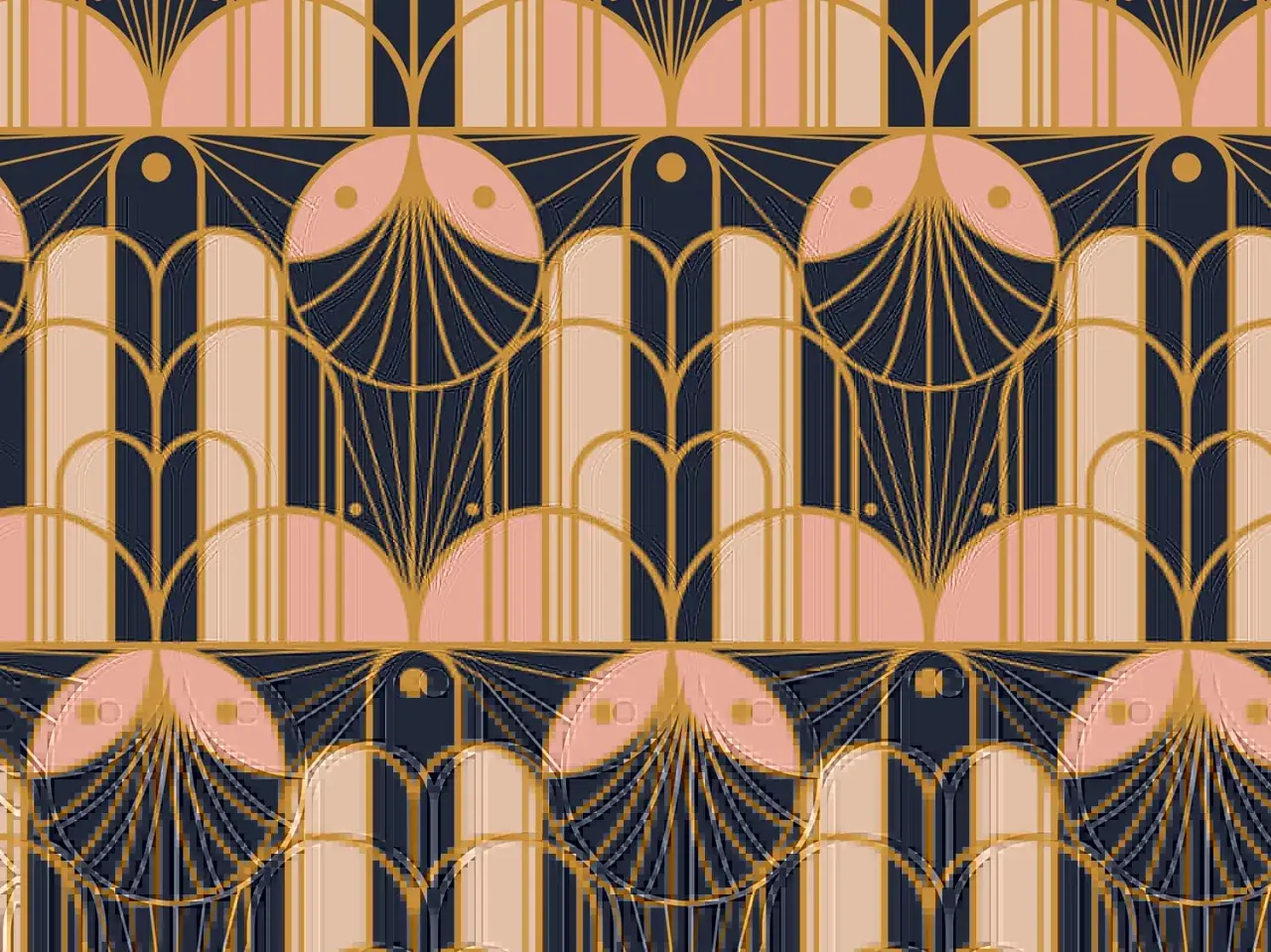
Art Deco is one of the few design languages that can feel disciplined and glamorous at the same time. It turns geometry, luxury materials, and confident craftsmanship into a style that still reads instantly in buildings, jewelry, furniture, and graphics. This article answers what is art deco, where it came from, which details define it, and how to tell it apart from close relatives such as Art Nouveau and Streamline Moderne.
Art Deco combines geometry, luxury, and modern craft
- It is a decorative style that shaped architecture, interiors, fashion, graphics, and objects.
- Its peak period ran through the 1920s and 1930s, with a major public breakthrough in Paris in 1925.
- The easiest signs are symmetry, stepped forms, chevrons, sunbursts, and polished surfaces.
- In the United States, it is especially visible in skyscrapers, theaters, hotels, and civic buildings.
- It differs from Art Nouveau by being more geometric and from Streamline Moderne by being more decorative and less aerodynamic.
- For preservation, original materials and surface finishes matter as much as the silhouette.
Art Deco is modern luxury built on order
At its core, Art Deco is a design movement that brought modern life into a more polished, dramatic visual language. It appears in architecture, interior design, furniture, jewelry, posters, textiles, and even everyday objects, but the logic is consistent: strong structure, deliberate ornament, and a sense of refinement. The Metropolitan Museum of Art has long treated that balance between ornament and modernity as one of the style's defining traits.
If I had to reduce it to one line, I would call Art Deco modernity made elegant. It does not hide decoration; it organizes it. That is why a Deco chair, a theater lobby, and a skyscraper crown can feel related even when they are made from very different materials. Once you see that, the style's history becomes easier to read.
How the style took shape in the 1920s and 1930s
Art Deco emerged in France in the years after Art Nouveau lost momentum, but it became internationally visible after the 1925 Exposition Internationale des Arts Décoratifs et Industriels Modernes in Paris. The V&A's overview makes that exhibition the turning point: designers, manufacturers, and critics saw a modern decorative vocabulary that could travel well across media and markets. The style then spread quickly through magazines, department stores, cinema, ocean liners, and the architecture boom of the interwar years.
In the United States, that spread was especially visible in New York and Miami, where commercial buildings, hotels, and entertainment spaces adopted the style with real confidence. By the 1930s, the look often became sleeker and less ornate, absorbing new materials such as chrome, aluminum, and early plastics like Bakelite. That evolution is why Art Deco can look lavish in one decade and streamlined in the next without losing its identity.
The visual traits that define Art Deco
There are a few visual cues I trust first when I am identifying Art Deco. They recur so often that, once learned, they are hard to miss.
- Symmetry - compositions usually feel balanced rather than free-flowing or asymmetrical.
- Geometry - chevrons, zigzags, circles, rays, triangles, and stepped profiles give the style its structure.
- Vertical emphasis - skyscrapers often rise in stacked masses, and that upward pull adds drama.
- Stylized motifs - flowers, animals, figures, and fan shapes are simplified into elegant patterns instead of naturalistic scenes.
- Luxurious materials - chrome, glass, lacquer, marble, exotic woods, and reflective surfaces make the style feel costly and intentional.
- Fine surface treatment - polished edges, inlays, metal trim, and carved reliefs do a lot of the work.
Two terms are worth keeping in mind. A ziggurat is a stepped, temple-like form that appears often in Deco architecture, and a bas-relief is a shallow carved decoration that sits close to the surface. Both help explain why the style feels sculptural without becoming heavy. Those cues become clearer when you look at real buildings and objects.

How to recognize Art Deco in architecture and objects
Architecture is usually the fastest way to spot Art Deco, especially in the United States. Think of the Chrysler Building's stainless-steel crown, Radio City Music Hall's lavish interior, or the pastel hotels of Miami Beach: each one uses a different palette, but the same basic language of geometry, rhythm, and polish. Offices, theaters, train stations, and civic buildings are especially rich places to look.
| Where to look | Typical Art Deco signs | Why it reads as Deco |
|---|---|---|
| Buildings | Setbacks, vertical piers, sunbursts, stepped crowns, decorative metalwork | The form feels monumental, but the ornament stays controlled and elegant |
| Interiors | Glossy finishes, mirrored surfaces, geometric floors, stylized lighting | The room feels theatrical without becoming visually chaotic |
| Furniture | Curved corners, lacquer, exotic veneer, chrome accents, repeated linear detail | The piece looks tailored, almost like architecture in miniature |
| Jewelry and metalwork | Bold symmetry, onyx, jade, coral, geometric mounts, contrast in color | The emphasis is on precision and graphic impact rather than softness |
| Posters and graphics | Angular lettering, flat color blocks, streamlined figures, strong diagonals | The image communicates speed, glamour, and modern life at a glance |
One practical detail helps here: a setback is the upper part of a skyscraper that recedes as the building rises. That shape is not just decorative; it also gives Art Deco towers their stepped silhouette. The trick is not to confuse that look with the styles closest to it.
How Art Deco differs from Art Nouveau and Streamline Moderne
People mix these styles up all the time, and the confusion is understandable because they overlap in time and sometimes in subject matter. The easiest way I sort them is by line quality, mood, and date.
| Style | Core look | Common motifs | How to tell it apart |
|---|---|---|---|
| Art Nouveau | Organic, flowing, and asymmetrical | Vines, flowers, whiplash curves, insects | Feels like nature drawn in motion, with soft, sinuous lines |
| Art Deco | Geometric, symmetrical, and glamorous | Sunbursts, chevrons, ziggurats, stylized figures | Feels structured and luxurious, with ornament organized into patterns |
| Streamline Moderne | Sleek, rounded, and aerodynamic | Horizontal bands, curves, portholes, smooth surfaces | Feels like speed and machine-age efficiency rather than ornament |
In plain English, Art Nouveau grows like a plant, Art Deco arranges like a machine with a designer's eye, and Streamline Moderne smooths everything down for speed. That distinction matters in preservation, because restoring the wrong details can erase the style rather than protect it.
What I check before preserving an Art Deco piece
When I look at an Art Deco building or object, I start with the parts that are easiest to lose in a bad restoration. Original chrome, terracotta, lacquer, glass, terrazzo, metal grillework, and veneer can change the whole reading of a piece if they are replaced with flatter, cheaper, or overly modern substitutes. For authentication, consistency matters more than one flashy motif.
- Proportion - the balance of vertical and horizontal lines should still feel intentional.
- Material honesty - a painted-over metal surface or a swapped-out veneer can weaken the original effect fast.
- Surface finish - Deco often relies on sheen, contrast, and crisp edges more than on heavy carving.
- Decorative integrity - sunbursts, panels, lettering, and reliefs should relate to the structure instead of floating as afterthoughts.
- Alterations - replacement windows, stripped facades, and removed trim are the first signs that a building has drifted away from its original character.
I also pay attention to restraint. Not every Art Deco work is loud; some of the best examples are quietly precise, with the glamour coming from proportion and material rather than excess ornament. That is why the style still feels fresh in 2026: it offers a rare combination of discipline, surface beauty, and confidence, and those are exactly the qualities worth preserving when a Deco object or building survives.
