
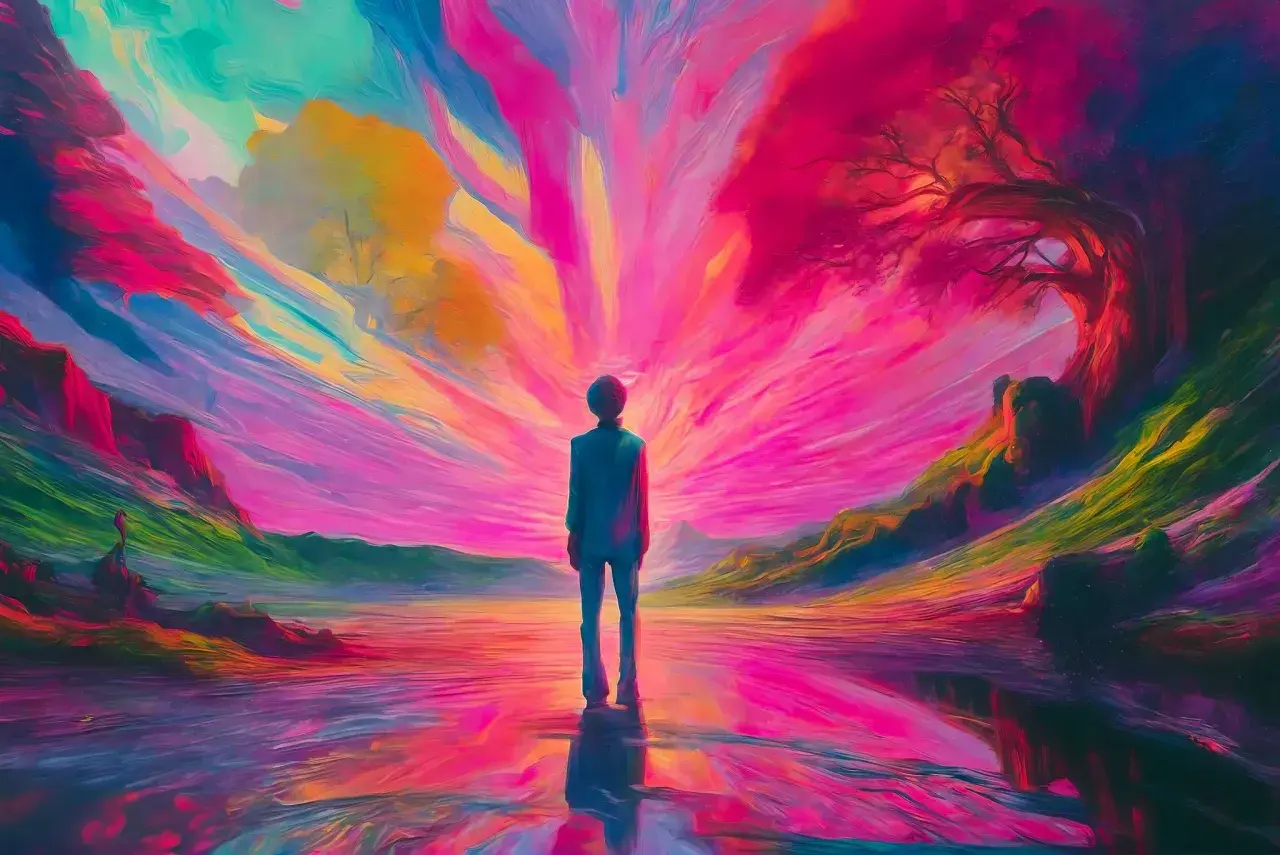
Surrealist artists used nature for more than scenery. Forests, coastlines, shells, birds, plants, and deserts become emotional terrain in which the visible world starts to behave like a dream. This article looks at how surrealist art and nature intersect, which visual patterns recur, which artists made the strongest use of organic imagery, and what matters if you are studying, collecting, or preserving these works.
What nature does inside surrealist art
- Nature usually appears as a vehicle for subconscious states, not as realistic landscape painting.
- Common motifs include distorted horizons, hybrid creatures, marine objects, botanical symbols, and unstable scale.
- Some of the clearest reference points are Joan Miró, Max Ernst, Eileen Agar, Paul Nash, Wifredo Lam, Leonora Carrington, and Dorothea Tanning.
- Mixed media and organic materials can create conservation and authentication issues that matter as much as style.
- In the U.S., major museum collections make it possible to study these works in person as well as online.
Why nature suited surrealist thinking
Surrealism was built around the idea that reality is only one layer of experience. The movement wanted access to dreams, instinct, desire, and the irrational, and the natural world gave artists an unusually flexible language for all of that. A tree can be a body, a storm can feel like a mood, and a shell can become a memory object without losing its status as a shell.
MoMA describes surrealist landscapes as works that tap the subconscious rather than simply copying what the eye sees. That is the useful starting point here: in surrealist art, nature is rarely treated as neutral scenery. It is charged, unstable, and often a little threatening. I think that is why these images stay memorable. They show us a familiar world that has stopped behaving in familiar ways.
Once you accept that logic, the rest of the movement opens up more clearly, especially the visual strategies artists kept returning to.
The main visual patterns behind these works
Not every surrealist artwork uses nature in the same way. Some artists turn landscape into a psychological stage. Others merge plants, animals, and bodies until the boundary between them disappears. A few make the natural object itself the center of the shock. I find it useful to sort the imagery into a few recurring patterns rather than treat every work as a one-off mystery.
| Pattern | What it does | Why it feels surreal | Useful artists to compare |
|---|---|---|---|
| Dream landscape | Turns sky, land, sea, or desert into an emotional space | The place feels real enough to enter, but not stable enough to trust | Joan Miró, Paul Nash, Salvador Dalí |
| Organic metamorphosis | Lets plants, animals, and bodies flow into one another | Nature stops being background and starts acting like a living mind | Max Ernst, Leonora Carrington, Dorothea Tanning |
| Found natural object | Uses shells, fur, feathers, stones, or drift material in a new setting | An ordinary natural fragment becomes uncanny when detached from its habitat | Eileen Agar, Meret Oppenheim |
| Hybrid ecology | Combines human, animal, and plant forms into one system | The scene feels alive, but also symbolic and psychologically loaded | Wifredo Lam, Leonora Carrington |
| Scale distortion | Makes tiny things monumental or huge spaces feel intimate | The viewer loses ordinary spatial certainty | Yves Tanguy, Paul Nash |
Artists and works that make the idea concrete
If you want to understand surrealist nature imagery quickly, I would start with works that are already canonical inside the movement. They show the range without making the subject feel abstract.
Joan Miró and the landscape as a field of signs
Joan Miró’s The Hunter (Catalan Landscape) is one of the clearest examples of a real place being turned into a symbolic field. The image brings together the real and the imaginary, abstraction and figuration, and even image and text. Instead of treating the landscape as a backdrop, Miró lets it become a visual code. The effect is playful on the surface, but it also feels private, as if the land itself has been translated into signs only half the viewer can decode.
Max Ernst and the forest as a psychological space
Max Ernst’s nature is rarely calm. Forests, birds, and strange organic textures often feel like pressure points rather than scenery. His work Two Children Are Threatened by a Nightingale shows how a natural motif can become a source of dream tension instead of comfort. Ernst also used frottage, a rubbing technique that transfers the grain of a surface onto paper, so that wood, stone, or other textures could generate imagery instead of merely supporting it. That is an excellent example of surrealism letting nature help make the picture.
Eileen Agar and the coast as a site of transformation
Art UK notes that Eileen Agar was deeply fascinated by nature and sought the surreal in natural forms. That description fits her work well. Rock formations, shells, sea creatures, and shoreline fragments appear not as souvenirs of a walk but as materials with sculptural charge. Her use of assemblage, meaning a work built from collected objects, pushes natural material into a different register: the shell is still a shell, but now it behaves like an image, a relic, and a proposition all at once. I think her work is especially useful because it shows how the sea can become both erotic and analytical without losing its mystery.
Paul Nash and the haunted English landscape
Paul Nash gives the English landscape a surreal afterlife. Fields, trees, stones, and horizons are often made strange by silence, repetition, or abrupt formal shifts. His landscapes do not feel empty; they feel watchful. Nash is important because he proves that surrealism did not need exotic subject matter to be effective. A local landscape, seen with enough psychic tension, can become as disorienting as any dream desert.
Read Also: Pop Art Symbols Explained - What Do They Really Mean?
Wifredo Lam, Leonora Carrington, and Dorothea Tanning in mythic nature
Wifredo Lam’s La jungla turns the jungle into a dense, hybrid system where human, vegetal, and animal forms are fused together. The work is not simply about a place in the natural world. It feels like a living structure with social and spiritual implications. Leonora Carrington and Dorothea Tanning take a different route, but they reach a similar result: animals, plants, and interior spaces slip into one another until the image behaves like a dream ecology. Their work matters because it resists the old habit of treating Surrealism as a mainly male or mainly European language.
Once you look at these artists side by side, the next question is not what the images mean in a strict sense, but how to read them without flattening them into one fixed code.
How I read these images without flattening them
I do not think the best surrealist works are riddles with one correct answer. They are closer to systems of pressure. When I look at a nature-based Surrealist image, I usually ask a few practical questions first:
- Is nature being used as a setting, a symbol, or a body?
- Does the work make the scale feel unstable?
- Are the forms observed from life, invented, or combined from both?
- Does the title redirect the image, or does it deepen the ambiguity?
- Is the emotional tone calm, comic, erotic, threatening, or all of these at once?
That approach prevents over-reading. A shell is not always a shell-as-psyche. A bird is not always a simple emblem of freedom. Sometimes an image works because it stays unresolved. In my experience, the strongest surrealist works invite interpretation without ever fully surrendering to it. That is a strength, not a weakness.
This same habit of looking closely also matters when the work is physically fragile, which is where preservation and authentication come in.
What matters for preservation and authentication
Nature-based surrealist works can be deceptively complicated from a conservation perspective. Paint on canvas is one thing. A work that includes feathers, fur, shells, sand, dried plant matter, found objects, or fragile adhesives is another. Organic components age unevenly, respond to light and humidity in different ways, and may have been replaced or stabilized during later interventions.
- Check whether the work is oil, gouache, collage, photography, mixed media, or assemblage.
- Ask for a condition report that identifies cracks, losses, pest damage, adhesive failure, fading, and prior repairs.
- Request the provenance trail, exhibition history, and any conservation documentation that explains material changes.
- Be cautious when natural materials look too fresh, too uniform, or too neatly integrated for the artist’s known practice.
- Compare the work’s handling of nature with authenticated examples by the same artist, especially when the piece is signed but materially unusual.
For collectors and institutions, this is not a minor detail. In Surrealism, the material choice often supports the meaning. If the object has been heavily altered, that change can affect interpretation as well as value. That is why the physical record of the work matters just as much as the image itself.
For readers in the United States, the next step is usually to look at the movement in a museum context, where scale and material presence are much easier to judge.
Where to look in the United States
If you want to study this subject in person, U.S. museum collections are a strong starting point. MoMA in New York is especially useful because its Surrealism resources group key works together in a way that makes comparison easy. The Philadelphia Museum of Art, the Menil Collection in Houston, and the Art Institute of Chicago also give you serious context for the movement rather than just isolated masterpieces.
- MoMA, New York for Miró, Ernst, Dalí, Carrington, Lam, and Tanning in a compact comparative frame.
- Philadelphia Museum of Art for a broad Surrealist collection that helps place individual works in a longer modernist story.
- Menil Collection, Houston for a concentrated Surrealism experience and strong historical context.
- Art Institute of Chicago for a broader modern art setting that helps you see how Surrealist imagery sits beside other movements.
If you can only look online, start with museum collection pages and image details rather than general overviews. Surrealist works reward close viewing. Texture, line, and spacing matter more than they do in many other modern movements, especially when nature is being used as a coded or transformed subject.
That leads to the final point: when nature turns uncanny, the image is usually doing more than looking strange.
What to remember when nature turns uncanny
The clearest rule is simple. In Surrealist art, nature is rarely just nature. It is a way to think about the subconscious, the body, desire, memory, and instability without stating those things directly. If a landscape feels too silent, too crowded, too scaled, or too alive, that is usually the point.
So the best way to read these works is to ask what kind of nature you are looking at: observed, invented, remembered, or transformed. If you keep that question in view, the movement becomes easier to navigate, and the works stop feeling like isolated oddities. They start to look like a coherent visual language, one that still feels current because it understands something basic about human perception: the natural world is never as fixed as it seems.
