
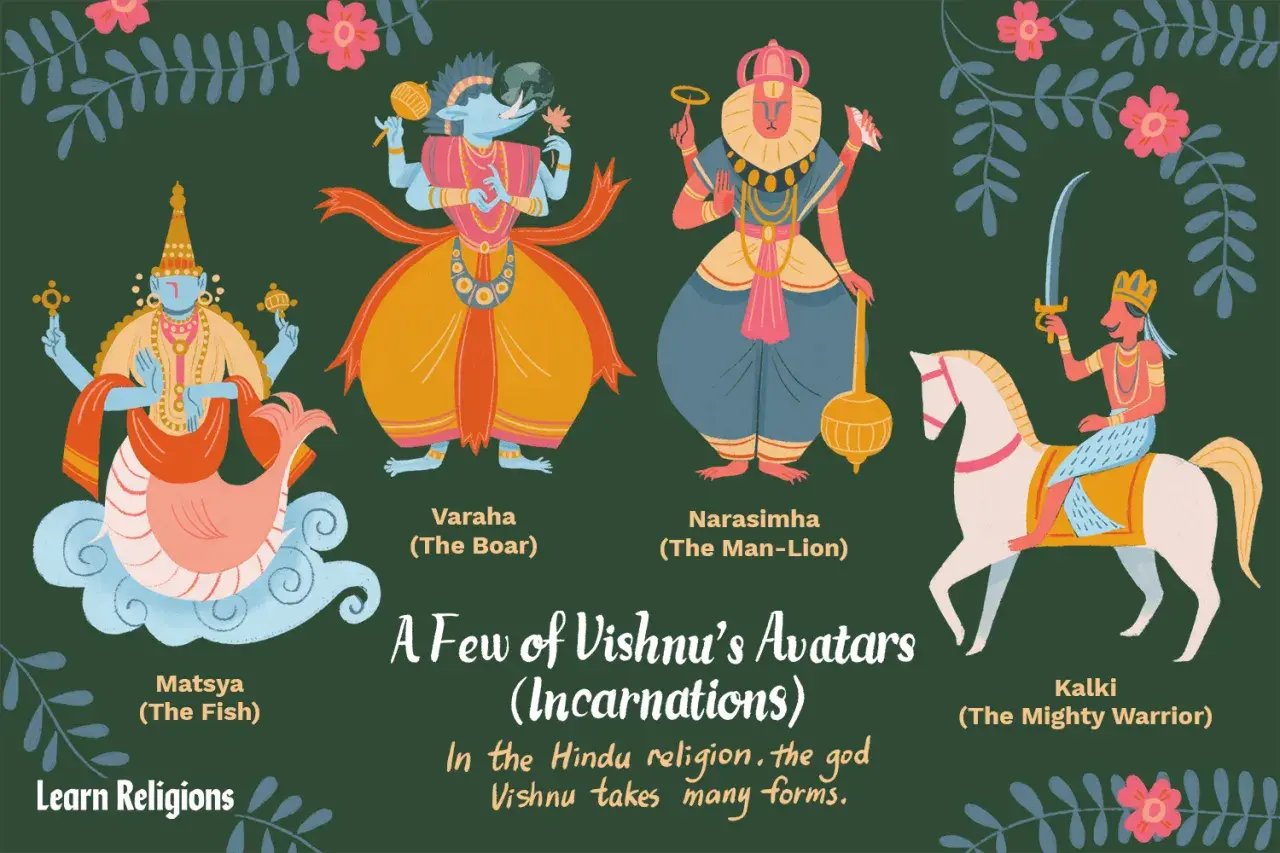
Vishnu’s avatars are best understood as a visual system, not just a mythological list. Each form carries its own iconography, from the fish that survives the cosmic flood to the future horseman who restores order at the end of the age. In this article I map the ten principal forms, explain the symbols that identify Vishnu in sculpture and painting, and show how to read the differences that matter in art history, conservation, and authentication.
Key points to keep in mind
- The Dashavatara is the standard ten-avatar cycle of Vishnu, but regional traditions sometimes replace one figure with another.
- The most reliable identifiers for Vishnu are the conch, discus, mace, lotus, four arms, crown, and blue body.
- Each avatar has a distinct visual logic, from animal form to royal hero to future rider.
- Context matters: pose, companions, and setting often confirm the identification more than one isolated attribute.
- In art-historical work, damaged hands, later repainting, and local variation can all affect how an image should be read.
Why the avatar cycle matters in art history
The standard ten-avatar cycle is called the Dashavatara. In most devotional and art-historical contexts, it begins with Matsya and ends with Kalki, but the list is not perfectly fixed across all regions and sects. Some traditions substitute Balarama for the Buddha, and some regional series introduce forms such as Jagannatha. I treat that variation as evidence of a living tradition, not an inconsistency.
That matters because the avatars are not random transformations. They are responses to different kinds of disorder: flood, cosmic imbalance, tyranny, arrogance, and moral exhaustion. Once you read the cycle that way, the imagery stops looking decorative and starts reading like a theological argument in visual form.
- Matsya and Kurma belong to the world of primordial survival.
- Varaha, Narasimha, and Vamana dramatize rescue through sudden transformation.
- Rama and Krishna translate divine order into human ethics, kingship, and devotion.
- Kalki pushes the cycle into the future and keeps the sequence open-ended.
With that framework in place, the next step is to look at each avatar as an image, not just a name.
The ten principal avatars and how to recognize them
The sequence below follows the most widely used order in South Asian art. If you see a slightly different list, I would read it as a regional or sectarian choice rather than a mistake.
| Avatar | Typical form | Visual clue | Core meaning |
|---|---|---|---|
| Matsya | Fish or fish-human hybrid | Scaled body, aquatic setting, rescue imagery | Preservation of life and knowledge during the flood |
| Kurma | Tortoise | Shell-bearing body, support for the churning mount | Stability, endurance, and cosmic support |
| Varaha | Boar, sometimes boar-headed human form | Earth goddess or globe lifted on a tusk | Recovery of the world from chaos |
| Narasimha | Man-lion | Lion face, claws, tense or violent movement | Protection that breaks through all limits |
| Vamana | Dwarf or small Brahmin figure | Short stature, begging posture, three-step narrative | Humility that exceeds arrogance by cosmic scale |
| Parashurama | Warrior-sage | Axe in hand, ascetic marks, martial stance | Discipline, retribution, and restraint of power |
| Rama | Royal archer and ideal king | Bow, quiver, composed posture, princely bearing | Dharma expressed through rule, duty, and self-mastery |
| Krishna | Flute-playing youth, king, or charioteer | Flute, peacock feather, dark skin, pastoral setting | Divine love, strategy, wisdom, and intimacy with devotees |
| Buddha or Balarama | Serene ascetic or plough-bearing brother | Calm face, monastic restraint, or agricultural weaponry | Tradition-specific ethical or devotional emphasis |
| Kalki | Future rider | White horse, sword, forward motion | Renewal after decay and the return of order |
In several museum series, the visual identity of the tenth position shifts depending on theology and region. The important point is not memorizing a rigid chart; it is recognizing how South Asian artists used sequence, posture, and attributes to turn doctrine into a readable image. Once you can do that, Vishnu himself becomes much easier to identify.
How Vishnu is identified before the avatar detail matters
When I read a Vishnu image, I start with the standard marks. The Met’s collection notes repeatedly identify Vishnu by the conch-shell trumpet, discus, mace, and lotus, and that remains the quickest reliable entry point in sculpture and painting. Those objects are not decorative extras; they are part of the deity’s visual grammar.
- Conch signals sacred sound, creation, and proclamation.
- Discus points to time, order, and the power to cut through disorder.
- Mace stands for strength, protection, and sovereign force.
- Lotus suggests purity, unfolding creation, and detachment from the mud below.
- Four arms mark a divine reach that exceeds ordinary human action.
- Blue skin is symbolic, usually read as vastness, depth, or sky-like immensity rather than literal complexion.
- Raised hand in abhayamudra, the fear-allaying gesture, tells the viewer the deity protects as well as rules.
Other details sharpen the reading. Vishnu may rest on Shesha, ride Garuda, or stand with Lakshmi at his side, and each setting changes the emotional tone of the image. A resting Vishnu communicates cosmic balance; a mounted Vishnu communicates movement and intervention; a paired Vishnu highlights auspicious abundance. That is why one symbol is never enough on its own.
For conservators and collectors, this is where iconography becomes practical. The wrong attribute can distort identification, and a missing hand can make a once-clear figure ambiguous. I always tell myself to read the whole body before trusting the label.
How regional styles change the reading
Vishnu appears differently in stone relief, bronze, manuscript painting, and later prints. A Chola bronze, a Hoysala relief, and a Pahari miniature may all present the same deity, but they do not communicate through the same visual weight. Style, material, and condition are not secondary details here; they are part of the evidence.
This is where misidentification often starts. A crowned, blue-skinned, four-armed figure is not automatically Vishnu. Krishna, Narayana, and later composite forms can share the same visual vocabulary, so I always look for context before I settle on a name.
- A boar-headed figure is Varaha only when the earth goddess or the lifted globe is present, not merely because the head is animal-like.
- Narasimha should show a clear lion-human threshold, usually with claws or a dramatic emergence from a pillar.
- Vamana needs scale to work; without the three-step narrative or the courtly context, the figure may be incomplete.
- Krishna usually needs more than blue skin. Flute, peacock feather, cows, or a pastoral setting make the identification much stronger.
- Rama is usually anchored by bow, quiver, and royal restraint, not just by heroic posture.
The same caution applies to damaged objects and restored icons. Later repainting can soften a face, replace a missing attribute, or flatten regional distinctions that were once obvious. In authentication work, I would rather say “probable” with reasons than force a confident label onto an image that no longer supports it cleanly.
Once you factor in regional style and condition, the avatar cycle becomes less about memorizing names and more about reading evidence carefully.
What the iconography reveals once you read it closely
What makes Vishnu imagery enduring is its clarity. The avatars are not just stories of transformation; they are visual solutions to different kinds of crisis. That is why they work so well in temple sculpture, devotional painting, and museum collections alike.
- The cycle moves from survival to restoration, not from spectacle to spectacle.
- The same symbolic toolkit keeps the deity recognizable even when the form changes completely.
- Regional variation is normal, so a careful reading should expect differences instead of flattening them.
- For attribution, the strongest identification comes from the combined evidence of pose, attributes, companions, and style.
If I had to reduce the whole subject to one working rule, it would be this: Vishnu is read through balance. His avatars look different, but they all show how order returns when the world tilts out of shape. That is the most useful way to approach these images, whether the goal is devotion, art history, or careful collection study.
