
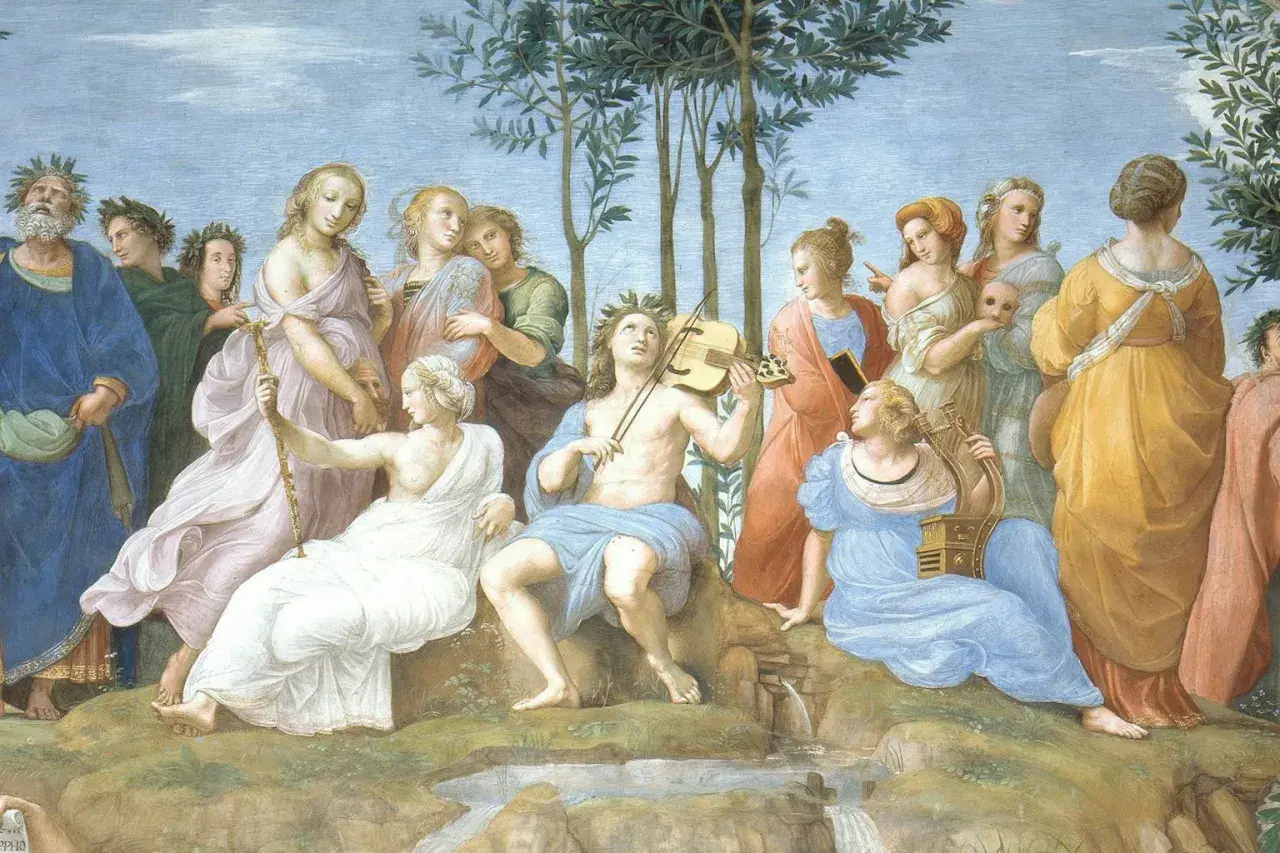
The Greek Muses are more than decorative figures from classical mythology. In art, they work like a visual language: a flute, a scroll, a globe, or a mask can tell you which branch of knowledge or creativity the artist wanted to evoke. In this article I focus on iconography and symbolism, so you can read Muse imagery more confidently in paintings, sculpture, prints, and later revival works.
Key points to keep in mind when reading Muse imagery
- The Muses were not fixed in one visual form from the start; early art often grouped them differently than later classical and Renaissance works.
- Attributes such as the lyre, scroll, globe, or tragic mask are useful clues, but they are not absolute proof on their own.
- Pose, clothing, and companions often matter as much as the object in a figure’s hand.
- In restoration and attribution work, a missing or altered attribute can change the identification of a figure.
- The strongest readings combine iconography with date, medium, and context.
What the Muses mean in visual culture
In Greek mythology, the nine sisters stand for inspired creation, memory, and the ordering of artistic knowledge. That is why they appear so often in spaces where culture wants to present itself as disciplined rather than casual: libraries, academies, courts, ceilings, frontispieces, and commemorative sculpture. They do not simply “decorate” a work; they announce that the work belongs to a learned tradition.
For me, the most important thing about these figures is that they sit at the intersection of idea and image. A Muse can stand for epic poetry, history, lyric song, comedy, tragedy, dance, hymn, and astronomy, but the artist still has to make that idea visible. Iconography is the bridge. Without it, the viewer sees a graceful woman; with it, the viewer sees a specific intellectual claim.
That is also why Apollo so often appears nearby. He gives the whole group an ordered, formal character. The Muses become less like abstract spirits and more like a visual hierarchy of the arts. From there, the symbols start doing real interpretive work.
How artists identified each Muse
The safest way to identify a Muse is to look for a combination of role, attribute, and pose. One object can mislead you; a cluster of clues is much stronger. The table below gives the most common iconographic markers, but I would still treat each reading as provisional until the whole image supports it.
| Muse | Usual domain | Common attributes | What the symbol usually tells you |
|---|---|---|---|
| Calliope | Epic poetry | Tablet, stylus, scroll, laurel crown | She usually signals authority, elevated speech, and long-form narrative. |
| Clio | History | Scroll, open book, chest of books | She points to record keeping, memory, and the writing of public events. |
| Euterpe | Lyric music and poetry | Flute or aulos | The instrument is the main clue; the image usually emphasizes music more than narrative. |
| Melpomene | Tragedy | Tragic mask, sword, cothurnus, vine leaves | She typically marks dramatic intensity, grief, or the theatrical stage. |
| Terpsichore | Dance and chorus | Lyre, plectrum, dancing posture | Movement matters here; her body language often matters more than a single prop. |
| Erato | Love poetry | Lyre, floral garland in later art | She usually softens the tone of a composition and points toward intimacy or lyrical feeling. |
| Polyhymnia | Hymns and sacred song | Veil, wrapped cloak, pensive pose, often no clear attribute | Her restraint is part of the image; contemplative stillness is often the clue. |
| Urania | Astronomy | Globe, pointer, measuring staff or compass | She usually marks celestial order, calculation, and the study of the heavens. |
| Thalia | Comedy and pastoral poetry | Comic mask, shepherd’s staff, ivy wreath | She tends to read as lighter, more playful, and more theatrical than Melpomene. |
A useful rule of thumb is this: the more specific the attribute, the safer the identification. A globe plus pointer strongly suggests Urania. A tragic mask almost always pushes you toward Melpomene. But a lyre alone is not enough to settle the question, because several Muses can appear with musical instruments, especially in later art.
Early Greek art complicates the picture even further. In some of the oldest representations, artists show only three Muses, and the visual code is much looser. The later nine-fold system is more familiar to modern viewers, but it did not erase older habits overnight. That is why the dating of the work matters as much as the symbol itself.
The symbolism behind their poses, dress, and companions
The props are only the most obvious part of the story. Pose and costume often carry the deeper meaning. A seated Muse usually suggests reflection, scholarship, or literary authority, while a standing or dancing figure feels more performative and immediate. Veils and full drapery can signal seriousness, reserve, or sacred knowledge. Laurel wreaths tend to imply honor, poetic success, or immortality.
Companions matter too. Apollo frames the Muses as disciplined and harmonious, not random or ecstatic. Springs, grottoes, and mountain settings point to sacred places of inspiration rather than literal landscape decoration. In some works, the Muses appear in a clustered ensemble that feels almost like a court scene; in others, one figure stands apart as a personification of a single art.
- Apollo nearby usually strengthens the reading of the scene as ordered artistic culture rather than private fantasy.
- A veil or lowered gaze often signals contemplation, especially in Polyhymnia.
- Motion in the body can be as important as an object in the hand, especially for Terpsichore.
- Theatrical elements such as masks, cothurni, or stage-like gestures move the image toward tragedy or comedy.
- Heavenly instruments such as the globe and pointer make Urania’s role easy to read even in damaged works.
There are also rarer motifs worth noticing. Some works show feathers on the head or shoulders, an allusion to the contest with the Sirens. When that happens, the artist is often doing more than naming a Muse; the image becomes a small argument about poetic power, competition, and the authority of song. That leads directly to the practical question of how to read these works without overclaiming.
How to read a Muse scene step by step
When I evaluate a Muse image, I do not start with the name. I start with the evidence. That approach is especially useful in museum work, where damaged surfaces, later restorations, and reused motifs can all blur the picture.
- Identify the medium and date. A vase painting, a Roman copy, a Renaissance ceiling, and a Neoclassical engraving may use the same figure in very different ways.
- Look for the strongest attribute first. A globe, mask, or scroll carries more weight than a general sense of elegance.
- Check whether the figure is isolated or part of a larger ensemble. Nine-figure groups are often more legible than single figures.
- Read the pose, clothing, and setting together. A pensive, veiled figure points somewhere different from a lively dancer with a lyre.
- Test the identification against condition and restoration. Missing hands, reattached heads, or later paint can alter the iconographic signal.
This is also where attribution work becomes interesting. A figure that looks generic in a damaged photograph may be much more specific in person, once texture, tool marks, or pigment traces are visible. I would rather call an identification cautious and well-supported than fast and wrong.
Where identification goes wrong
Most mistakes come from reading one sign too quickly. The Muses are flexible figures, and artists borrowed their language across centuries. If you assume every female figure with a book is Clio, or every musical figure is Euterpe, you will overidentify the image and miss what the artist actually meant.
| Common mistake | Why it happens | Better reading |
|---|---|---|
| Calling any lyre-bearing figure Euterpe | Several Muses can be associated with music or song | Use pose, grouping, and period conventions before naming her |
| Assuming a veiled woman is automatically Polyhymnia | Veils also appear in allegory, mourning, and religious imagery | Look for contemplative stillness and the broader iconographic program |
| Confusing Urania with a generic allegory of wisdom | Both can use celestial or scholarly imagery | Check for the globe, pointer, and any clear astronomical context |
| Trusting restored details too much | Later repairs can add or sharpen attributes | Compare the object’s surface history with its current appearance |
| Ignoring period changes | Renaissance and Neoclassical artists updated ancient symbols | Match the iconography to the date and workshop tradition |
One of the most common blind spots is assuming that a classical subject must follow a single ancient formula. It rarely does. Artists often simplified, merged, or modernized the Muses to suit new audiences, which means the visual code can be partly ancient and partly contemporary to the work itself. That is not a flaw in the artwork; it is part of its history.
Why this visual code still matters in conservation and attribution
For conservation and authentication, these symbols are not decorative trivia. They help establish what kind of object you are looking at, which parts are original, and which details may have been altered by later hands. A missing scroll, a repainted globe, or a softened mask can change the meaning of the figure enough to affect cataloguing and interpretation.
That is why I treat Muse iconography as evidence, not ornament. When the symbol, pose, material, and date all support the same reading, the identification becomes much stronger. When they clash, the safest answer is usually to stay provisional until more of the object’s history is clear. Good art history starts with the image and ends with the object in front of you.
Seen that way, the Muses are useful well beyond mythology. They teach you how to read art with discipline, how to separate stable symbols from later additions, and how to let the work’s own visual logic lead the interpretation.
