
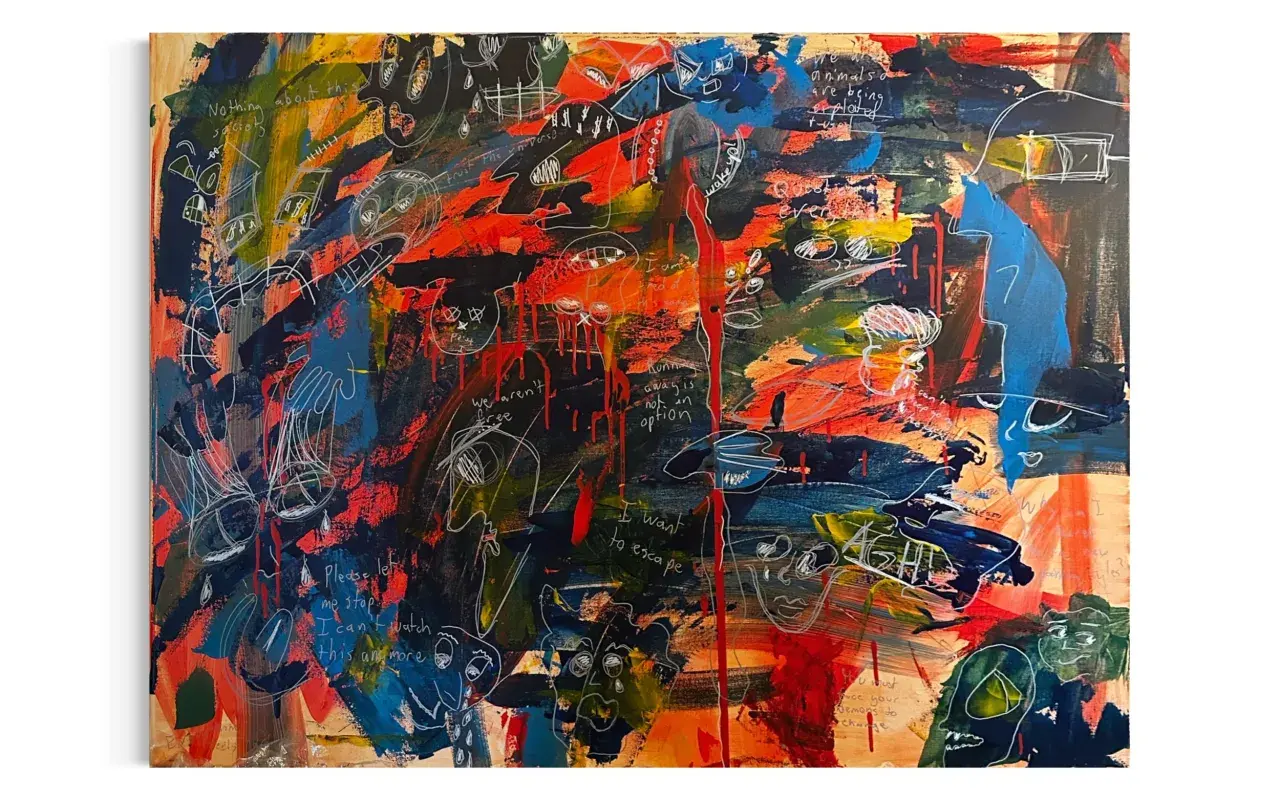
Modern expressionism art is less about rendering the world exactly as it appears and more about turning feeling, memory, and instinct into visible form. In this article, I break down what the style means, how to recognize its visual language, where it overlaps with expressionism and neo-expressionism, and what to check if you are looking at a work as a viewer, collector, or curator.
The style is emotional, but the best examples are still disciplined
- Think of the term as a practical umbrella for contemporary work driven by subjective emotion, distortion, and bold mark-making.
- The strongest pieces usually combine visible brushwork, heightened color, and some kind of internal structure.
- The closest historical comparison is often neo-expressionism, especially for late-20th-century figurative painting.
- Not every rough or loud painting belongs in this category; the difference is whether the image feels intentionally charged rather than merely messy.
- For authentication and care, provenance, support condition, and surface stability matter more than the first impression of energy.
What modern expressionism is really trying to do
At its core, this branch of painting asks a simple question: what happens if the artist gives emotion priority over realism? The answer is usually a work that feels immediate, personal, and slightly restless, even when the subject is recognizable. I think of it as art that does not merely describe experience; it tries to make the viewer feel the pressure of that experience on the canvas.
That is why the term is a little slippery. In museum language, you are more likely to see Expressionism, Abstract Expressionism, neo-expressionism, or the broader phrase contemporary expressionist painting. In everyday use, though, modern expressionism works as a useful umbrella for art that keeps emotion, imagination, and subjective interpretation at the center. The important point is not the label itself but the visual commitment behind it, and that becomes easier to see once you know what to look for.
The visual language that gives the style its force
I would not call every expressive painting an example of the movement. The strongest works usually have a clear internal logic, even when they look raw or unfinished on purpose. The surface may be wild, but the choices are rarely random.
- Distorted figures and forms that bend anatomy or perspective to heighten mood.
- Visible brushwork that keeps the artist’s hand present instead of hiding it.
- Intense or uneasy color, often used for emotional contrast rather than local truth.
- Layered surfaces with scraping, overpainting, or dense impasto that make the painting feel physically charged.
- Symbolic fragments such as text, animals, masks, anatomy, or repeated icons.
- Composition under tension, where balance exists, but only barely.
These traits often work together. A painting can be figurative and still feel unstable, or almost abstract and still carry a strong psychological presence. That flexibility is part of the appeal, and it also explains why the style keeps showing up in different decades and mediums, which leads directly to the question of where it sits in relation to better-known movements.
How it differs from expressionism, abstract expressionism, and neo-expressionism
The label gets confusing because several movements share the same emotional DNA. I find it easier to separate them by asking what each one protects most: the figure, the gesture, or the feeling itself.
| Movement | Rough period | Typical look | What it prioritizes |
|---|---|---|---|
| Expressionism | Early 20th century | Distorted people, charged color, psychological intensity | Subjective emotion over physical realism |
| Abstract Expressionism | 1940s to 1950s | Large-scale abstraction, gesture, stain, or field | The act of painting and the emotional impact of abstraction |
| Neo-expressionism | Late 1970s to 1980s | Return to figuration, rough handling, vivid color, myth, and narrative fragments | Expressive painting after conceptual and minimalist restraint |
| Contemporary expressive painting | 1990s to 2026 | Hybrid, figurative, symbolic, mixed-media, sometimes ironic | Personal voice inside a contemporary visual language |
For most readers in the United States, this distinction matters because the market and the museum often use different shorthand. A 1980s canvas with heavy emotional figuration will usually be closer to neo-expressionism than to the original Expressionist movement. A fully abstract canvas with gestural paint may owe more to Abstract Expressionism. When I see the term modern expressionism used broadly, I assume the writer means one of those later, revived, or hybrid forms rather than a strict historical school, and that distinction helps avoid a lot of confusion before you start looking at examples.

Artists and works that show the range
Once you move from definition to actual work, the style becomes much easier to understand. The point is not that these artists all look the same. It is that each one shows a different way emotion can control form without collapsing into chaos.
- Jean-Michel Basquiat uses text, anatomy, crowns, and repeated symbols to create a visual language that feels fast but carefully staged. His work is useful because it proves that expression can be culturally layered, not just spontaneous.
- Philip Guston shows how a painter can turn to blunt figures and comic-like shapes without losing moral seriousness. His late work is a reminder that expressionism can be uneasy, self-critical, and almost uncomfortable to look at.
- Julian Schnabel brings scale and material drama to the foreground. Broken plates, large gestures, and rough surfaces make the object itself part of the emotional statement.
- Eric Fischl keeps the figure in play while exposing social tension, memory, and private unease. His work is a good example of how expressive painting can still be narrative.
- Susan Rothenberg demonstrates that a reduced subject, such as a horse or a partial body, can carry enormous psychological weight when line and space are controlled carefully.
The lesson from these examples is simple: the movement is not defined by one palette or one level of abstraction. It is defined by the way the artist uses distortion, surface, and symbolism to make inner life visible. That is also why attribution and authenticity checks matter, because a strong style can sometimes hide weak facts.
How to judge a work without getting fooled by the surface energy
Expressive art can be persuasive at first glance, which is exactly why I pay close attention to the evidence behind it. A painting can feel immediate and still be misattributed, heavily restored, or simply not as strong as its first burst of color suggests.
If you are evaluating a piece, I would start with four questions:
- Does the work have a clear provenance, including ownership history, invoices, or exhibition references?
- Do the signature, inscriptions, labels, and stretcher details support the claimed origin, instead of carrying the whole argument by themselves?
- Does the surface behave like its medium should, or do the textures, craquelure, and repairs look inconsistent under closer inspection?
- Has the work been stored and displayed in stable conditions, especially if it uses thick impasto, paper, or mixed media?
Condition is especially important with this kind of art. Thick paint films are vulnerable to cracking if the environment swings too much, and works on paper can fade quickly under poor lighting. For display, I usually aim for stable room conditions rather than perfection: moderate humidity, a steady temperature, no direct sunlight, and UV-filtered glazing for works on paper. The goal is not to sterilize the artwork; it is to keep the expressive surface intact enough that future viewers can still read the artist’s decisions. Once you think in those terms, the final question becomes less about whether the style is bold and more about why it still feels necessary now.
Why the style still feels immediate in 2026
Expressive painting keeps returning because it solves a problem that slick images often do not: it makes hesitation, anger, grief, wit, or memory physically visible. In a visual culture full of polished screens, the roughness of a human-made mark has real force. I think that is why collectors, curators, and general viewers still respond to it, even when they do not use the same critical vocabulary.
The strongest modern examples are not loud for the sake of being loud. They have structure, pacing, and a point of view. If you are studying the style, looking to buy into it, or simply trying to read it more confidently, keep your eye on three things: emotional clarity, formal control, and material honesty. When those line up, the painting does more than signal intensity; it earns it. That is the standard I would use before I call any work expressionist in a meaningful sense.