
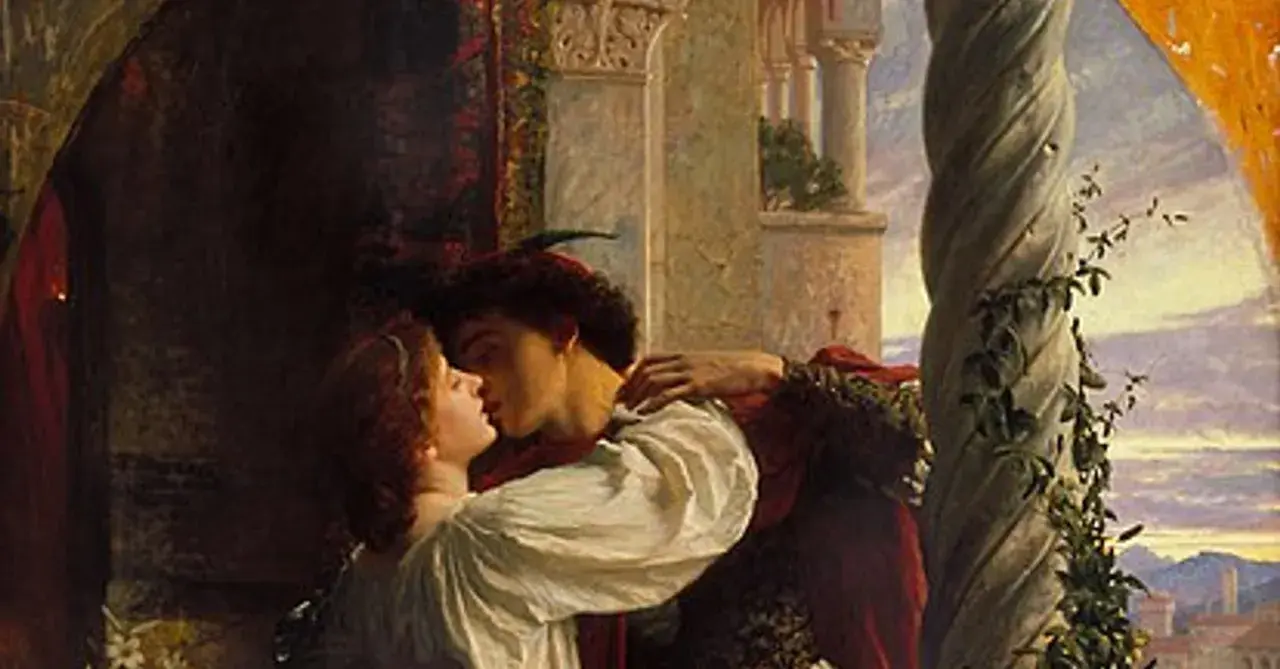
The image of Juliet on the balcony has outlived the play’s plot details because it condenses everything into one charged visual: love, distance, secrecy, and the risk of crossing a boundary. In this article, I unpack why the scene became such a durable icon, what its symbols actually mean, and how to read paintings, prints, and illustrations without flattening them into mere romance.
Key ideas that make the balcony scene more than a love image
- The balcony works as a threshold, not just a location, so it carries strong ideas of separation and access.
- Artists often use height, light, color, and gesture to signal whether the scene feels hopeful, forbidden, or tragic.
- Some versions follow Shakespeare closely, while others compress the whole scene into a kiss or embrace for instant visual impact.
- In art-historical terms, the image is useful because it reveals period taste as much as it shows the play.
- If you are assessing a print or painting, medium, date, and provenance matter as much as the romantic subject.
Why the balcony scene became a visual shorthand for forbidden love
I think the reason this moment endured is simple: it is emotionally complete. Romeo is below, Juliet is above, and the space between them becomes a story in itself. The Royal Shakespeare Company’s scene guide keeps that structure front and center, showing Romeo under Juliet’s position and making the vertical separation part of the dramatic grammar.
That separation does more than arrange the stage. It creates the central tension of the image: desire reaching upward toward something beautiful, but not yet secure. The balcony scene also lets artists show love as both intimate and precarious, which is a much richer visual idea than a straightforward kiss. When painters return to this moment, they are rarely just illustrating Shakespeare; they are staging an argument about longing, social barriers, and the illusion that love can float above consequence.
This is why the scene reads so differently from a generic romantic tableau. It is not only about affection. It is about a boundary being crossed, and that makes the image feel charged even when the rest of the play is left out.
The symbols that do the real storytelling
What makes the balcony image endure is not the architecture alone but the symbolic language wrapped around it. I read it as a compact system of signs: height, light, color, wall, window, and gesture all doing separate jobs at once.
| Visual cue | What it suggests | Why it matters |
|---|---|---|
| Juliet above Romeo | Elevation, idealization, distance | Turns her into both a person and an unreachable image |
| Romeo below or climbing upward | Longing, pursuit, risk | Makes love feel active rather than passive |
| Moon, stars, or night sky | Secrecy, fate, intimacy | Places the lovers in a world apart from daily life |
| White dress and pale light | Purity, vulnerability, youth | Softens Juliet into an almost iconic figure |
| Red cloak or warm garment tones | Passion, danger, heat | Gives Romeo visual urgency and emotional force |
| Wall, window, or ledge | Barrier and threshold | Reminds the viewer that this love is not free or safe |
When these cues are balanced well, the image feels inevitable. When they are overdone, it starts to look decorative instead of dramatic. That distinction matters, because the best versions do not simply sentimentalize the scene; they make the symbolism legible without killing the tension.

How artists turn the moment into composition
The strongest versions of this subject are usually built around vertical movement. A painter can let Juliet dominate the upper register, keep Romeo half-hidden in shadow, or connect both figures with a diagonal line of arms, fabric, or gaze. Those choices are not incidental. They tell the viewer whether the scene should feel distant, tender, suspended, or physically urgent.
Frank Dicksee’s 1884 Romeo and Juliet is a useful example because it leans into late-Victorian romance while still keeping the scene theatrical. Southampton City Art Gallery notes that the work grew out of illustrations for a luxury edition of the play, and that origin helps explain the painting’s polished, illustrative clarity. It is not trying to surprise the viewer with ambiguity; it wants the balcony moment to read instantly, almost like a high-status memory of Shakespeare.
Julius Kronberg’s 1886 Romeo and Juliet on the Balcony takes a different route. In that kind of treatment, the lovers are often pulled closer together, and the scene becomes more immersive than literary. I find that shift revealing: the further an artwork moves from stage logic, the more it tends to emphasize emotional climax over textual nuance. In other words, the picture may become more romantic, but also less exact.
Read Also: Woman at the Well Art - Decode Its Hidden Meanings
Three compositional habits that matter most
- Top-and-bottom framing creates hierarchy and distance, which is ideal when the artist wants Juliet to feel luminous or untouchable.
- Diagonal bodies or fabrics create motion, which makes the image feel like a brief interruption in a larger tragic arc.
- Low-key night lighting hides context and amplifies secrecy, but it can also flatten the architecture into atmosphere.
Once you notice these habits, the balcony scene stops being a single motif and starts reading like a set of visual decisions. That is where comparison becomes useful, because different versions are not just prettier or uglier; they are making different claims about the play.
What changes when the scene becomes kiss, window, or terrace
Not every depiction is faithful to the dramatic setup, and that is not necessarily a flaw. Some works show Romeo and Juliet kissing on the balcony, some show Juliet at a window, and others turn the whole exchange into an embrace on a stone ledge. Those choices change the meaning in subtle but important ways.
- Window version - Emphasizes secrecy and domestic enclosure. Juliet feels protected, but also watched.
- Balcony version - Emphasizes the threshold between private and public space. This is the most symbolic and most recognizable form.
- Kiss version - Emphasizes closure and emotional payoff. It gives the viewer a satisfying image, but it compresses the dialogue and uncertainty.
- Terrace or garden version - Emphasizes atmosphere and landscape. It can look painterly, but it risks losing the sharp vertical tension that makes the scene memorable.
I usually tell people that the more a work moves toward a direct embrace, the more it shifts from literary illustration to romantic icon. That is not bad work; it is just a different job. If you are looking at the image as art history, that shift tells you a lot about the period, the audience, and what the artist thought viewers wanted to feel first.
How I would read authenticity and context in a Juliet image
Because this subject is so popular, it appears in everything from museum oils to poster reproductions and decorative prints. If you are trying to assess a work honestly, I would start with the basic object facts before getting lost in the romantic subject matter.
- Medium - Is it oil, watercolor, print, or digital reproduction? The medium changes both value and visual texture.
- Date - A late-19th-century painting, for example, usually signals different taste priorities than a 20th-century illustration or a contemporary reinterpretation.
- Condition - Retouching, fading, and varnish discoloration can alter the way the moonlight, skin tones, and fabric colors read.
- Provenance - Exhibition history and collection history help separate a serious work from a decorative derivative.
- Iconographic consistency - Does the work support the text’s tension, or does it simply use the balcony as a romantic prop?
That last point matters more than collectors sometimes admit. A strong image can still be weak art-historically if it reduces Shakespeare to costume and atmosphere. The best works preserve the drama of uncertainty, which is exactly why they stay alive outside the play itself.
What still makes the image work in 2026
The balcony scene remains useful because it still solves a visual problem that contemporary audiences recognize immediately: how do you show love that is sincere, risky, and not fully allowed? The image does that faster than explanation ever could. It also survives because it is flexible enough for museums, book covers, posters, films, and private collections without losing its core meaning.
If I were cataloguing or buying a Juliet-related work today, I would not stop at the romance of the subject. I would ask whether the artist understood the threshold, the vertical imbalance, and the light-and-shadow logic that make the scene iconic in the first place. When those elements are handled well, the image becomes more than a famous quotation in paint; it becomes a compact study in longing, status, and fate.
That is why the balcony still matters. It is not just where Juliet stands. It is where the whole tragedy briefly looks hopeful, and that contrast is exactly what gives the image its staying power.
