
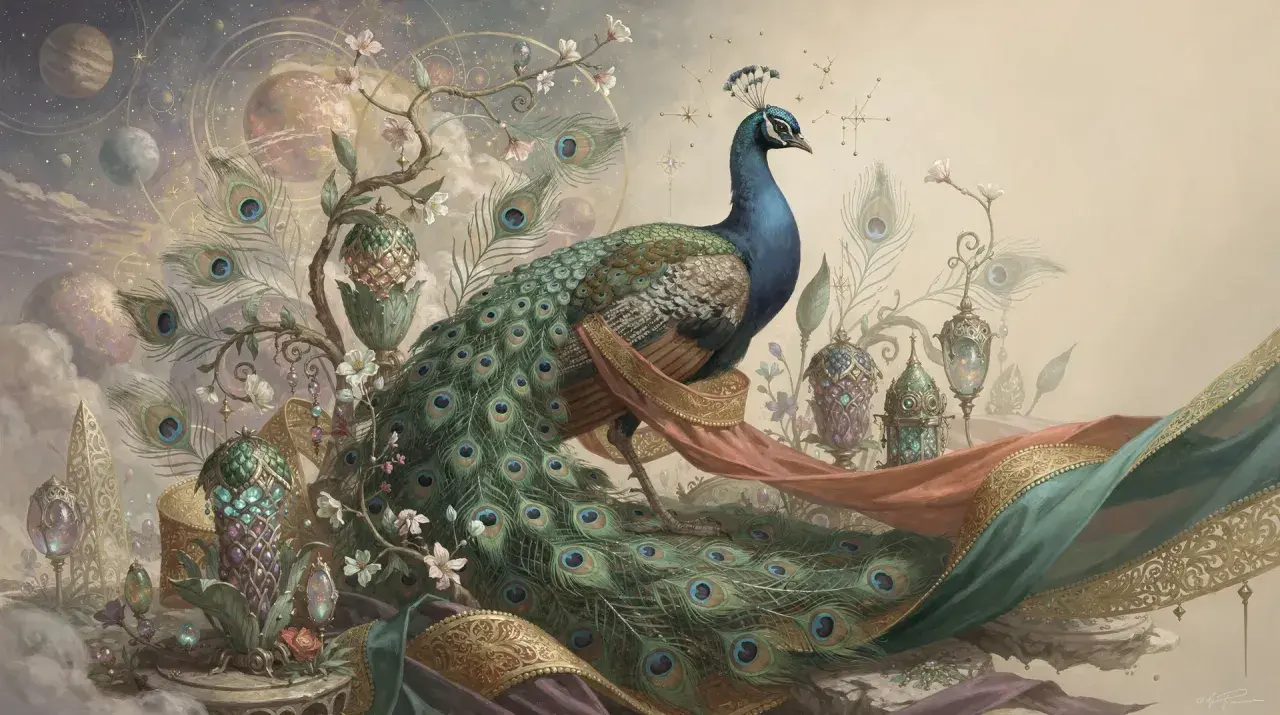
I read the peacock as one of the most flexible symbols in art history. If you are trying to pin down what a peacock symbolizes in art, the short answer is that context controls the meaning. In one setting it suggests beauty, luxury, and confidence; in another it points to resurrection, immortality, protection, or divine watchfulness.
The peacock usually stands for beauty, status, and renewal
- Beauty and display are the most immediate associations because the bird is built to be seen.
- Immortality and resurrection appear often in Christian art, especially in funerary and paradise imagery.
- Protection and wisdom show up in Buddhist and some East Asian traditions, where the bird can ward off harm.
- Rank and prosperity are common in courtly art, textiles, and ceremonial objects.
- Vanity or pride is the darker reading, especially in moral or satirical contexts.
The peacock's core meanings in art and belief
When I interpret a peacock motif, I start with a simple rule: the bird rarely carries one fixed meaning. It is more useful to think of it as a symbol with a stable center and a wide cultural orbit. The stable center is display - the bird is spectacular, expensive-looking, and impossible to ignore - while the orbit includes spiritual, moral, and political meanings that can shift from one work to the next.
| Meaning | What it usually suggests | How it shows up |
|---|---|---|
| Beauty | Grace, color, elegance, visual excess | Decorative borders, textiles, painted screens |
| Status | Wealth, courtly taste, rank, luxury | Robes, porcelain, elite interiors |
| Renewal | Rebirth, immortality, spiritual continuity | Tombs, mosaics, sacred panels |
| Protection | Ward off harm, divine vigilance | Religious images, protective emblems |
| Pride | Self-display, arrogance, vanity | Satire, moral literature, emblem books |
The point is not that every peacock means all of these at once. It means the bird is versatile enough to carry either blessing or warning, which is why its imagery stayed alive for centuries. That range makes more sense once you look at the bird itself.
Why the bird became such a strong visual symbol
I think the peacock's biology does half the symbolic work for us. Its fanlike tail, metallic colors, and unmistakable eye-spots give artists a ready-made language for spectacle, gaze, and abundance.
- The tail fan reads as deliberate display, so it naturally invites ideas of confidence, courtliness, and performance.
- The eye-spots can suggest watchfulness or an all-seeing presence, which is why they appear so often in religious interpretation.
- The annual molt helped older traditions associate the bird with renewal, because it seems to shed and return in a renewed form.
- The rarity and cost of feathers in luxury arts made the bird useful for signaling power, especially in court settings.
- The bird's appetite for snakes and poisonous creatures is a traditional explanation in some cultures for its apotropaic, or harm-warding, reputation.
The Metropolitan Museum of Art notes that peacock-feather threads were used in China from the fifth century, which is a good reminder that symbolism often follows material prestige: when a motif is hard to make, it quickly becomes a marker of value. Once you see how the bird's body turns into visual shorthand, the cultural readings start to make sense.
How different cultures read the peacock
There is no universal peacock meaning. In art history, I find it more accurate to treat the bird as a shared motif that different traditions bend toward their own theology, politics, and taste. The table below shows the most common readings I see again and again.
| Culture or context | Common meaning | Typical visual clues |
|---|---|---|
| Early Christianity | Immortality, resurrection, paradise, divine watchfulness | Peacocks near tombs, fountains, trees, or paired flankers |
| Hindu traditions | Divine vehicle, victory, beauty, purity, protection | Associated with Kartikeya, Krishna, or Saraswati |
| Buddhist and Japanese art | Wisdom, protection from harm, auspicious power | Peacock kings, temple imagery, motifs tied to guarding against evil |
| Islamic and Persian art | Beauty, royalty, paradise, sacred splendor | Stylized feathers, garden scenes, luxurious textiles, paired birds |
| Chinese court art | Rank, fame, good luck, prosperity, imperial taste | Robes, ceramics, court decoration, feather-derived green-blue hues |
| Modern Western use | Confidence, fashion, vanity, performance | Branding, interior design, editorial illustration, costume |
The Christian reading was helped by an older belief that the bird's flesh did not decay, which made it an easy emblem for eternal life. In Hindu and Buddhist settings, the emphasis shifts toward divine power, wisdom, and protection. That is why I would never assign a peacock the same meaning everywhere; the surrounding culture decides which layer is active. Those differences become clearer once the bird is placed inside actual compositions.
Where peacocks appear in art and what the pairings mean
Iconography is the study of recurring symbols and the way artists arrange them, and peacock imagery is a classic example. I always look at what the bird is doing, what is next to it, and whether the artist has placed it in a sacred, courtly, or purely decorative setting.
- Two peacocks facing one another often suggest balance, paradise, or guardianship.
- A peacock beside a vase, fountain, or drinking vessel can point to eternal life in Christian settings or abundance in secular ones.
- A peacock near a tree or floral spray often strengthens paradise imagery and visual symmetry.
- A single feather usually shifts the meaning toward beauty, fashion, or status rather than theology.
- Highly stylized feathers in textiles or ceramics usually signal luxury as much as symbolism, because the bird becomes part of a larger design language.
In early Christian and late antique art, these pairings can be surprisingly precise; in later decorative arts, they can become more ornamental and less doctrinal. I find that difference important because a peacock in a tomb does not mean the same thing as a peacock on a salon wall, and that tension leads directly to the bird's darker readings.
When the peacock signals pride rather than holiness
Not every peacock is benevolent. In Western moral imagery, the bird has long stood for vanity and pride because it seems to admire its own display. That is one of the strongest examples of how a symbol can carry opposite meanings depending on tone: the same feathers that suggest paradise in a tomb can become a warning against self-importance in a moral print.
- Vanity appears when the bird is shown alone, posed theatrically, or emphasized for spectacle.
- Pride is common in emblem books, sermons, and moralizing illustrations.
- Status signaling is the modern secular version, where the peacock becomes shorthand for style, prestige, or expensive taste.
In contemporary branding, fashion, and interior design, the peacock often becomes aspirational rather than religious. That does not erase the older meanings; it just changes which layer of meaning is doing the work. If I see a peacock in a glossy campaign or a high-end decor scheme, I usually read it as confidence first and theology second.
Reading peacock imagery without forcing a single answer
If I were interpreting a peacock motif for a painting, mosaic, textile, or object, I would start with four checks: period, setting, companions, and function. Is the bird in a tomb, a temple, a palace, a fashion spread, or a decorative border? Is it alone, paired, or set beside a tree, vase, or deity? Those clues usually tell you whether the artist wanted immortality, prosperity, protection, or mere visual splendor.
The safest reading is usually the one that respects the object's world first and the bird's general symbolism second. In attribution or conservation work, I would never treat a peacock as proof by itself, but I would absolutely treat it as useful evidence about how a work was meant to be seen. That is the practical value of peacock iconography: it gives you a fast entry point, then forces you to read more carefully.
