
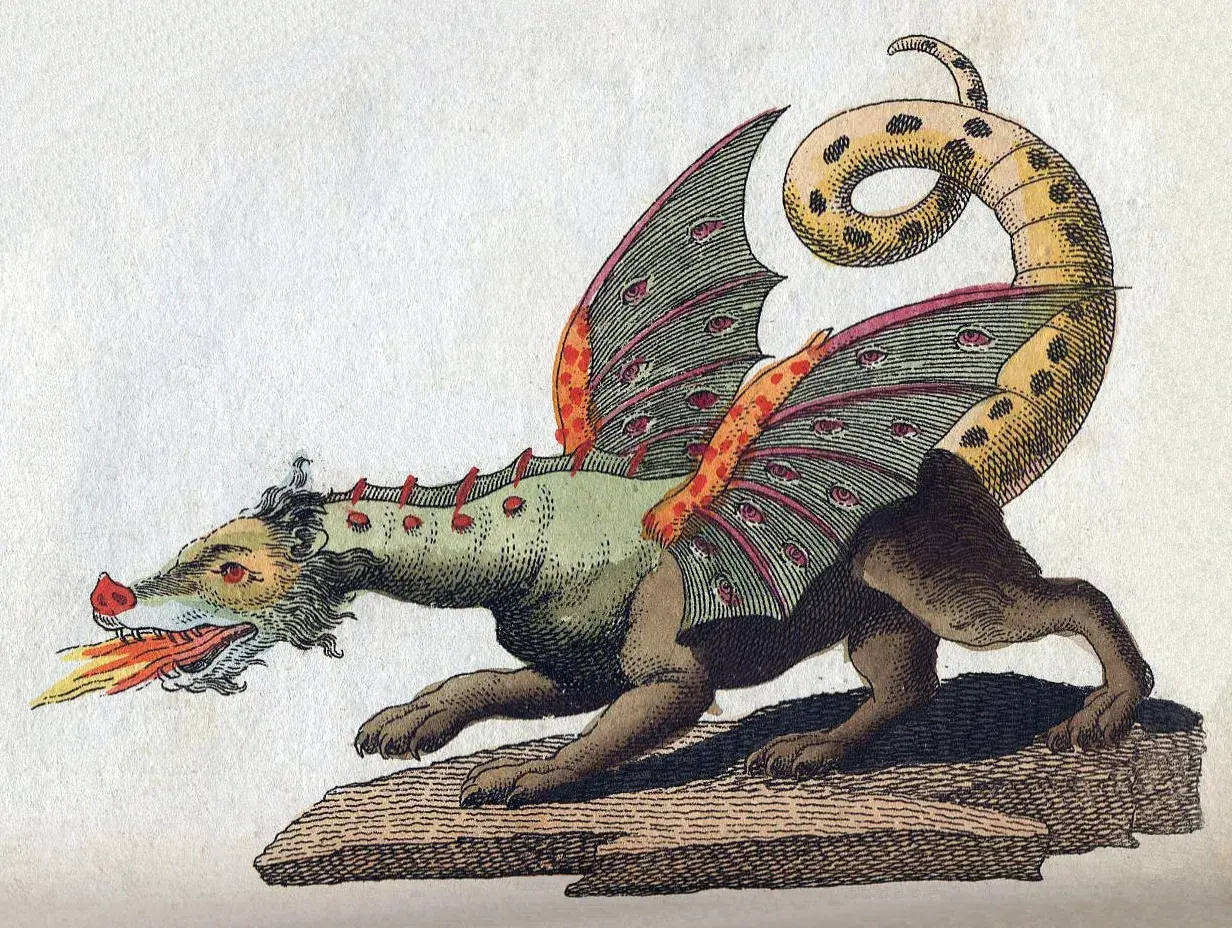
Historical medieval dragon art is best understood as a visual argument rather than a decorative fantasy. In manuscripts, sculpture, metalwork, and church imagery, dragons usually stand for moral conflict, doctrinal warning, or protective power, and their bodies were designed to be read as carefully as any written text. This article explains how medieval artists shaped the dragon’s iconography, why its symbolism changes from one setting to another, and what practical clues help distinguish a bestiary beast from a saintly combat scene or a border creature.
What matters most when reading medieval dragon imagery
- Medieval dragons are usually hybrid serpents, not standardized fantasy monsters.
- Their meaning depends on context: evil in one image, protection or prestige in another.
- Bestiaries made the dragon a moral emblem, while saint legends turned it into a defeated enemy.
- Posture, tail shape, wings, claws, and placement often reveal the intended message.
- Wear, repainting, and lost gilding can flatten those cues, so surface reading matters as much as iconography.
Why dragons became such a durable medieval symbol
I usually start with a simple fact: medieval viewers did not need dragons to be “real” for them to be useful. Dragons worked because they could hold several ideas at once. They could stand for the Devil, temptation, chaos, heresy, or enemies of the faith, but they could also mark thresholds, guard treasure, or frame a saint’s triumph. That flexibility made them perfect for a culture that read images morally as well as visually.
The medieval dragon was also a creature of boundaries. It sat between serpent and beast, land and air, nature and invention. That hybrid quality mattered. Artists liked forms that looked familiar enough to be legible but strange enough to carry spiritual weight. A dragon was never just an animal study. It was an image of disorder given shape, which is exactly why it could be defeated, mastered, or repurposed in art.
That symbolic range becomes clearer once you look at how artists built the creature itself.
How artists gave the dragon its recognizable body

Medieval dragons rarely follow one fixed anatomy. The most common solution was a hybrid body built from serpentine movement, reptilian scales, birdlike claws, and, in many cases, wings. In bestiary tradition, the dragon is often treated as the largest of serpents, which explains why the body can look long, low, and coiled even when the creature is airborne.
I read medieval dragon forms in four visual layers:
- The body is usually elongated and flexible, so it can coil, arch, or wrap around a saint, a staff, or a page.
- The tail is often the real weapon; some images stress squeezing and constriction more than biting.
- The head may be toothless, gaping, horned, or bearded, depending on whether the artist wants menace, antiquity, or symbolic force.
- The wings and claws often signal supernatural mobility, but they are not always present, and their absence does not weaken the dragon’s meaning.
One detail is easy to miss: medieval artists did not always care about consistency in the way modern fantasy art does. Some dragons are feathered in feel, some are almost pure serpents, and some are closer to a sinuous monster than a later “classic” dragon. I think that irregularity is a feature, not a flaw. It lets the image stay conceptually open while still feeling unmistakable.
Once you know the body plan, the next question is where that body appears and what it is doing there.
Where dragon imagery appears and how its meaning shifts
The same dragon can mean very different things depending on whether it appears in a manuscript margin, a church portal, a saint’s legend, or a liturgical object. Context does most of the interpretive work. I would not read every dragon as evil, and I would not assume every dragon is ornamental. The object type decides a lot.
| Context | Typical dragon form | Symbolic job | What to look for |
|---|---|---|---|
| Bestiaries | Long, serpentine, often winged or clawed | Moral warning, Devil figure, spiritual danger | Text-image interplay, dramatic tail placement, page-wide diagonals |
| Saint narratives | Beast underfoot, pierced, or restrained | Victory of good over evil, conversion, martyrdom | Foot on neck, spear, lance, horse, defeated body |
| Manuscript marginalia | Small, playful, sometimes exaggerated or comic | Commentary, wit, visual punctuation, border energy | Placement in the margin, interaction with vines, initials, or letters |
| Ritual metalwork | Dragon turned into a vessel, handle, or mount | Controlled power, prestige, practical use | Fine casting, symmetry, functional openings, surface detail |
| Architecture and portals | Large, emblematic, often highly legible | Guarding, warning, public theology | Placement at thresholds, decorative rhythm, relation to saints or inscriptions |
The point is not that medieval people had contradictory ideas with no logic. The point is that dragons were useful precisely because they could move between roles. That is why the clearest examples are worth reading one by one.
Reading the major scenes through the best examples
When I teach or examine medieval dragon imagery, I keep returning to a small group of scenes. They are common for a reason: they compress theology, drama, and visual clarity into one image. Each one does something slightly different, and that difference matters.
Saint George and the dragon
Saint George is the most familiar dragon-slayer in medieval art, but the image is more than an action scene. In many versions, the saint’s foot on the dragon’s neck or the downward thrust of the lance makes the moral reading obvious: evil has been mastered. In late medieval sculpture and painting, George also becomes a chivalric model, so the dragon scene can speak to knighthood, discipline, and social order as much as to faith.
What I watch for here is composition. The horse, lance, and dragon usually lock into a tight visual triangle, and that geometry matters. It makes the victory feel inevitable, almost ceremonial. The beast is not only slain; it is staged as the losing side of history.
Saint Michael and the dragon
Michael’s battle is more cosmic than George’s. The dragon is usually the devil or the Antichrist in serpentine form, and the saint appears as Heaven’s military agent. In one French example from around 1475, the dragon’s tail curls around Michael’s leg, a detail that sharpens the sense of struggle and reflects the medieval idea that dragons kill by squeezing. That is the kind of detail I value most: it shows the artist translating doctrine into motion.
Michael images also tend to feel more armored and hierarchical. They are not just about a brave individual. They are about divine order entering the world through force.
Saint Margaret and the dragon
Saint Margaret is a more intimate and bodily version of the same symbolic language. In the legend, Satan assumes dragon form and swallows her; she survives by invoking the cross. That is a different emotional register from George or Michael. The image can look almost startlingly compact, with the saint standing on the dragon as if the body itself has become the proof of faith.
This scene matters because it blurs categories. The dragon is not simply an external monster. It is a form of demonic deception, and that makes the image a lesson in discernment as much as triumph.
The bestiary dragon
Bestiaries are where dragon symbolism becomes most explicit. The dragon is not just pictured; it is explained, moralized, and placed inside a hierarchy of creatures. In one English bestiary page from about 1240 to 1250, the dragon stretches diagonally across the page, and the text describing its tail is interrupted by the tail itself. That kind of interaction is not accidental. It tells the reader that the image is part of the argument.
I find bestiary dragons especially useful because they show how medieval art trained readers to move between language and image. The creature is often less about zoology than about spiritual pedagogy. If the beast looks overwhelming, that is the point: the page is teaching you how temptation, danger, and deception feel before it tells you what they mean.
Read Also: Mythological Female Warrior Names - Read Their Visual Code
Dragon objects outside the manuscript page
Not every dragon is there to be slain. A dragon-shaped aquamanile, for example, turns the creature into a practical vessel used for washing hands in both liturgical and secular settings. That reversal is important. It shows the dragon being harnessed into service, not destroyed. The object gains force from the tension between its beastly form and its useful function.
For me, that is one of the richest medieval moves: a frightening creature becomes a tool, and a tool becomes a sign of skill, ritual order, and luxury. The dragon is still there, but it has been disciplined by craftsmanship.
Once those narrative types are clear, the most common reading errors become easier to avoid.
Common mistakes when interpreting medieval dragon art
The biggest mistake is assuming every medieval dragon should look like a later fantasy dragon. That expectation flattens the historical record. Medieval dragons can be winged or wingless, coiled or stretched out, terrifying or oddly restrained, and their shape is often closer to a serpent than to a modern blockbuster monster.
- Do not assume fire is the main feature. In many medieval sources, constriction, poison, deceit, or moral corruption matters more than flames.
- Do not ignore the setting. A dragon under a saint’s foot means something very different from a dragon in a manuscript margin.
- Do not treat marginal creatures as meaningless decoration. Margins often comment, joke, or extend the main text in clever ways.
- Do not separate symbolism from structure. The pose, tail, and placement are part of the meaning.
- Do not forget later alterations. Repainting, abrasion, and restoration can hide the original visual hierarchy.
I would rather start with function than with preloaded fantasy expectations. That keeps the reading grounded and usually produces a better historical interpretation.
What the surviving surface still tells us about the work
For conservation and attribution, dragon motifs are more useful than many viewers realize. Scales, claws, wings, gilded edges, and painted contours often survive unevenly, and that uneven survival can tell you how the image was originally meant to work. A dragon that now looks muddy or soft may once have been sharply legible in color and gold. In other words, the object you see today is often only part of the iconographic story.
When I look at a surviving dragon image, I ask three practical questions: what was the original visual effect, what details still guide the eye, and what later damage has changed the reading? That approach is especially helpful in manuscript illumination and polychromed sculpture, where small losses can change the balance between menace, humor, and triumph. The safest reading is usually the one that respects both the symbolism and the material evidence.
So the most reliable way to understand medieval dragon imagery is to read it in order: context first, body second, action third, surface last. Once you do that, the dragon stops being a vague medieval monster and becomes what it really was in medieval art, a tightly controlled symbol that could warn, guard, accuse, or celebrate depending on where the artist placed it.
