
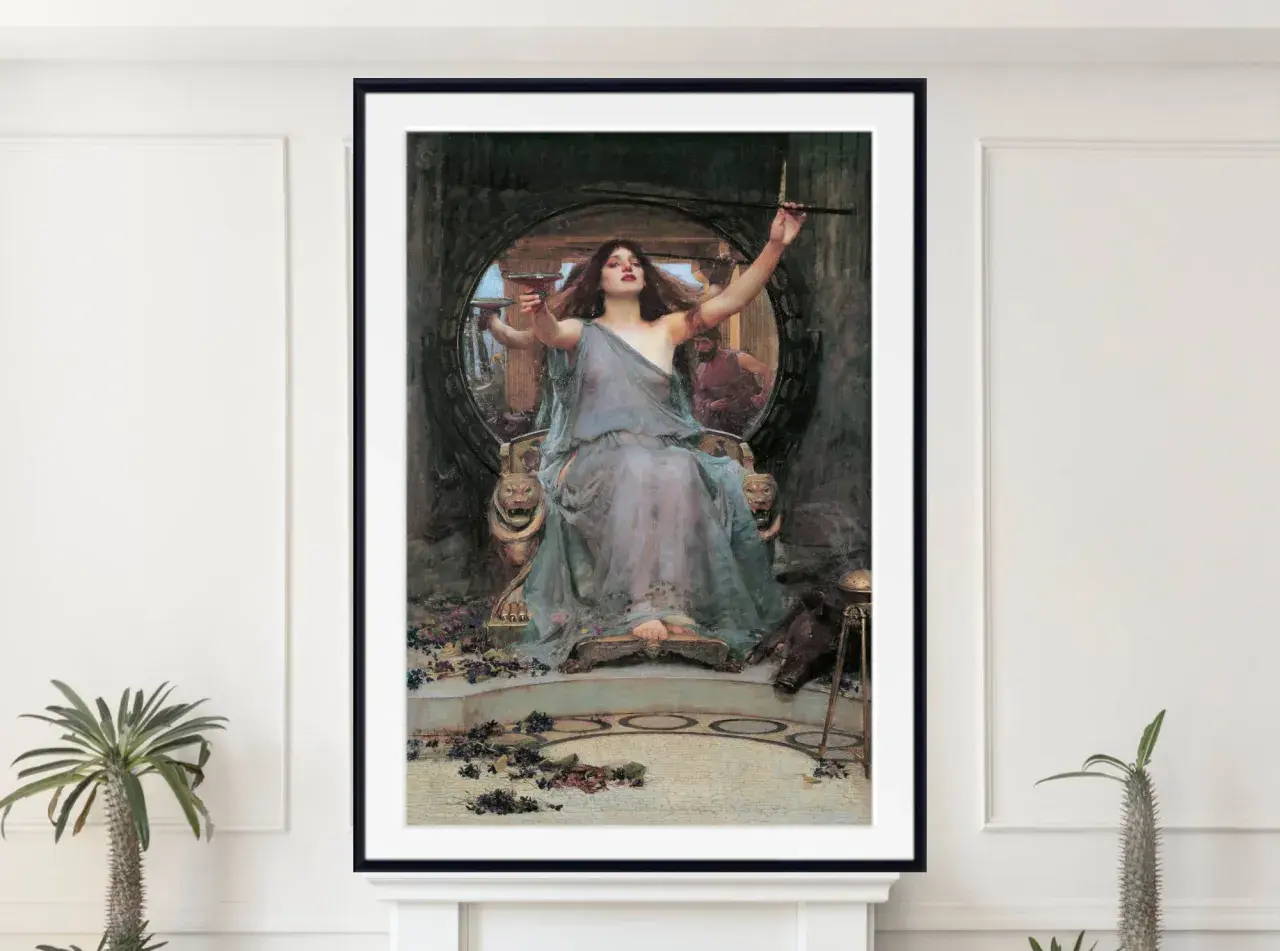
John William Waterhouse’s Circe Offering the Cup to Ulysses is a compact lesson in how myth becomes image. The painting turns a single gesture, a woman extending a cup, into a scene about seduction, danger, and control, while also giving art historians a rich set of clues to read: the wand, the mirror, the pigs, the throne, and the uneasy balance between beauty and threat. What follows is a close reading of the myth, the iconography, and the symbolism, with enough practical detail to help you interpret the work accurately in a gallery, catalog, or reproduction.
Key points to keep in view
- The scene comes from Book 10 of Homer’s Odyssey, where Circe offers Odysseus an enchanted drink.
- The cup is the painting’s central symbol: it stands for hospitality turned into a weapon.
- Waterhouse uses a mirror, a wand, and transformed pigs to make the threat legible at a glance.
- The composition frames Circe as powerful, not passive, and Odysseus as distant and uneasy.
- Art UK identifies the work as an 1891 oil on canvas now held by Gallery Oldham.
- The image is best read as both a mythological episode and a Victorian meditation on female power.
What the scene shows in Homer and in Waterhouse
The myth behind the painting is straightforward, but the image is not. In the Odyssey, Circe lives on the island of Aeaea and welcomes Odysseus’s crew with food and drink before transforming them into animals; Odysseus survives the enchantment and later forces her to release his men. The title uses Ulysses, the Roman name for Odysseus, which is common in English-language art history and helps place the work within the classical tradition rather than a strictly Homeric one.
Waterhouse narrows that long story to one suspenseful instant: the offering itself. Art UK identifies the painting as an 1891 oil on canvas, and that dating matters because it places the work firmly in the late Pre-Raphaelite orbit, where myth is often staged with tactile detail and emotional tension. I read that choice as the artist’s first major decision: he is not illustrating the transformation, but the moment before choice and consequence separate.
That shift is crucial, because it means the painting is about intention as much as action. The cup is already in Circe’s hand, but the spell has not yet fully landed. That delay is what gives the image its force, and it leads directly to the symbolism embedded in each object she holds or surrounds herself with.
Why Waterhouse freezes the moment before the spell takes hold
Waterhouse understands that myth becomes more powerful when the viewer is made to anticipate what happens next. Instead of showing the men already transformed or the struggle already resolved, he gives us a threshold scene. Circe is in command, Odysseus is held back, and the danger is still suspended in the air.
The British Museum describes Circe in this context as both alluring and threatening, and that balance is exactly what Waterhouse exploits. Her posture is composed, her gaze is direct, and the visual hierarchy is clear: she dominates the foreground while Odysseus is pushed into a reflection behind her. That compositional choice reduces him physically, but it also makes the scene feel psychologically sharper. He is not absent; he is trapped in a visual position where he can see the danger without fully controlling it.
I think that is why the painting feels more modern than a simple myth illustration. It is not only about magic. It is about the tension between attraction and alarm, where the viewer is invited to feel both at once. From there, the small objects in the scene start doing a lot of interpretive work.
The visual clues that carry the symbolism
Once you slow down, the painting reads like a dense system of signs. Waterhouse does not rely on one emblem; he builds meaning through a cluster of repeated cues. The cup, the wand, the mirror, and the pigs each carry a separate symbolic charge, and together they turn the image into a compact moral drama.
| Visual element | What it shows | What it suggests |
|---|---|---|
| The cup | A vessel offered with ritual calm | Corrupted hospitality, poison, temptation, and control |
| The wand | Circe’s active hand of magic | Authority, spellcraft, and deliberate agency |
| The mirror | Odysseus seen indirectly behind Circe | Distance, unease, surveillance, and divided perspective |
| The pigs | Transformed crewmen near her feet | Dehumanization, punishment, and the cost of surrender |
| The throne and lions | Circe seated in formal authority | Sovereignty and dominance, not mere seduction |
| The flowers and palette | Rich purples and ornamental detail | Sensuality, luxury, and an atmosphere that feels intoxicating before the spell is cast |
The table above is useful because it prevents a common mistake: treating the work as a generic “witch with a cup” image. It is much more specific than that. Every object supports the same message, but each object does it differently. The cup threatens through hospitality, the wand through action, the mirror through distance, and the pigs through consequence. That layered structure is what makes the painting durable as both narrative art and symbolic art.
Circe as an enchantress, not a cardboard villain
One reason the painting has lasted is that it refuses to flatten Circe into a simple monster. In Homer, she is dangerous, but she is also intelligent, independent, and capable of reversal. She knows herbs and potions; she understands how to manipulate bodies and desires. Waterhouse keeps that ambiguity intact. He makes her beautiful, certainly, but he also makes her self-possessed.
That matters in Victorian visual culture, where women were often split into two opposing types: pure and passive on one side, seductive and dangerous on the other. Circe belongs to the second category, yet Waterhouse gives her more than the usual warning-label treatment. She becomes a figure of power who is not ashamed of that power. I read that as the painting’s deepest tension: it invites the viewer to admire the very force that the myth says should be feared.
The result is a classic femme fatale image, but a smart one. It does not rely on shock. It works because the viewer recognizes the rules being broken. Hospitality should protect, not trap. Beauty should invite, not threaten. Circe overturns both expectations at once, and that is what gives the scene its moral voltage.
How I would read the painting in a catalog or reproduction
For anyone studying the work as an object rather than only as an image, the iconography also functions as an identification tool. The most stable markers are the cup in Circe’s right hand, the wand in the other, the pig at her feet, and the mirror that carries Odysseus’s anxious presence into the background. If a reproduction loses two or three of those elements, it may still be “Circe,” but it is no longer clearly this composition.
That is where preservation and authentication begin to matter. The painting’s impact depends on subtle contrasts: skin against dark drapery, gold against shadow, and the reflected figure behind the throne. In a heavily varnished or poorly cleaned version, those relationships can flatten quickly. The image may still be recognizable, but the psychological staging becomes weaker, and the symbolism reads as decorative instead of intentional.
When I compare versions, I look first for the structure of the scene rather than the glamour of the surface. Does Circe sit enthroned? Is Odysseus only partially visible? Are the pigs present as signs of previous transformation? Those details tell you whether you are looking at Waterhouse’s specific mythic construction or at a looser derivative of the theme. In art historical terms, that distinction is not minor; it changes the meaning of the work.
What the scene leaves the viewer with
Circe Offering the Cup to Ulysses endures because it compresses a whole moral universe into one poised exchange. The cup is not just a cup, and Circe is not just a sorceress. She is the point where desire, danger, and authority meet, and Waterhouse makes that meeting visible without overexplaining it.
If you remember only one interpretive thread, keep this one: the painting presents power as hospitality with a hidden cost. That is why the image still rewards close looking, and why its symbols remain legible even when the story behind them is already familiar.
