
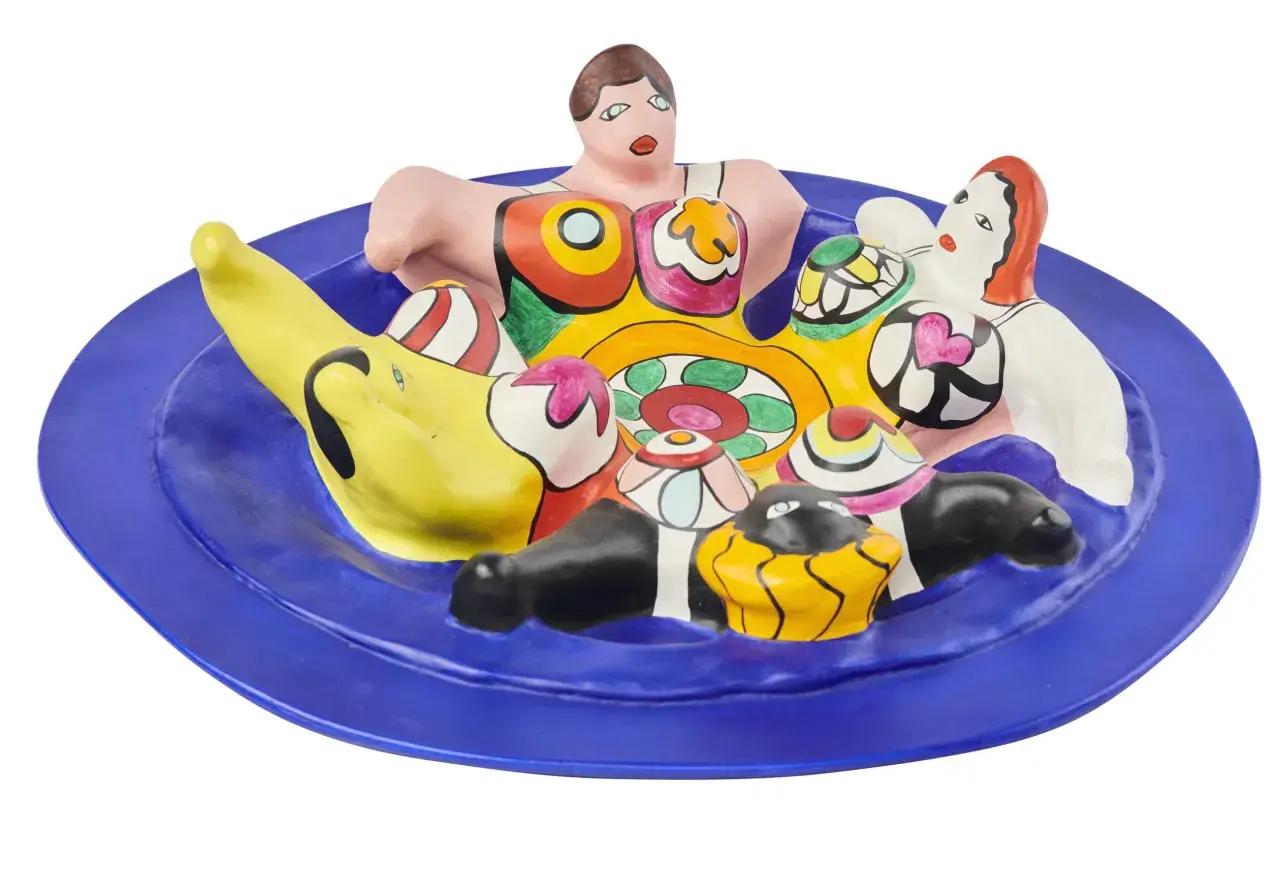
The Nanas combine exuberance, politics, and public presence into one unmistakable sculptural language
- Core idea: the female body is enlarged and celebrated instead of reduced or idealized for the viewer.
- Visual code: bright color, exaggerated curves, tiny heads, and active poses all carry meaning.
- Political layer: the series includes responses to feminism, racism, and civil rights, not just generic femininity.
- Material layer: early mixed-media construction and later polyester change both durability and interpretation.
- Preservation note: fading, repainting, or structural repairs can weaken the intended effect and should be read carefully.
What the Nanas are really saying
I read the Nanas as a reversal of the traditional art-historical female body. Instead of a figure posed to be looked at, Saint Phalle gives us a body that occupies space with confidence: hips, belly, breasts, and legs become architecture, not ornament. The Metropolitan Museum of Art describes the series as radiating mother-goddess symbolism, and that is a useful way into the work because it captures both the archetypal and the playful.
That balance matters. The figures are approachable, but they are not empty decoration. They turn femininity into scale, movement, and presence, which is why they still read so strongly in public space. I think that is the first thing readers often want to understand: these sculptures are not “about women” in a narrow sense; they are about who gets to appear large, visible, and unapologetic in culture.
The word itself is casual and a little cheeky, and that matters too. It keeps the sculptures from sounding solemn before you even see them, which is part of Saint Phalle’s strategy. She lets joy do some of the argumentative work.
How body, color, and pose build the symbolism

Saint Phalle rarely relies on a single symbol. She stacks meaning through silhouette, color, and motion. The small head is part of that language: it pushes attention away from individual psychology and toward the body as a shared sign. I often read that compression as a refusal of the old hierarchy that puts mind over flesh.
| Visual element | Symbolic reading | Why it matters |
|---|---|---|
| Oversized hips, breasts, and belly | Fertility, abundance, bodily authority | Turns the female body into a public monument rather than a private object |
| Tiny head | Less emphasis on intellect, more on presence and instinct | Reverses the usual power balance in portraiture and sculpture |
| Bright colors and patterns | Joy, spectacle, and visibility | Makes the work feel welcoming while keeping it visually forceful |
| Dance-like poses | Agency, motion, self-possession | The figure acts instead of waiting to be interpreted |
| Black surfaces | Gravity, tribute, and political specificity | Expands the series beyond a single reading of femininity |
The most common mistake is to call the surfaces “cute” and stop there. Color in the Nanas is not just decorative paint; it is part of the sculpture’s rhetoric. It lowers intimidation, but it also intensifies the message. The body is enlarged, the palette is saturated, and the whole object insists on being seen.
That is why I would never separate formal analysis from symbolism when looking at these works. In Saint Phalle’s hands, form is the message.
Motherhood, feminism, and political solidarity
Motherhood is one of the obvious readings, but Saint Phalle keeps widening the frame. The figures borrow from fertility imagery, yet they do not trap women inside maternity. They suggest generative force, not domestic duty. That distinction is important, especially if you are trying to read the series without flattening it into a sentimental celebration of “womanhood.”
Several Nanas are also explicitly political. Guggenheim Bilbao links the black figures to Saint Phalle’s solidarity with Black women and to the civil rights movement, which makes the series much sharper than a simple celebration of the female body. In other words, these sculptures can carry race, social conflict, and public memory at the same time as they carry joy.
What changes when you notice that? The figures stop functioning as universal symbols in the abstract. They become grounded, situated responses to the world Saint Phalle lived in. I find that this is where her work becomes most interesting: she never lets the viewer settle for a single meaning if the social reality around the work is more complicated.
Some of the strongest works in the series make that complexity visible by combining playfulness with a direct political edge. A Nana can feel festive and confrontational in the same glance. That tension is not a flaw in the work; it is the point.
Why materials and scale matter as much as iconography
For preservation and authentication, materials are not a footnote here; they are part of the meaning. Early Nanas were made from paper mâché, wool, and found objects, then later figures moved toward polyester so they could become larger, more durable, and more at home outdoors. That shift changes how the work behaves physically and how it reads visually.
| Phase | Typical materials | Effect on meaning | Conservation concern |
|---|---|---|---|
| Early figures | Paper mâché, wool, found objects | More intimate, improvised, handmade, and visibly assembled | Fragile seams, abrasion, and sensitivity to humidity |
| Later outdoor works | Polyester and painted surfaces | Plumper, more monumental, and ready for public space | UV fade, surface cracking, delamination, and patchy restorations |
From a conservation perspective, this matters because a damaged surface can alter the work’s emotional tone. If the color dulls, the sculpture can feel heavier or more somber than intended. If repairs are clumsy, the figure can lose some of the lightness and swagger that give it meaning in the first place.
When I assess a Nana mentally, I do not separate iconography from condition. I ask what the object originally signaled, what it now signals, and whether wear has changed that message. That is especially important with outdoor sculptures, where the intended vitality depends on good surface health as much as on the shape itself.
How to read a Nana without flattening it
When people misread these sculptures, they usually make one of three mistakes. They reduce the Nanas to decoration, they treat them as a generic celebration of womanhood, or they see them only through the lens of kitsch. Each reading misses something important.
- Decoration only misses the political and feminist charge of the body becoming monumental.
- Generic femininity misses the fact that some works speak to specific histories of race, activism, and exclusion.
- Kitsch only misses the seriousness of the formal decisions, especially the way color and scale shape interpretation.
What I look for instead is whether the figure is performing joy, protest, or both. The pose, the surface pattern, and the context of display usually tell you more than the first impression does. A Nana in a museum gallery can read differently from one installed outdoors, and that shift is not superficial; it changes the social meaning of the work.
If you want a reliable reading, start with three questions: what is the figure doing, how is the body exaggerated, and what has the artist chosen to make impossible to ignore? Once you answer those, the sculpture becomes much harder to dismiss as merely playful.
What the series still teaches us in museums and collections
For a museum visitor, the simplest way to read a Nana is to start with the silhouette, then move to the color, and only then ask about history. For a curator or collector, the order is almost reversed: identify period, material, provenance, and any later intervention before making strong claims about meaning. That discipline matters because Saint Phalle’s surfaces are expressive, but they are also vulnerable to alteration.
For me, that is what keeps the series current in 2026. The Nanas still speak to bodies in public space, to who gets enlarged into a symbol, and to how joy can carry critique without becoming vague. If you want the reading to stay honest, keep the sculpture’s physical state in view; the symbolism is strongest when it is tied to the object as it exists, not only to the idea of it.
That is also why these works remain useful for anyone studying preservation and authentication. The image is not separate from the object’s materials, repairs, or exhibition history. In the Nanas, the body is the message, but the object’s condition is part of the sentence.
