
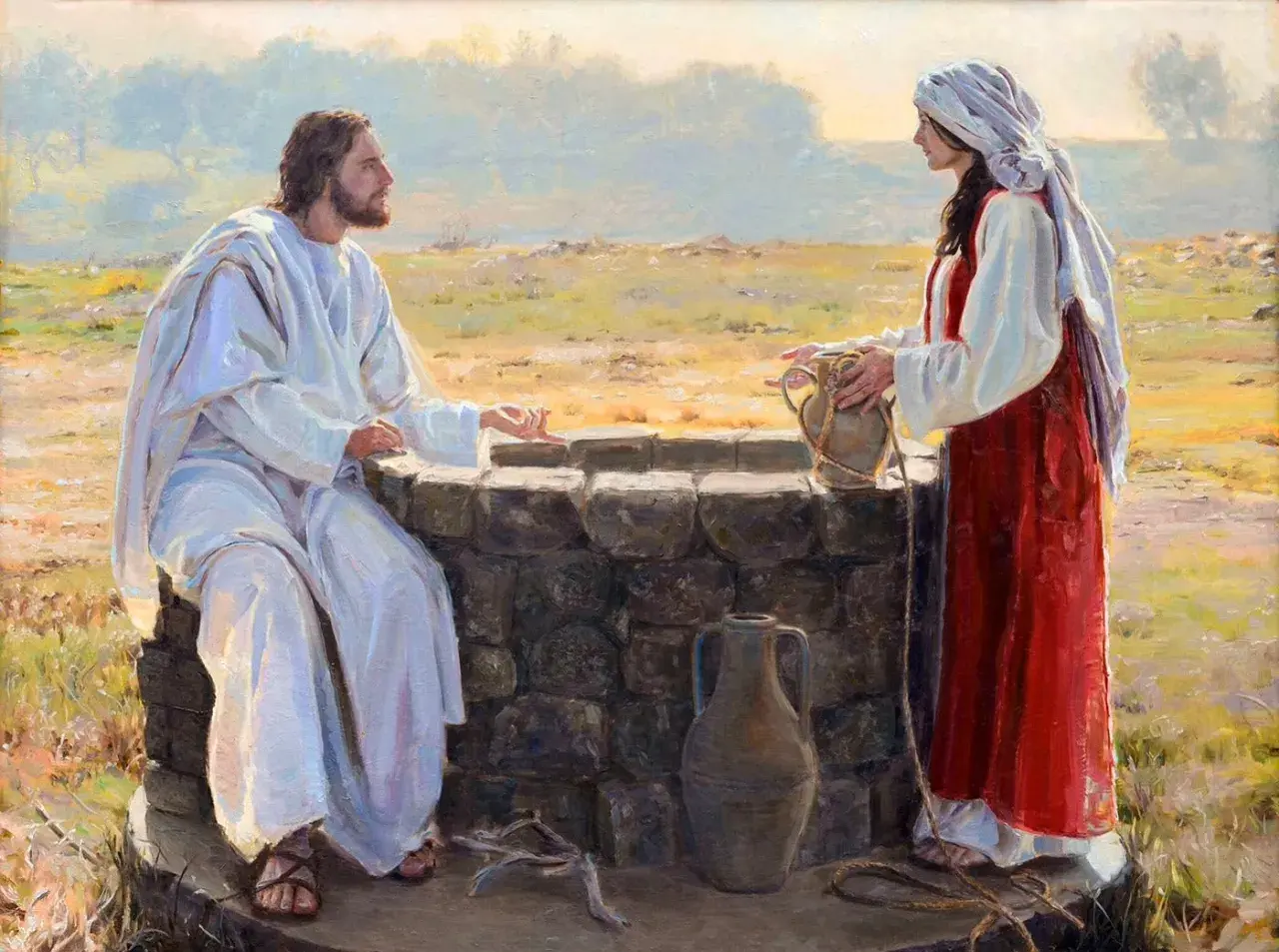
This guide unpacks woman at the well art through the symbols, gestures, and compositional choices that artists have used to turn John 4 into a dense visual story. At first glance the scene is simple: Jesus meets the Samaritan woman at Jacob’s well, asks for water, and opens a conversation about living water. In practice, the most revealing images are built from small decisions, such as where the vessel sits, how the hands move, and whether the artist stresses intimacy, doctrine, or social boundary-crossing.
Key takeaways from the Samaritan woman scene
- The scene centers on revelation, not just conversation.
- The well usually signals both literal water and baptismal meaning.
- A pitcher or jug often marks the woman’s labor and the change that follows her encounter.
- City walls, gestures, and figure placement help artists show exclusion, witness, and mission.
- Medium matters: mosaic, relief, icon, stained glass, and oil painting each emphasize different theological points.
- Condition and restoration can change the reading of a work, so damaged details need careful interpretation.
What the scene means before you read the symbols
The biblical episode itself gives artists a strong narrative core: a private meeting, a difficult social boundary, and a conversation that moves from ordinary thirst to spiritual recognition. That is why the subject has stayed so durable in Christian art. It is not only a scene of conversation; it is a scene of disclosure, in which a seemingly ordinary act of drawing water becomes a statement about grace, belonging, and transformation.
I usually read the best depictions by asking a simple question first: what part of the story does the artist want me to feel? Some works make the exchange look formal and theological. Others make it emotionally immediate, as if the viewer is standing at the edge of the well and overhearing the moment the woman realizes who Jesus is. That choice shapes everything that follows, including how the symbols are handled.
Once that narrative intention is clear, the iconography starts to make sense. The next step is to look at the recurring visual signs artists keep returning to.

The symbols artists rely on most
I usually start with the vessel, because the jug or pitcher is the quickest clue to how literal or theological the image wants to be. In many works, the object is just the woman’s practical tool. In others, it becomes the hinge of the whole composition: a sign of daily labor, of the burden she carries, or of the life she is about to leave behind.
| Symbol | Common reading | Why it matters in the image |
|---|---|---|
| Well | Literal source of water and, symbolically, a source of living water | Sets up the contrast between ordinary thirst and spiritual renewal |
| Water jar or pitcher | Daily labor, receptivity, and sometimes a burden transformed | Marks the woman as a real person, not an abstract figure |
| Rope or drawing line | Access to depth, penitence, or the effort of reaching hidden water | Connects the physical act of drawing water with inner change |
| City wall or gate | Sychar, communal life, and social boundary | Frames the encounter as one that will move outward to other people |
| Raised or pointing hand | Teaching, revelation, or direction toward a higher truth | Often guides the viewer from the narrative moment to the theology |
| Bright robe or strong color contrast | Honor, transformation, or the woman’s significance as a messenger | Visually elevates her from background figure to theological witness |
Those signs are rarely isolated. A well without a vessel is a different story from a well with a rope, and a woman who turns away with the jar can mean something very different from a woman who leaves it behind. Small differences matter because the iconography is doing more than decorating the scene; it is assigning emphasis. That is why the same biblical episode can feel contemplative in one work and urgent in another.
The next question is how artists alter those symbols when they move from mosaic to paint to sculpture.
How different media reshape the same story
The medium changes the message more than many viewers realize. A sixth-century mosaic, for example, favors clarity and public legibility. A Baroque oil painting can lean into emotion and atmosphere. A carved relief depends on contour, depth, and the way light strikes the surface. An icon tends to preserve theological distinctions with unusual precision. In every case, the same story survives, but the emphasis shifts.
| Medium | What it emphasizes | Typical visual effect |
|---|---|---|
| Mosaic | Liturgy, clarity, and distance reading | Flattened space, bright color, simplified figures, strong frontal placement |
| Relief or terracotta | Tactile devotion and sculptural presence | Weight, shadow, and physical immediacy |
| Oil painting | Psychology and atmosphere | Subtle gestures, landscape setting, dramatic light, more narrative detail |
| Icon | Doctrinal clarity | Compressed composition, explicit theological symbols, deliberate stylization |
| Stained glass | Teaching through light | Bold outlines, simplified silhouettes, luminous color that reads from afar |
This is why a Ravenna mosaic and a seventeenth-century painting can both depict the same Gospel passage without feeling redundant. The mosaic can compress the episode into three figures and a central well so the viewer reads it instantly from below. The painting can slow the encounter down and let the expression on the woman’s face carry the drama. Neither is more “correct” than the other. They are simply solving different visual problems.
That difference in medium also affects how we read gesture, which is where the scene becomes unexpectedly precise.
What composition and gesture tell you
If I had to name the single most important thing to inspect in a Samaritan-woman image, it would be the direction of movement. Who is seated, who is approaching, who is turning, and who is pointing? Those answers tell you whether the artist wants the scene to feel like an interruption, a revelation, or a commission. The woman’s posture often shifts from guarded to receptive. Christ’s hand may indicate teaching, blessing, or the invisible source of living water. The disciples, when they appear, usually widen the meaning of the scene by turning a private conversation into a public moment.
- Follow the gaze. If Christ looks toward the viewer, the work often extends the invitation beyond the biblical moment.
- Read the hands. Open palms, lifted fingers, and turned wrists are rarely decorative in sacred art.
- Watch the direction of exit. When the woman moves away with the jar, the image often anticipates her witness to others.
- Check the background figures. Disciples arriving from the city can signal recognition, surprise, or the widening of the story.
- Notice scale and placement. A small rope or pitcher placed at the center of the composition can carry more meaning than a larger figure at the edge.
One reason this subject rewards close looking is that it often compresses several verses into one image. A painter may blend the initial request for water, the discussion of living water, and the woman’s future role as a witness into a single visual field. That compression is not a flaw. It is how sacred narrative art works: it turns sequence into structure. Once you start seeing that, the surface details become easier to read, and the next issue is less about meaning and more about survival.
Why condition and restoration change the reading
For preservation and authentication work, this subject is especially sensitive because some of its most meaningful details are also the most fragile. A missing hand can erase a gesture of teaching. A repainted jar can flatten the contrast between ordinary labor and spiritual change. A softened or replaced face can affect whether the woman reads as startled, skeptical, or already transformed. In other words, the iconography is often carried by the parts that suffer first.
That is why condition reports matter so much. In one terracotta relief, for instance, the woman’s bust was later replaced before the work entered the museum collection. That kind of intervention is not a footnote; it changes how much confidence I put in the surviving facial expression and the originality of the surface. When a work has been cleaned, patched, overpainted, or partially reconstructed, the symbolic reading has to remain provisional.
- Check whether the vessel, rope, or hand is original, restored, or reconstructed.
- Look for repainting around the face, the water, and the well-head, since those areas often receive attention in later campaigns.
- Read missing details carefully: absence can mean loss, not symbolism.
- Compare the surface texture across figures and background elements to spot later insertions.
That caution is not a pessimistic note. It is how the image stays honest. The scene can still speak powerfully even when it is damaged, but only if we separate what the artist likely intended from what later hands may have repaired.
How to read the scene when the surface no longer tells the whole story
When I evaluate a worn or restored Samaritan-woman image, I look for three things first: whether the symbol system is still coherent, whether the narrative remains legible, and whether the object’s condition is transparent enough to support interpretation. A strong example does not need a crowded composition. Sometimes the most convincing works use just a well, a pitcher, and two figures, then let gesture carry the theology.
- If the well is central but the vessel is gone, the image may still be readable, but the emphasis shifts toward Christ rather than the woman.
- If the woman is brightly colored or unusually prominent, the work may be stressing witness and mission rather than only the exchange itself.
- If the setting includes a wall, city gate, or approaching disciples, the artist is probably widening the scene from private revelation to public consequence.
- If the surface is heavily restored, the safest reading is the one that follows the clearest surviving forms, not the most dramatic missing ones.
That is the balance I trust most in this subject: believable human encounter on one side, disciplined symbolism on the other. When those two qualities stay in view together, the image remains readable even after centuries of wear, and that is what makes this biblical scene such a durable subject in art history.
