
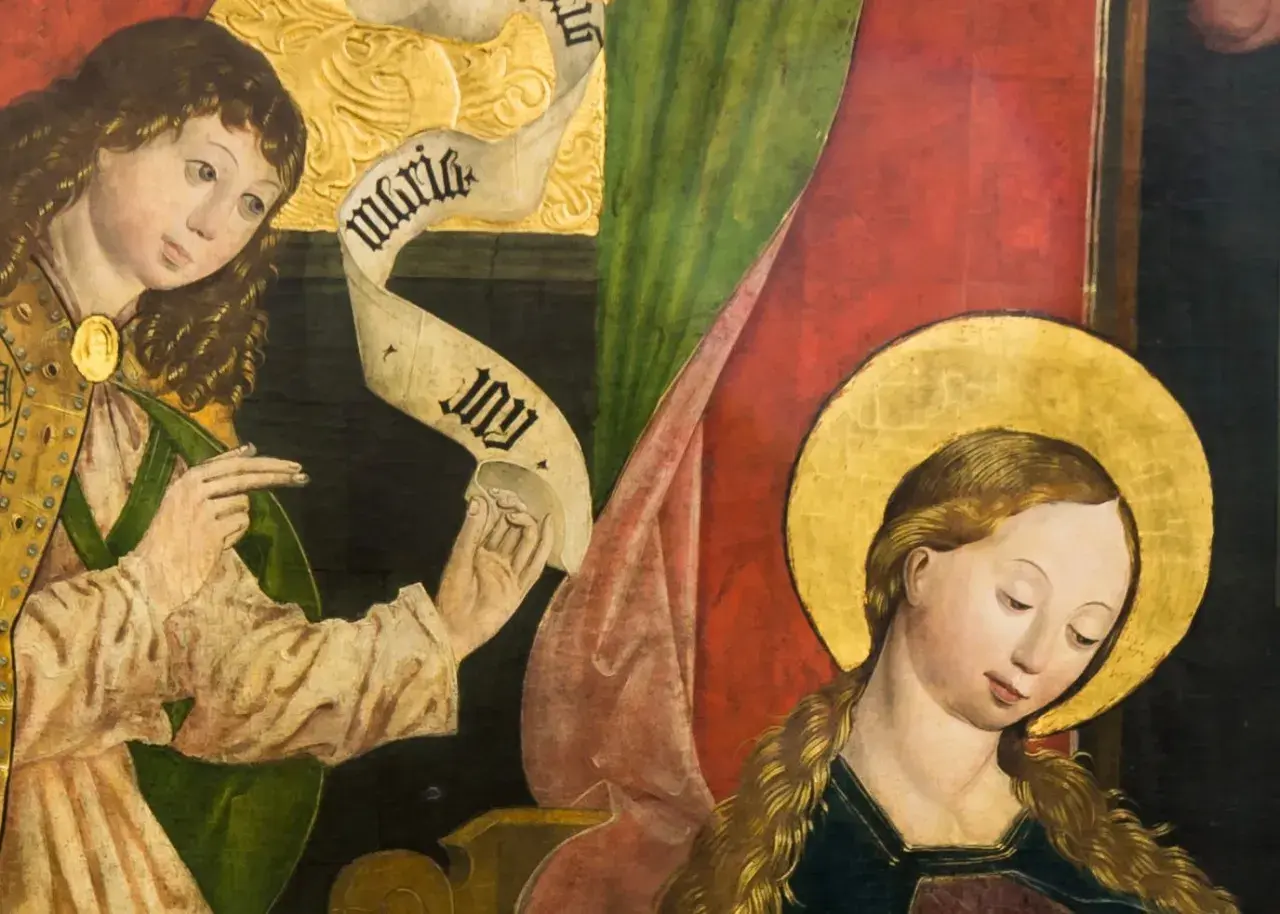
Marian painting sits at a rare point where devotion, politics, and visual invention overlap. The famous paintings of the Virgin Mary are not only religious images; they are also a record of how artists taught viewers to read purity, grief, authority, and tenderness through color, gesture, and setting. Here I focus on the best-known works, the symbols that make them legible, and the practical details that matter when you are looking at originals, reproductions, or restored panels.
The core pattern is simple: each work uses Mary’s pose, colors, and setting to turn theology into a visible story.
- Most major Marian images fall into a few recurring scenes: Madonna and Child, Annunciation, Pietà, Assumption, and Coronation.
- Blue, red, lilies, pomegranates, books, and enclosed gardens are the symbols I read first.
- Giotto, Jan van Eyck, Leonardo, Botticelli, Raphael, and Titian shaped the visual language most viewers still recognize.
- Condition matters: varnish, abrasion, and retouching can change how Mary’s robe, face, and halo appear.
- The fastest way to understand a Marian image is to identify the scene, then read the body language, objects, and setting together.
Why Marian images became so central to Christian art
When I look at Marian art, I start with function. These works were made to do more than decorate a wall: they were meant to support prayer, teach doctrine, honor patrons, and make a theological idea feel immediate. Mary could stand for motherhood, humility, intercession, sorrow, and queenship all at once, which gave painters an unusually rich subject with almost no visual limits.
That is why the subject keeps returning in different forms. A Madonna and Child image concentrates intimacy and protection. An Annunciation scene emphasizes the moment of acceptance and divine interruption. A Pietà or mourning Virgin image shifts the focus to grief and sacrifice. An Assumption or Coronation painting pushes Mary into a celestial, royal register. In other words, the same figure can hold several different stories depending on the scene the artist chooses.
For a reader trying to recognize a famous painting quickly, that matters more than memorizing dates. Once you know the scene, the famous works begin to sort themselves into a clear family of types, and the individual masterpieces become easier to compare.

The famous works people usually mean first
Lists of Marian masterpieces often blur together, so I prefer to separate them by what they contributed visually. Some made Mary feel monumental. Some made her feel human. Others fixed details that later artists repeated so often they became shorthand.
| Artist | Work | Why it matters | What to notice |
|---|---|---|---|
| Giotto | Ognissanti Madonna (c. 1310) | Gives Mary weight, volume, and authority; it is a key step away from rigid medieval flatness. | The monumental throne, the sense of mass, and the way the Virgin dominates the space without losing dignity. |
| Jan van Eyck | Madonna of Chancellor Rolin (c. 1435) | Blends donor portraiture, devotional image, and microscopic landscape detail in one scene. | The enclosed garden, jewel-like surfaces, and the tiny angels that make the image feel both intimate and cosmic. |
| Fra Angelico | Madonna of Humility (15th century) | Makes humility literal by placing Mary low and close to the viewer. | The softened hierarchy, the devotional stillness, and the way the body language turns modesty into form. |
| Leonardo da Vinci | Virgin of the Rocks (c. 1483-1486; later version also survives) | Replaces the throne with a mysterious landscape and uses gesture to organize theology. | The protective hand, the rocky setting, and the triangular grouping that keeps the figures in balance. |
| Sandro Botticelli | Madonna of the Pomegranate (c. 1487) | Uses the fruit to connect Mary and the Christ Child to Passion and Resurrection. | The delicate line, the inward mood, and the pomegranate that quietly does the symbolic heavy lifting. |
| Raphael | Sistine Madonna (c. 1512-1513) | Becomes one of the most reproduced Marian images in Western art, especially because of its two cherubs. | The curtain, the direct gaze, and the floating sense that Mary is being presented rather than merely depicted. |
| Titian | Assumption of the Virgin (1516-1518) | Turns Marian art into a grand upward movement of color, bodies, and light. | The vertical thrust, the dramatic scale, and the feeling that the entire composition is lifting with her. |
I leave out many worthy candidates here, but the point is not to build an exhaustive canon. It is to show how a handful of masterpieces fixed the visual grammar that later viewers still expect, which leads directly to the symbols that make the images readable.
What the symbols actually say
Most viewers notice Mary’s face first. I usually notice the objects and colors first, because they often tell the story before the label does. In Marian painting, symbolism is not decoration; it is structure.
Blue and red garments
Blue often reads as purity, heaven, and royal dignity, while red carries associations with love, sacrifice, and motherhood. The pair is so common that many viewers treat it as a costume choice, but it is really a compressed theology. I would be careful, though, not to overstate one fixed meaning: in some paintings the hues are softened by age or varnish, and in others the artist uses them more for balance than for a strict code.
Lilies and enclosed gardens
The lily is one of the clearest Marian signs. It points to purity and, in Annunciation scenes, to the moment Gabriel announces the Incarnation. The enclosed garden, or hortus conclusus, suggests protected virginity and sacred enclosure. When Mary appears in a garden, I do not read it as a scenic backdrop; I read it as part of the argument the painting is making about her role.
Books, thrones, and veils
A book often implies contemplation, literacy, or fulfilled prophecy. It can also hint that Mary is receiving divine revelation with quiet discipline rather than theatrical surprise. A throne makes her the Seat of Wisdom or Queen of Heaven. A veil can signal modesty, reverence, or the threshold between ordinary space and sacred presence. The strongest painters use these objects sparingly, because too much symbolism flattens the image instead of deepening it.
Pomegranates, stars, and halos
The pomegranate is especially useful because it carries several layers at once: the red flesh suggests suffering, the seeds suggest abundance and life, and the fruit as a whole can point toward Resurrection and Church symbolism. Stars and halos confirm celestial status, but they also tell you how the artist wants the figure to be read. A crown pushes the image toward queenship; a halo keeps it within devotional language. These signs are small, but they change the entire emotional temperature of the painting.
Those symbols are stable enough to recognize, but their tone changes radically from medieval icon to Renaissance altarpiece, and that shift is where the subject becomes especially interesting.
How the image of Mary changed from icon to Renaissance human being
I think the biggest mistake readers make is assuming all Marian paintings are variations of the same formula. In reality, style changes the message. The same mother can look stern, tender, introspective, or monumental depending on the period and the painter’s priorities.
Byzantine and medieval authority
Earlier images often use gold backgrounds, frontal poses, and stiff symmetry. Mary is presented as a sacred presence more than a private mother. The effect is formal on purpose: these works are built to command reverence, not to mimic casual experience. The viewer is meant to feel the distance between the earthly and the divine.
Early Renaissance tenderness
By the time of Giotto and Fra Angelico, the body begins to carry more meaning. Faces turn softer, hands become expressive, and the Christ Child can lean, twist, or grasp in a way that feels more emotionally direct. The result is not realism for its own sake. It is a new kind of devotional intimacy, where sacred meaning survives but the figures become easier to imagine as present in real space.
High Renaissance balance
Leonardo and Raphael bring compositional clarity to the subject. They favor stable geometry, controlled gestures, and idealized faces that do not feel cold because the emotional temperature is carefully managed. This is where Mary becomes both human and archetypal. The paintings look calm, but the calm is doing work: it suggests theological order, emotional restraint, and visual harmony all at once.
Read Also: Niki de Saint Phalle's Nanas - Beyond "Cute" - See Their True Power
Baroque drama
Later painters push the image toward motion, shadow, and intensity. Titian’s great Marian altarpieces are a good example of how the subject can become almost kinetic. The upward sweep, the deep color, and the active crowd below turn Mary into the center of a spiritual event rather than a static emblem. That shift matters because it changes the viewer’s experience from contemplation to participation.
Style is not separate from meaning here. It changes how close Mary feels, how solemn the moment seems, and how much of the story the viewer is expected to supply, which is why the surface condition of a painting can alter the reading just as much as the composition does.
Why conservation changes what you think you see
Because this site cares about preservation as much as history, I would be remiss not to say that Marian paintings often look different from what they once were. Yellowed varnish can mute blues. Old retouching can soften a cheek or flatten a hand. Abrasion can remove the sharp edge of a halo, a fold of drapery, or the tiny highlights that made a face feel alive.
That matters more than people realize. A darkened robe is not always an intended dark robe. A dim background is not always a painter’s original choice. In many old panels, especially those that were heavily handled, copied, or restored, the surviving surface is a negotiation between the artist’s hand, later conservation campaigns, and centuries of environmental wear. If I am trying to judge the iconography, I want to know whether the image has been cleaned aggressively, left under aged varnish, or altered by later repainting.
- Varnish can shift the emotional tone by warming or dulling the palette.
- Overpainting can change facial expressions, gestures, or background details.
- Panel movement can create cracks that interrupt the flow of drapery and line.
- Workshop repetition can make authorship difficult, especially for popular Madonna types.
For authentication, those details are not peripheral. They help distinguish original passages from later intervention and can explain why two versions of the same subject feel surprisingly different in person. That leads to the most practical skill of all: reading the painting quickly without oversimplifying it.
A quick way to read a Marian painting in the gallery
When I have only a few minutes in front of a Marian work, I use the same sequence every time. It keeps me from getting lost in beauty alone.
- Identify the scene first. Is it Madonna and Child, Annunciation, Pietà, Assumption, or Coronation?
- Study Mary’s posture and gaze. Is she protective, passive, sorrowful, or exalted?
- Check the secondary figures. Angels, donors, saints, or the Christ Child often determine the emotional direction.
- Read the objects and setting. Look for books, lilies, gardens, thrones, fruits, curtains, or clouds.
- Notice the material surface. Ask whether age, restoration, or workshop practice is changing the image you think you see.
That sequence works because it moves from story to symbol to material fact, which is the order in which these paintings were built in the first place. If you follow it, the image stops being a general religious icon and starts becoming a precise visual statement about Mary’s role, the artist’s skill, and the history the object has survived.
