
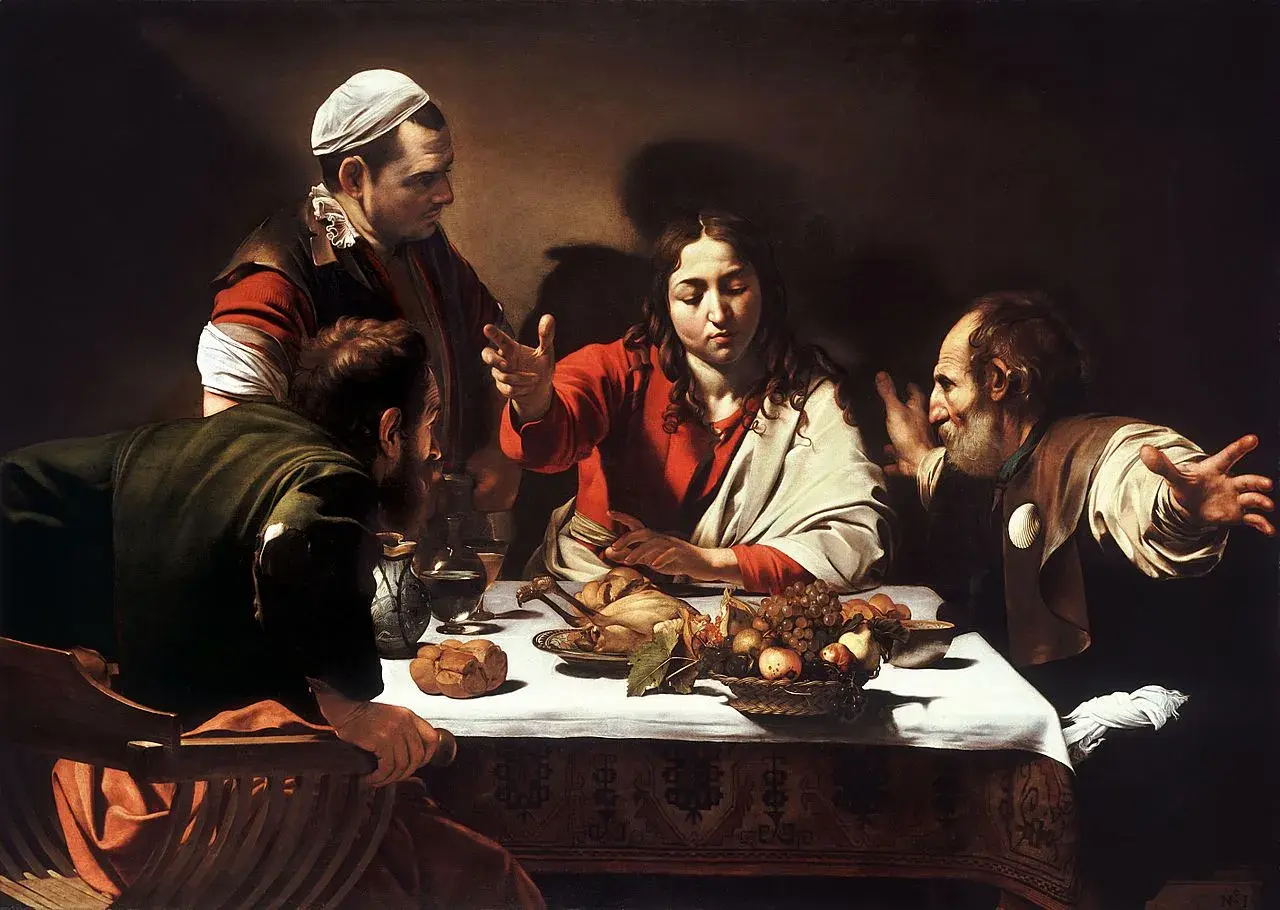
Caravaggio’s Emmaus scene is one of the clearest examples of how a biblical subject can be turned into a living, urgent event. I read the canvas less as a simple religious anecdote and more as a tightly constructed drama of seeing, where recognition arrives through gesture, light, and carefully chosen objects. That is why bread, shadow, fruit, and body language matter here as much as the faces themselves.
What matters most in the painting at a glance
- The scene is not just about a meal; it is about the instant when the disciples recognize the risen Christ.
- Caravaggio uses chiaroscuro, the contrast of light and shadow, to turn revelation into a physical shock.
- The bread, basket, shell, and empty space at the table all carry symbolic weight.
- The London and Brera versions tell the same story, but with very different emotional pressure.
- Close viewing matters because the surface, lighting, and condition shape how the symbolism reads.

The Emmaus story is about recognition, not just a meal
The Gospel account gives the painting its core tension: two disciples walk with Christ without recognizing him, and the revelation comes only when he blesses and breaks bread. That sequence matters because the story is not really about hospitality or food; it is about the moment when the ordinary becomes legible as sacred. Caravaggio chooses the instant when recognition is still forming, not the calmer moment after it has already settled.
That is the first thing I would tell any reader approaching this image. If you miss the narrative of delayed recognition, you flatten the painting into a historical scene with a religious label, when in fact it is built around surprise, hesitation, and the sudden opening of perception. Once that is clear, the next question is how Caravaggio makes the viewer feel that shock rather than simply understand it.
Caravaggio turns revelation into a physical event
Caravaggio strips the setting down to a dark, nearly empty field so the group feels pressed up against our space. The strong chiaroscuro isolates Christ’s face, the disciples’ hands, and the edge of the table as if each were under a separate theological spotlight. He also gives Christ a youthful, beardless face, which makes the figure feel less like a familiar icon and more like an interruption from another order of reality.
The body language does the heavy lifting. One disciple throws his arms outward; the other seems on the point of rising from his chair; Christ answers them with a quiet, contained blessing gesture. I read that contrast as the painting’s main engine: human astonishment is expansive, while divine presence stays calm. The scene feels almost theatrical, but it is not theatrical for its own sake. Caravaggio is using space, posture, and light to make the miracle feel close enough to enter. From there, the table objects start to carry the weight of the story.
The symbols on the table carry most of the theology
The still life is never just decoration in this painting. Each object deepens the meaning of the scene, and Caravaggio arranges them so that they feel both ordinary and charged with implication.
- Bread points directly to the breaking of bread in the Gospel and to the Eucharistic reading of the scene. It is the simplest object on the table, which is exactly why it carries so much force.
- The fruit basket teetering near the edge of the table suggests instability, abundance, and the fragility of worldly things. Some viewers also read the basket and its shadow as carrying a fish motif, though that is an interpretive reading rather than an uncontested fact.
- Wine, water, and the roast bird keep the meal grounded in everyday life, but they also push the image toward sacrifice, communion, and the transformation of ordinary nourishment into sacred meaning.
- The empty space at the table matters as much as the occupied seats. Caravaggio leaves room for the viewer, so the painting does not stay safely inside its own frame.
What looks like a simple domestic table is really a visual theology of presence, mortality, and recognition. Caravaggio does not pile on symbols for decoration; he uses believable objects so that the sacred enters through the material world. The figures then repeat the same message in human form.
The disciples, the innkeeper, and the pilgrim clues
One disciple wears a scallop-shell brooch, a pilgrim emblem that gives the figure a journeying identity and, in some readings, aligns him with St Peter. The other is often identified as Cleopas, and Caravaggio gives him a posture that feels midway between disbelief and standing up. He turns partly away from us, which is important: we do not get easy access to his face, only to the body’s sudden recognition.
The standing figure at the edge of the scene, usually read as an innkeeper or servant, is just as revealing. He remains outside the revelation, face shadowed, almost as if the world of routine continues while grace is unfolding inches away. That split is one of Caravaggio’s sharpest iconographic choices. He is showing that the same event can be unmistakable to one person and invisible to another, and that difference is what the painting is really about. That reading shifts again when the two surviving versions are set beside each other.
Why the two versions read differently
Caravaggio painted the subject twice, and the comparison is worth making because it shows how far he could move the emotional register of the same biblical event. The London version is the more expansive, while the Brera canvas is generally read as more intimate and restrained. Both are unmistakably Caravaggio, but they do not insist on the same kind of revelation.
| Aspect | London version | Brera version |
|---|---|---|
| Date | 1601 | 1605-1606 |
| Scale and feel | Larger, more outward-facing, more explosive in gesture | Slightly narrower and more intimate, with a quieter emotional pitch |
| Light and palette | Strong contrast and a richer, more dramatic color range | Plainer palette with dramatic light still doing the main expressive work |
| Symbolic emphasis | The still life and outstretched arms pull the viewer into the miracle | The same subject becomes more meditative and inward |
| Interpretive effect | Recognition feels like a public shock | Recognition feels more like a moment of concentrated revelation |
The Brera painting is especially useful because technical examination has shown an earlier version beneath the final image, confirming that it is an original reworking rather than a copy. That detail matters for interpretation: Caravaggio was not simply repeating a formula. He was testing how much drama the subject really needed, and how much silence could still carry theological force. A final layer appears when the paint surface itself is treated as evidence, not just image.
What the surface still tells you after four centuries
This painting rewards close looking because Caravaggio’s method is part of its meaning. Technical study of the London canvas shows that he often worked directly on the canvas and used brushed outlines, or abbozzo, to position the still life and figures. In other words, the apparent spontaneity is carefully engineered. The miracle may look sudden, but the image is not accidental.
That is also why reproductions can be misleading. In a flat photograph, the dark background can swallow detail, the basket can lose its precarious edge, and subtle shadows can disappear into one black mass. In a gallery, the effect depends on angle, ambient light, varnish, and how well the surface has survived. For me, that is the real lesson of the Emmaus canvas: symbolism is not pasted on afterward, it is built into the way the work catches light, controls space, and makes recognition feel physical. Stand close, and the theology becomes a matter of looking, not just knowing.
