
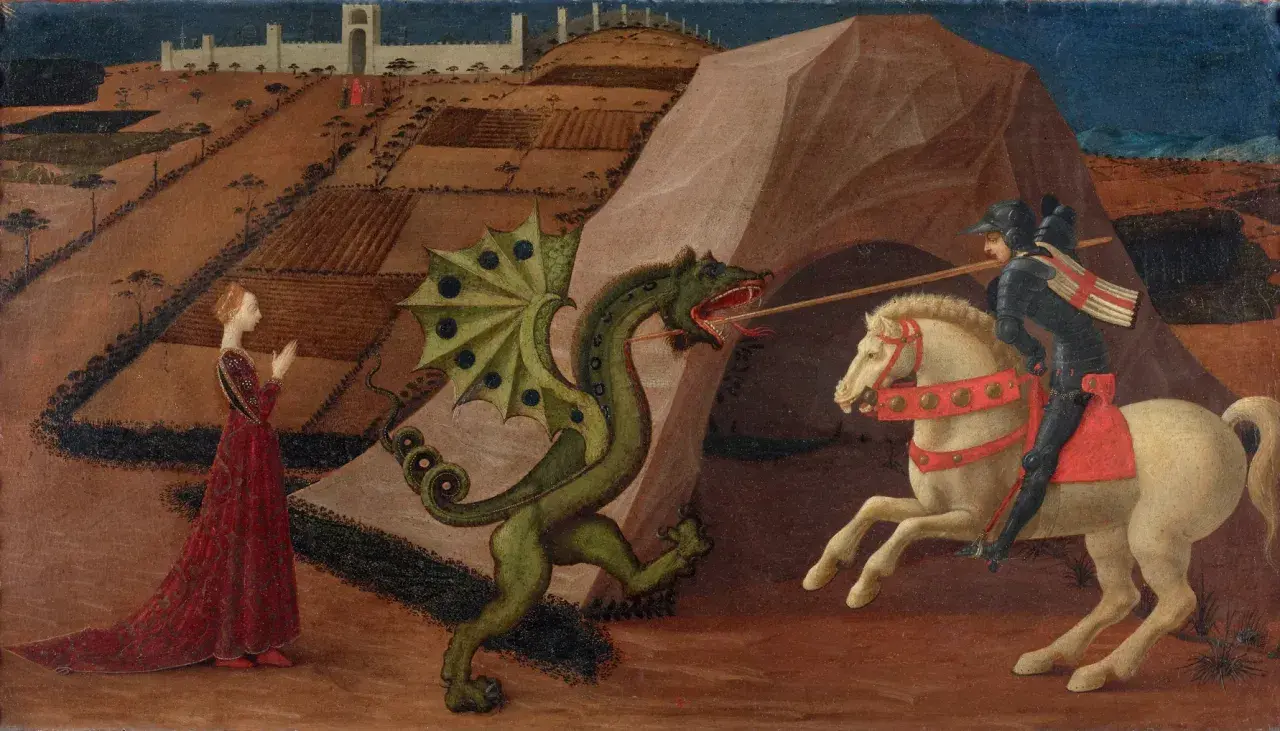
Paolo Uccello’s Saint George and the Dragon is one of those paintings that looks straightforward until you start reading the details. The dragon, the princess’s belt, the crescent moon, the strange cave, and the deliberately unsettled perspective all carry meaning, and together they turn a medieval legend into a compact meditation on faith, danger, and control. I want to unpack how the iconography works, what the usual Christian reading actually means, and why the panel still rewards close looking in 2026.
The painting turns a familiar legend into a layered symbolic image
- Uccello compresses two moments of the Saint George story into one scene, which is why the image feels so dense.
- The princess, the dragon, the cave, and the horse are all symbolic actors, not just narrative accessories.
- The painting usually reads as a Christian victory over evil, but its domestic scale gives it a quieter, more ambiguous tone.
- Perspective, moonlight, and weather are not decorative effects; they help build the painting’s meaning.
- Condition and materials matter because pigment shifts and underdrawing can change how the symbolism reads.
What Uccello compresses into one scene
The first thing I tell readers is simple: this is not a literal snapshot of the legend, but a carefully compressed narrative. In the traditional story, Saint George confronts the dragon, the princess survives, and the city is freed through conversion; Uccello folds that sequence into a single image so that the act of attack and the act of control happen at once. That compression is what gives the panel its strange energy, because your eye has to hold several meanings in one glance.
The small scale matters here. The London panel is intimate rather than monumental, and that intimacy changes the symbolism: the painting feels less like a public altarpiece and more like a private image meant to be contemplated closely. The result is that George does not merely defeat a monster; he becomes an emblem of disciplined, ordered action inside a compressed world. That tension between story and symbol is the engine of the whole work, and it leads directly to the figures themselves.
Why the main figures matter
Uccello’s iconography is strongest when you look at each figure as a symbol with a job to do. The painting is not built from isolated details; it is built from relationships. The saint, the princess, the dragon, and the horse all define one another, and the meaning changes depending on how you read those relationships.
| Figure | What it signals | Why it matters |
|---|---|---|
| Saint George | Christian knight, virtue, sanctioned force | He is not shown as chaotic or furious; he acts with controlled, almost ceremonial violence. |
| The princess | Rescue, mediation, civic or spiritual deliverance | Her blue belt becomes a leash, which makes her more active than a passive victim. |
| The dragon | Evil, pagan threat, plague, disorder | Its angular body and cave-like form make it feel like part creature, part landscape. |
| The horse | Nobility, discipline, focused energy | Its stylized body pushes the image away from realism and toward emblematic meaning. |
| The cave | Hidden danger, origin of threat, threshold space | The cave mirrors the dragon’s shape, linking the beast to the world that shelters it. |
What I find most revealing is the princess’s role. She is not just rescued; she helps restrain the dragon, which shifts the story away from simple combat and toward a larger idea of restored order. Once that becomes clear, the rest of the composition starts to feel purposeful rather than odd.

How composition turns symbolism into atmosphere
Uccello’s perspective is famously unstable, and in this painting that instability is doing symbolic work. The ground, the cave, the cloud, and the distant city all pull the eye in different directions, so the scene feels dreamlike rather than spatially secure. I do not read that as a mistake. I read it as a way of placing the legend in a world where ordinary physics do not fully apply.
The crescent moon is part of that effect. It suggests twilight or dawn, which places the action at a threshold moment, neither fully day nor fully night. That is exactly the right time for a miracle story, because threshold moments suit transformation. The storm cloud reinforces the same idea: the weather seems to gather around the saint as if divine intervention were embedded in the sky itself. The National Gallery notes that the storm’s eye lines up with George’s lance, and that alignment is the kind of subtle visual decision that makes the symbolism feel almost mechanical, as though heaven itself has been diagrammed into the composition.
The horse, too, is stylized enough to matter. Its angular hooves, curved neck, and forward-set head keep it from looking like a naturalistic animal and push it toward heraldic force. Uccello is not just showing motion; he is showing order imposed on motion. That distinction is important, because it leads directly to the painting’s broader meaning.
How I read the Christian and civic layers
The standard reading is stable and useful: Saint George stands for the triumph of Christianity over pagan threat, and the dragon represents everything that resists conversion. Musée Jacquemart-André describes the subject in exactly that broad tradition, and that is still the best starting point if you want the image’s historical logic. In that sense, the princess becomes a figure of deliverance, and the city waiting in the background becomes the place where order is restored.
But I would not stop there. Uccello’s panel is too intimate, too elegant, and too oddly theatrical to be reduced to a single doctrinal message. The non-religious feel of the image matters: it looks less like a sermon and more like a private meditation on power, restraint, and danger. That is why the painting can support civic readings as well as devotional ones. In a Renaissance domestic setting, a figure like Saint George could also imply disciplined nobility, public virtue, and the right use of force.
So the painting works on two levels at once. It is a Christian legend, yes, but it is also a meditation on how a community turns fear into structure. That layered reading becomes even clearer once you look at the object as a physical panel rather than a pure image.
What close examination reveals about the panel
For preservation, attribution, and even plain visual analysis, the material side of the work is not a footnote. The London panel is small, in oil on canvas, and the National Gallery notes that it contains no expensive pigments or gilding, which supports the sense that it was made for private viewing rather than display in a grand ecclesiastical setting. That economy of means is not just technical; it shapes interpretation, because modest materials often push a painting toward intimacy and wit rather than solemn magnificence.
Close examination also changes how the symbolism reads. According to the National Gallery, infrared reflectograms show earlier compositional traces beneath the surface, including changes in the princess’s dress, cave shape, and George’s lance. Pigments have shifted as well, especially the greens and blues, so the sky and vegetation do not look exactly as they did originally. When greens darken and reds fade, the scene can feel colder, stranger, or more distant than the painter may have intended. That matters because color is part of the iconography here: a drained palette can make a victory scene feel more haunted than triumphant.
| Feature | What to look for | Why it affects interpretation |
|---|---|---|
| Small scale | Domestic viewing distance | Encourages close reading rather than public spectacle |
| Material economy | No gilding, restrained palette | Makes the image feel private and lightly theatrical |
| Underdrawing and revisions | Altered dress, cave, and lance positions | Shows Uccello shaping meaning as he worked |
| Pigment change | Darkened greens, altered blues, faded reds | Can soften the original drama and shift the mood |
| Perspective mismatch | Multiple vanishing directions | Creates unease and reinforces the fantasy register |
If you are studying Uccello seriously, this is the point where preservation and iconography meet. A panel like this is never only an image; it is also a changing object whose surface affects how its symbols land. That is why comparison with the other versions of the subject is so useful.
Why Uccello’s Saint George still resists a single reading
One of the best things you can do after reading this painting closely is compare it with Uccello’s earlier Saint George panels in Melbourne and Paris. The story remains recognizable, but the emphasis shifts: different versions stress different moments, different kinds of violence, and different degrees of symbolism. That comparison shows something important about Uccello’s method. He does not repeat the legend mechanically; he recalibrates it.
For me, that is the lasting value of the London Saint George. It is legible enough to read instantly, but unstable enough to keep rewarding slower looking. The dragon is evil, yes, but it is also design. The princess is rescued, but she is also an active figure in the system of meaning. The saint is a warrior, but he behaves like an emblem of order. Uccello gives you the legend and then complicates it with atmosphere, geometry, and restraint.
If you are approaching the painting for study, the most useful habit is to read every formal choice as part of the iconography: the leash, the cave, the moon, the angle of the spear, even the way space refuses to settle. That is where Uccello’s intelligence is most visible, and it is why the panel still feels fresh rather than merely historic.
