
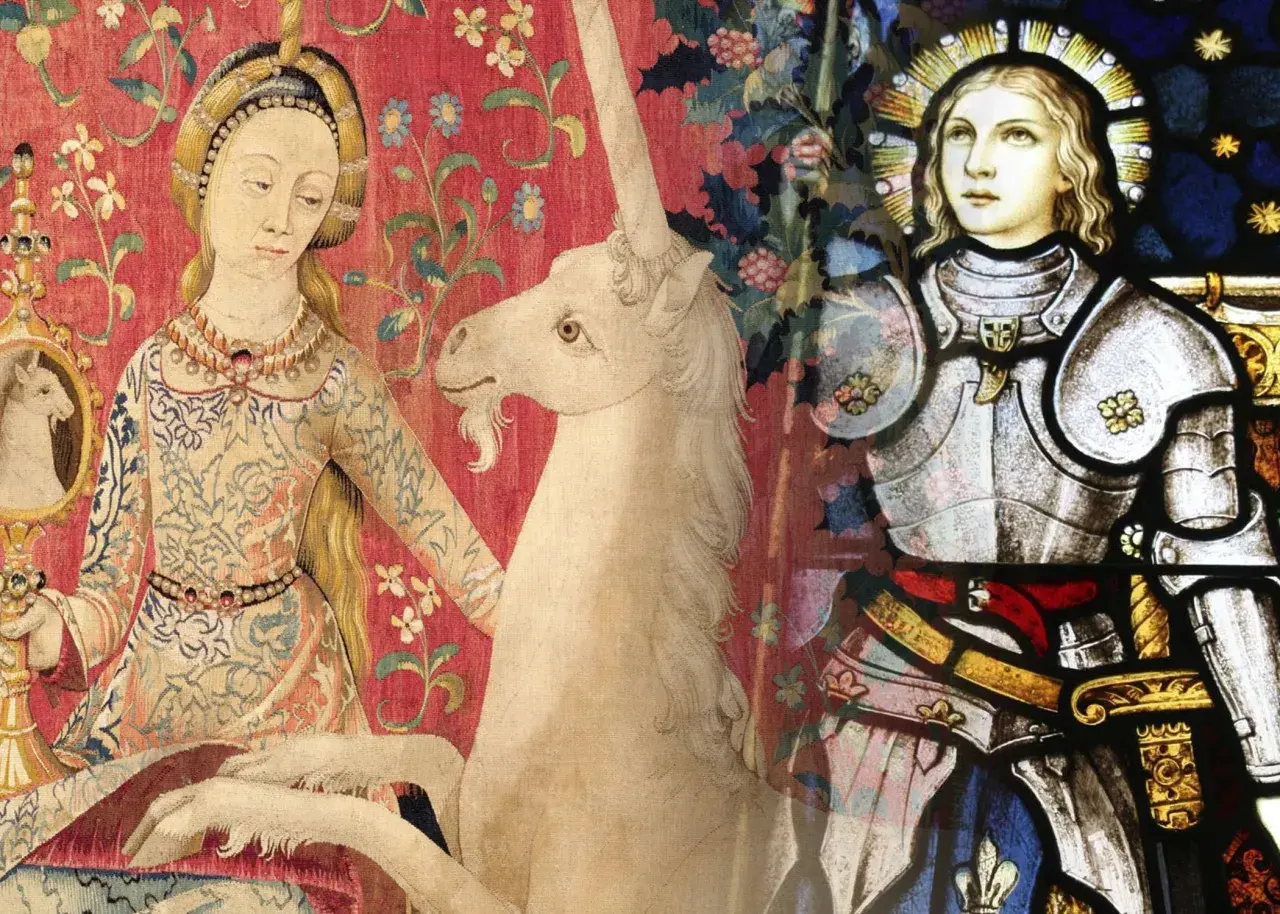
The image of a unicorn in captivity is less about a trapped animal than about a carefully coded idea: desire restrained, purity contained, and wildness turned into meaning. In the best-known medieval version, the scene is built from symbols that reward close looking, from the fence and tether to the pomegranates and enclosed garden. That is why the motif still matters to anyone reading art, literature, or medieval symbolism with care.
What this image is really doing
- Captivity is symbolic, not merely narrative; the unicorn often stands for love, chastity, or Christ.
- The strongest medieval example is a tapestry woven around 1495-1505 in the seven-piece Unicorn Tapestries.
- The scene’s meaning depends on small visual cues: the low fence, the tether, the garden, and the fruit.
- Two readings usually overlap: a secular reading about marriage and a sacred reading about Incarnation and Resurrection.
- In modern writing, the motif often shifts toward themes of enclosure, consent, longing, and loss of freedom.
- Condition matters: worn dyes, missing borders, or damaged details can change how the iconography reads.
Why the captive unicorn is more than a fantasy creature
The unicorn did not enter medieval art as a neutral beast. It arrived already loaded with ideas about rarity, purity, and irresistible attraction, which is why artists could use it to speak about human desire without saying so directly. In the unicorn hunt tradition, the creature is tamed, drawn in, and finally contained; that arc gave artists a way to talk about surrender, union, and sacrifice in a single image.
What I find most useful here is the difference between a simple scene of capture and a symbolic scene of restraint. In the medieval imagination, a wild creature that cannot be kept becomes especially meaningful when it is shown willingly near a boundary, and that is exactly what makes the motif persuasive. The unicorn is not merely defeated; it is translated into allegory. That is the core of the image, and it leads naturally to the visual language that makes the allegory legible.
How the scene makes restraint look chosen
Artists rarely present the captive unicorn as a victim in a crude sense. Instead, they frame the body with signs that suggest a bond rather than brute force: a chain, a tree, a low fence, a flowering meadow, or an enclosed garden. The composition is usually calm, almost ceremonious, which matters because the emotional tone changes the meaning. If the unicorn looked terrified, the scene would read as cruelty; because it appears quiet and settled, the image becomes about enclosure, consent, or spiritually ordered restraint.
That is why the setting is doing so much work. The garden is not backdrop; it is part of the argument. The creature’s white body against dense greenery creates an image of purity set inside fertility, and the boundary around it turns space into symbol. The whole image says that not every enclosure is a prison, even though the word “captivity” would normally push us in that direction.

The symbols that do the interpretive work
The iconography is dense enough that a few details can redirect the entire reading. When I inspect this kind of image, I look first for the objects that look decorative but actually govern the meaning of the scene. The table below shows the most important ones and what they usually signal.
| Symbol | Visual role | What it often means |
|---|---|---|
| Low fence or enclosure | Marks a boundary without making escape impossible | Chosen restraint, controlled desire, protected union |
| Chain or tether | Links the unicorn to a fixed point | Bond, possession, covenant, or domestication |
| Pomegranate | Adds a fruiting, seed-filled detail to the garden | Fertility, marriage, abundance |
| Enclosed garden | Turns space into a bounded interior | Purity, chastity, sacred enclosure |
| White coat | Makes the creature visually singular | Innocence, sanctity, idealized beauty |
| Still posture | Softens the idea of imprisonment | Peace after pursuit, acceptance, settled desire |
The Metropolitan Museum of Art describes the best-known tapestry as a confinement that could be escaped if the unicorn wished, which is precisely why the image feels so deliberate. The symbolic force comes from the fact that the restraint is visible but not absolute. That tension between freedom and chosen limit is what keeps the motif from becoming a simple hunting scene.
Why the same motif can mean marriage, desire, or Christ
The medieval viewer did not have to pick only one meaning. In fact, the strongest readings often overlapped, and that ambiguity is part of the charm. The Metropolitan Museum of Art notes that the broader tapestry cycle supports both secular and sacred interpretations, which is a useful reminder that medieval art often worked on several levels at once.
The secular reading
In a secular frame, the captive unicorn can stand for the tamed beloved: rare, sought after, and brought within the boundary of marriage. The pomegranates matter here because they are packed with seeds, so they naturally suggest fertility and progeny. The enclosed garden, or hortus conclusus, literally means “enclosed garden,” and in this context it becomes a visual metaphor for union that is private, protected, and socially sanctioned.Read Also: Peacock Symbolism in Art - What Does the Peacock Mean?
The sacred reading
In a sacred frame, the unicorn becomes a Christ figure. The hunt can be read as Incarnation, the wound or capture as Passion, and the survival or renewal of the creature as Resurrection. This is one reason the motif never feels flat: it holds together vulnerability and triumph at the same time. I think that is also why the image stayed powerful well beyond the medieval period. It lets artists speak about submission without reducing it to defeat.
Once you see that double coding, the next question is how later writers and artists adapt the idea when they are no longer working inside a medieval Christian framework. That shift changes the emotional center of the image, but not its symbolic energy.
How writers and modern artists reuse the idea of captivity
Later literature tends to keep the emotional logic of the motif while loosening its theology. The unicorn becomes a figure of rarity, vulnerability, or untamed conscience placed inside a world that does not know how to hold it. That is why the theme still works in fantasy, poetry, and visual art: it is immediately legible as a conflict between essence and enclosure.
In modern use, I usually see four recurring themes:
- Longing, when captivity is tied to a relationship that cannot be fully free.
- Domestication, when the wild is softened into something human institutions can contain.
- Loss of innocence, when the unicorn’s enclosure marks the end of a protected state.
- Chosen belonging, when restraint reads less like punishment and more like commitment.
The theme works best when the artist understands that the power of the unicorn is not just that it is rare, but that it resists being reduced to ownership. If that resistance disappears, the image becomes decorative. If it remains, the scene stays alive. That leads directly to a practical issue that art historians and conservators know well: damaged or incomplete works can make the symbolism harder to read than the original makers intended.
How fragments and restorations can change the meaning
For preservation and authentication, this motif is a good reminder that condition affects interpretation. A worn fence may look like a decorative border. A faded pomegranate may lose its fertility meaning. A missing edge can remove the cue that the garden is enclosed at all. In other words, the symbolism is often distributed across several small elements, and a single loss can flatten the whole reading.
That is why I would never judge a unicorn image only by the animal itself. The border pattern, plant forms, thread color, and composition all matter. A later copy might preserve the pose but miss the symbolic plant life; a cleaned textile might recover color but lose surface subtleties that once helped the enclosure feel intimate. For anyone studying or conserving such a work, the practical question is not just “what is depicted?” but “which signals still survive to support the original meaning?”
That question becomes even more important when the motif moves from original tapestry into reproduction, illustration, or digital reuse. The image still communicates, but it communicates differently once the material evidence is thinner.
What this motif still gives modern viewers
The reason the captive unicorn continues to resonate is simple: it captures a paradox that never goes out of date. We still care about freedom and constraint, desire and commitment, beauty and control. Medieval artists gave those tensions a form that is elegant enough to reward close looking and flexible enough to support more than one truth at once.
When I read the motif carefully, I do not see a creature merely trapped. I see an image built to ask whether restraint can be voluntary, whether enclosure can protect value, and whether the rarest things sometimes become meaningful only when they are held inside a boundary. That is the real strength of the unicorn image, and it is why the theme still deserves serious attention in both art history and literary interpretation.
