
A king’s portrait was rarely just a likeness. It could announce legitimacy, carry authority into foreign courts, and keep the ruler present in rooms where he was never physically standing. In practice, the answer to how a king’s portrait was used is a mix of politics, ceremony, diplomacy, and everyday circulation.
Royal portraits worked as public proof of authority
- They projected legitimacy, succession, and the right to rule.
- Copies were sent to courtiers, ambassadors, and foreign embassies.
- Coins, medals, and printed reproductions spread the image far beyond the palace.
- Crowns, robes, thrones, armor, and inscriptions carried most of the message.
- Today they still matter as ceremonial images and historical evidence.

The portrait as a declaration of power
State portraiture dates back to the 16th century, and the basic idea has barely changed: the image is designed to make authority visible. The Royal Collection Trust describes these works as the monarch’s definitive public image, which is the right way to think about them. A king’s portrait usually places the ruler in full regalia, in a controlled setting, with posture and scale doing as much work as the face itself.
I usually read this kind of portrait as a visual announcement. It says not just who the ruler is, but how the ruler wants to be seen: lawful, stable, wealthy, and above ordinary life. A portrait by Holbein of Henry VIII, for example, did not simply record a likeness; it helped build the king’s image as commanding and unanswerable. That is why these paintings were hung in prominent spaces and copied again and again.
Once you understand the portrait as a public declaration, it becomes easier to see why the same image was so useful in court politics and diplomacy.
Diplomacy without sending the king himself
Royal portraiture was one of the most practical diplomatic tools in early modern Europe. Portraits could be sent ahead of the monarch, presented to allies, or used to impress foreign courts and embassies. In that sense, they let a ruler travel by image rather than by body, which was especially useful in negotiations, marriage planning, and alliance building.
Miniatures and small-scale likenesses made the effect even more personal. They could be carried, framed, or exchanged as gifts, turning political loyalty into something portable and tangible. The Royal Collection Trust notes that copies of state portraits were often distributed to courtiers, ambassadors, and foreign embassies, and that distribution mattered because it extended royal presence into places the king could not occupy in person.
That movement from palace to politics leads directly to the next use: making the king visible in ordinary circulation.
Turning the king into something you could spend and see every day
Coinage is one of the clearest examples of how royal portraiture worked in public life. A coin portrait, or effigy, is the standardized image struck onto currency, and it was never just decorative. It linked the monarch to economic trust, legal order, and the daily exchange of goods. If the ruler’s face appeared in every transaction, sovereignty stopped feeling distant.
Queen Elizabeth II appeared on UK coins for almost 70 years, which shows how long a royal image can stay in circulation once it becomes familiar. The Royal Mint’s coinage portrait tradition shows how durable that idea is: the face of the monarch becomes a small but repeated symbol of the state. For a modern U.S. reader, the closest analogy is an official government seal combined with an everyday portrait image, except the royal version usually carries more explicit dynastic messaging.
| Medium | How it was used | What it communicated |
|---|---|---|
| Coins | Placed on everyday currency and carried across a realm | Authority, continuity, and accepted value |
| Medals | Issued for coronations, victories, and commemorations | Dynastic memory and public celebration |
| Prints and copies | Reproduced for wider distribution outside the court | Reach, propaganda, and visual consistency |
| Seals and official papers | Used to authenticate authority and paperwork | Legitimacy and administrative control |
When the portrait becomes portable, repeatable, and official, it stops being a single artwork and starts acting like a state instrument. That is why the iconography inside the image matters so much.
How to read the symbols that made the image persuasive
Royal portraits rarely relied on likeness alone. They used a compact visual language that viewers were expected to recognize immediately:
- Crown signaled sovereign status and succession.
- Sceptre and orb suggested rule, justice, and sacred or ceremonial authority.
- Robe of state emphasized office rather than personality.
- Armor or military dress linked the king to command and protection.
- Throne room or grand interior framed the ruler as part of an institution, not a private individual.
- Inscriptions and badges anchored the image in dynasty, office, or a specific political message.
These choices were never random. A frontal, full-length pose usually aimed for public authority, while a smaller or softer image could signal accessibility, family, or private loyalty. As a result, the same king could appear severe on a coin, reassuring in a palace portrait, and almost intimate in a miniature given to an ally.
For conservators and historians, that matters because copies, later adaptations, and restoration work can blur the original message. If a portrait was repeatedly reproduced, the surviving version may tell you as much about later political needs as it does about the king himself.
That is one reason royal portraiture still rewards close looking, even after the monarchy itself changes shape.
Why the king’s portrait mattered beyond the frame
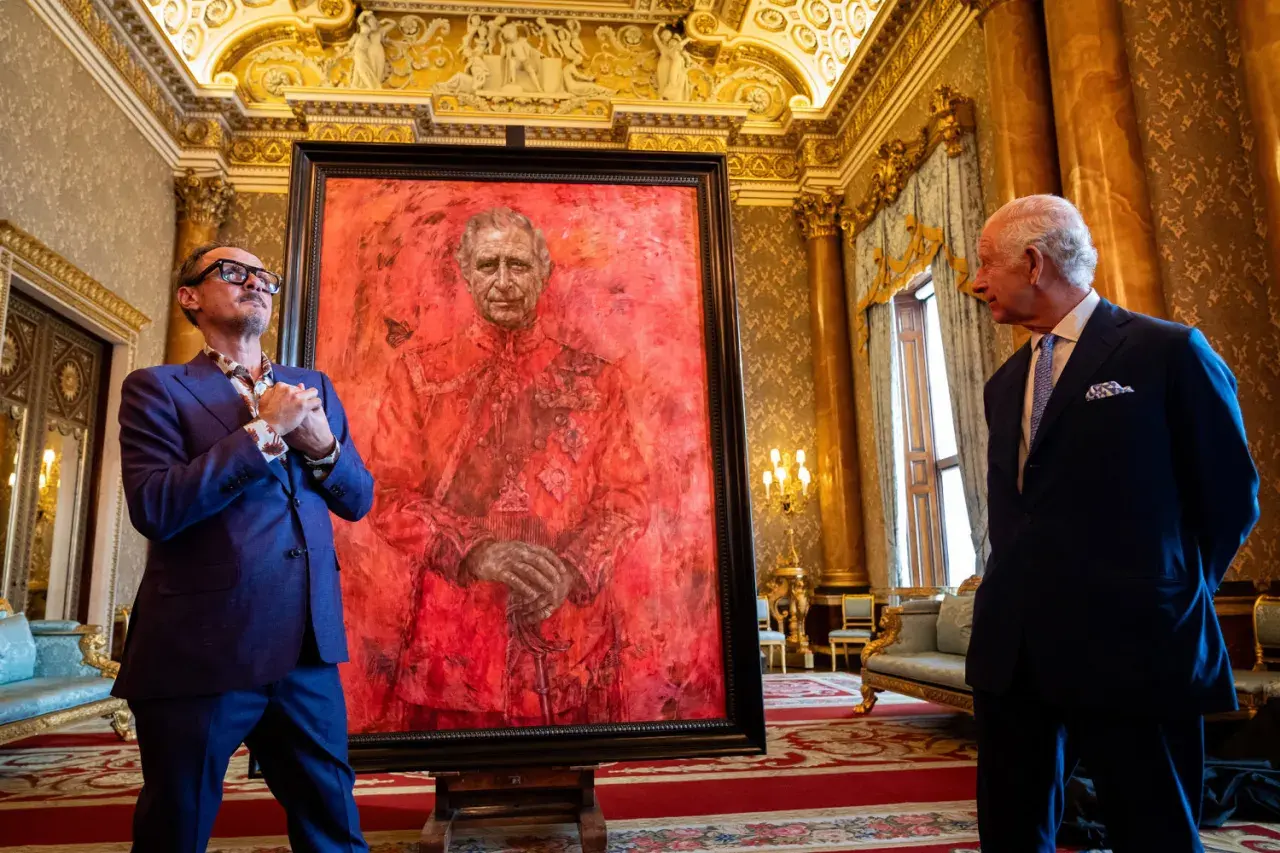
In a constitutional monarchy, the portrait does less direct political work than it did under absolute rule, but it still has a public function. It marks coronations, reinforces continuity, and gives institutions a visible link to the crown. Contemporary state portraits can look more restrained than Tudor or Stuart examples, yet they still rely on the same grammar of posture, dress, setting, and symbols.
For me, the clearest way to think about the shift is this: the portrait no longer has to prove that the king controls everything, but it still has to prove that the crown means something. That is why the image remains useful in state rooms, official collections, commemorative issues, and public ceremonies. It is not just an artwork on a wall; it is a controlled statement about identity and continuity.
If you are researching or authenticating a royal portrait, the next question is usually whether you are looking at a presentation copy, a workshop replica, or a later reproduction, because each one carried a different audience and a different kind of authority.
What royal portraiture reveals beyond the likeness itself
A king’s portrait could be used as propaganda, a diplomatic gift, a ceremonial object, a coin design, an official record, and a repeated image that carried the monarchy into daily life. The best portraits did all of those jobs at once, which is why they were so carefully staged and so often copied. When I look at one, I am not just looking for resemblance; I am reading a political object built to outlast a moment.
If you want the quickest practical takeaway, it is this: the portrait’s real power came from circulation. The more places it appeared, and the more clearly its symbols were understood, the more effectively it turned one ruler into a visible institution.
