
Cleopatra survives in art less as a single fixed face than as a set of competing visual claims: ruler, strategist, seductress, and symbol. The portraits of Cleopatra are worth studying because they sit at the intersection of royal propaganda, Hellenistic style, and centuries of later invention. In practical terms, that means the real question is not just what she looked like, but which images can be trusted and why.
What matters most in Cleopatra portraiture
- There is no universally accepted life portrait of Cleopatra VII; the most secure evidence comes from coins and a few carefully debated objects.
- Ancient likenesses were political tools, so idealization is built into the medium from the start.
- Coins, gems, and sculpture each preserve different kinds of evidence, and each has clear limits for attribution.
- Later paintings and prints matter, but mainly as reception history rather than as evidence for her actual appearance.
- The strongest identifications combine iconography, provenance, material study, and comparison with securely identified coin portraits.
What counts as a Cleopatra portrait
When I talk about a portrait here, I mean any image that claims to represent Cleopatra VII or was later understood to do so. That includes official coin portraits, carved heads, engraved gems, and a much larger body of later paintings that turned her into a cultural symbol. The first mistake most readers make is assuming all Cleopatra images are trying to do the same job. They are not.
A coin portrait, for example, was designed to circulate authority. A marble head might have been an honorific likeness, a private commission, or, in some cases, a later misidentification. A Baroque painting of her death is not evidence for her face at all; it is evidence for how a later era imagined her story. Once you separate those categories, the subject becomes far clearer.
The useful question is not simply “Is this Cleopatra?” but “What kind of image is this, and what evidence supports the label?” That shift in focus is what keeps art history from sliding into fantasy, and it leads directly to the objects that matter most.
The surviving likenesses that matter most
The most reliable evidence is also the most modest in scale. Cleopatra was an active ruler in the final decades of the Ptolemaic kingdom, and the images that survive from that world were made to travel, to be repeated, and to project legitimacy.
| Medium | What it can tell us | Why it matters | Main limitation |
|---|---|---|---|
| Coins | Official profile, royal titles, diadems, and standard court iconography | The closest thing we have to distributed state portraiture | Small, stylized, and not intended as photographic likeness |
| Marble heads and busts | Hair arrangement, facial modeling, and sculptural style | Can preserve more visual nuance than coins | Many attributions are debated, and later restoration can alter the face |
| Gems and intaglios | Iconography in a highly portable elite format | Useful for tracking how royal identity was compressed into small objects | Hard to date and attribute with confidence |
| Later paintings and prints | Reception history, costume, drama, and symbolism | Show how Cleopatra was remade by later cultures | They are not evidence for her actual appearance |
The bronze- and stone-age instinct is to privilege a large, impressive bust, but for Cleopatra I usually start with the smallest object on the table. Coins are often better witnesses because they are more tightly controlled, more repeatable, and easier to compare across mints and dates. A portrait head may be visually richer, but that does not make it more trustworthy.
That distinction matters because many famous “Cleopatra” images are really only Cleopatra-like, and the next step is learning how scholars separate the secure from the suggestive.
How I check an attribution
In practice, I use the same sequence every time: context first, iconography second, style third. If those three do not agree, I slow down. Cleopatra is famous enough that weak attributions often sound convincing long before they are convincing.
- Start with provenance. Where was the object found, when was it recorded, and is the ownership chain continuous or broken?
- Compare it with secure coin types. Coin portraits are the best anchor we have for facial and symbolic comparison.
- Check for royal markers. A diadem, stephane, paired imagery with Antony, or Egyptian royal symbols can support an identification, but none of them is enough on its own.
- Look for restoration or re-cutting. A cleaned nose, modern smoothing, or an inserted section can quietly change the whole reading of the face.
- Ask whether the object is portrait, ideal type, or retrospective label. Many works are identified after the fact because they resemble the queen’s image, not because they were made as her portrait.
The British Museum notes that one marble head once identified as Cleopatra VII is now widely thought to show a woman who modeled herself on Cleopatra’s image rather than the queen herself. That kind of revision is not a failure of scholarship; it is exactly how attribution should work when the evidence is thin and the fame of the subject is enormous.
A Cleopatra-like face is not the same thing as Cleopatra. The difference sounds small, but in authentication it is everything. From here, the next question is why her image was so easy to shape in the first place.
Why her official image mixes Greek and Egyptian language
Cleopatra ruled at the end of the Ptolemaic period, when Greek dynastic rule and Egyptian kingship had already been intertwined for centuries. The Met’s overview of the Ptolemaic period is useful here: Egyptian and Greek traditions were in active contact, so official art often blends languages rather than choosing one or the other. That hybridity is not confusion. It is strategy.
On the Greek side, Cleopatra’s image could use a profile bust, a tied-back coiffure, and a strong, sometimes severe facial profile. On the Egyptian side, you might see a diadem, a uraeus, or references to divine kingship. Together, those elements made her look legitimate to different audiences at once. The point was not to flatter the eye; it was to stabilize authority.
I think this is where many modern viewers misread ancient portraiture. We expect softness, symmetry, and cosmetic polish because we have been trained by photography and cinema. Ancient royal portraiture often did the opposite. It emphasized rank, lineage, and political control, even when that meant a face looked hard, unidealized, or deliberately unsentimental.
In other words, Cleopatra’s image was designed to persuade before it was designed to resemble. That political purpose explains why her likeness was so easy for later artists to reinvent, which is exactly what happened next.
How later artists turned Cleopatra into a symbol
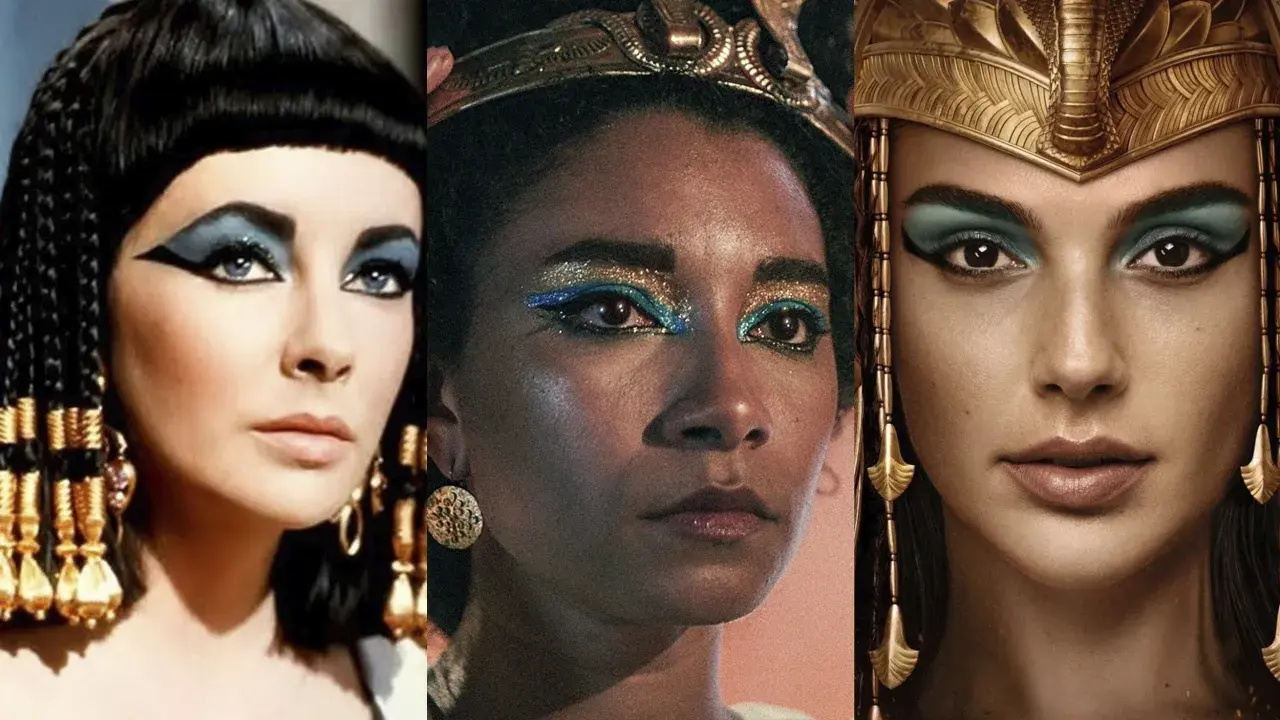
After antiquity, Cleopatra stops functioning mainly as a ruler and starts functioning as a cultural mirror. Renaissance and Baroque artists used her to think about virtue, excess, erotic power, and death. Nineteenth-century painters pushed her toward Orientalist spectacle. Modern film and advertising then compressed all of that into a handful of instantly readable signs: heavy eyeliner, gold jewelry, dramatic drapery, and a gaze that is supposed to feel both royal and dangerous.
That shift matters because later portraits tell us more about the viewer than about the queen. A Baroque canvas such as Guido Cagnacci’s The Death of Cleopatra is not a face study in the classical sense; it is a staged meditation on power, surrender, and theatrical emotion. The subject is Cleopatra, but the real content is the era that painted her.
For readers trying to understand portraits of Cleopatra, I would separate later imagery into four broad uses:
- Moral drama, where her story becomes a lesson about desire or fate.
- Exotic display, where costume and setting matter more than historical precision.
- Political allegory, where she stands in for sovereignty, resistance, or collapse.
- Celebrity image-making, where the queen is recast through the visual habits of the modern era.
Each of those uses can be artistically strong, but none should be confused with ancient portrait evidence. That distinction becomes even more important when an object is being preserved, cataloged, or sold.
What preservation and authentication teams look for
Cleopatra is one of those names that can distort judgment because it adds market value, not just historical interest. That is why preservation and authentication have to stay disciplined. A convincing label is not enough; the object has to survive scrutiny from material, stylistic, and documentary angles.
When I assess a supposed Cleopatra object, I look for five practical things:
- Provenance depth, especially older records that predate modern market hype.
- Material consistency, meaning the stone, metal, or gem should fit the period and workshop practice.
- Surface history, including wear, cleaning, and any sign that the object was over-restored.
- Iconographic discipline, so the symbols match what a Ptolemaic ruler would plausibly use.
- Comparative fit, especially against securely identified coin portraits and related royal imagery.
The biggest red flag is a face that looks too neatly Cleopatra-shaped. That sounds ironic, but it is common. A damaged ancient portrait can be made to look more certain than it is after aggressive cleaning or modern retouching. The result may be visually appealing and historically weak at the same time. In conservation terms, that is a problem; in scholarship, it is a warning sign.
If you are working in collecting, curating, or simply reading an object critically, the safest habit is to ask whether the evidence supports the label or whether the label is doing all the work. That habit leads to a clearer reading of the image itself.
A reliable way to read Cleopatra images now
If I had to reduce the whole subject to one rule, it would be this: trust the object only as far as its evidence will carry it. A coin with a secure mint context can tell you a great deal about royal self-presentation. A marble head with a broken provenance may tell you less than its label claims. A later painting may tell you nothing about Cleopatra’s face and still tell you a lot about her legend.
So when I look at Cleopatra imagery now, I move through three questions in order: what is the medium, when was it made, and what job was it meant to do? If those answers line up, the image becomes meaningful even when the attribution remains cautious. If they do not line up, I would rather call it Cleopatra-inspired than Cleopatra herself.
That restraint is not skepticism for its own sake. It is the difference between an attractive story and a defensible one, and it is exactly the standard that serious art history should keep.
