
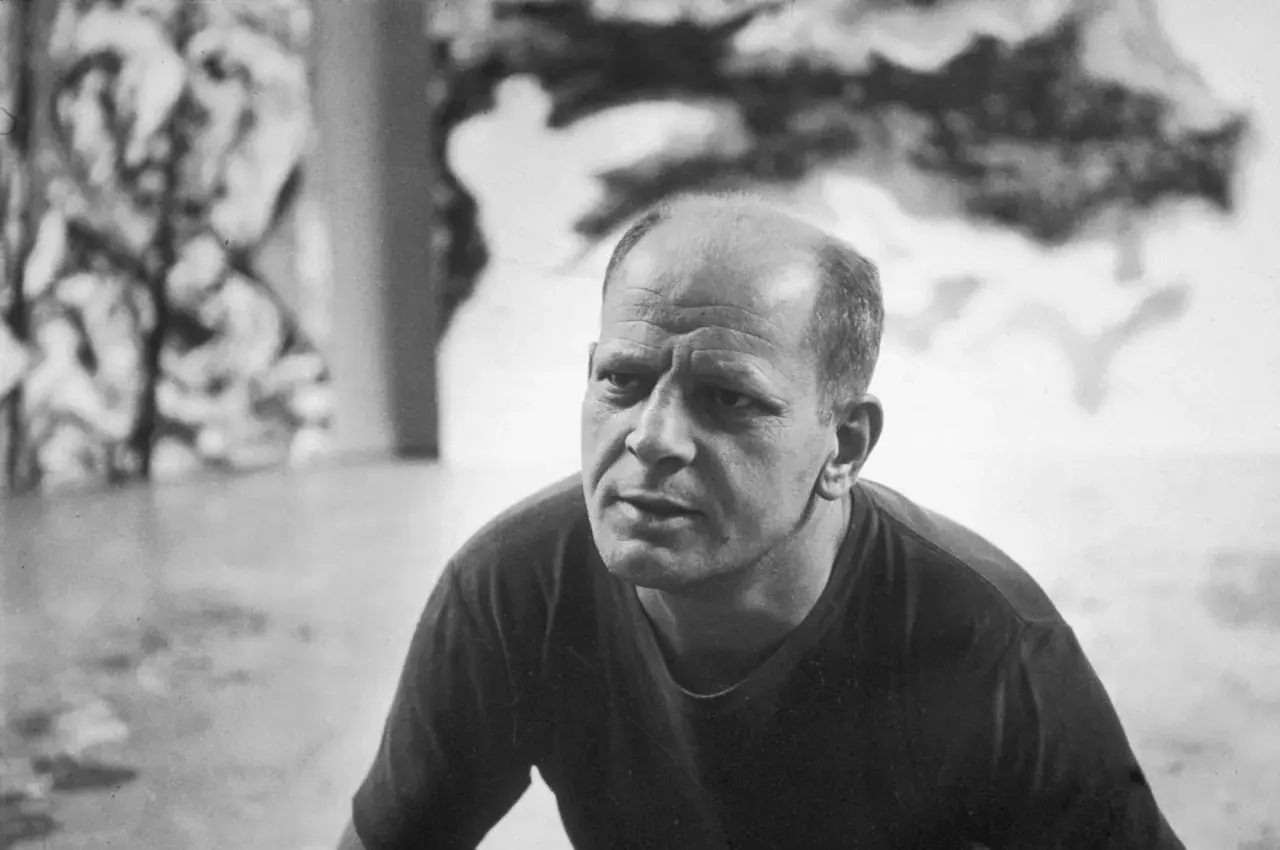
An image of Jackson Pollock's face is most useful when it does more than identify the artist. The best version tells you when it was made, who made it, and whether you are looking at a posed portrait, a candid studio shot, or a later reproduction. This article separates those image types, shows how I judge reliability, and explains why Pollock still matters in portrait history even though his painting is famously non-figurative.
The strongest Pollock images are the ones that combine likeness, context, and provenance
- Archival photographs are usually the safest choice when accuracy matters most.
- Studio images add historical context that a cropped face alone cannot provide.
- Early figurative drawings show that Pollock worked with heads and bodies before abstraction took over.
- Metadata matters: date, photographer, collection, and rights information help separate real sources from loose copies.
- For editorial use, one verified portrait is usually better than several unverified repeats.

What readers usually want from a Pollock face image
In practice, this kind of query usually points to one of three needs: a clear head-and-shoulders portrait for identification, a documentary photo for biography, or a historical reference image for art writing. I treat those as different jobs, because each one demands a different kind of evidence.
If the goal is simple recognition, a frontal or near-frontal photograph works best. If the goal is to explain the artist as a cultural figure, a studio image is stronger because it places the face inside the working environment that shaped his myth. And if the goal is to discuss Pollock as a painter before full abstraction, an early figurative drawing or portrait study is often more revealing than a later photograph.
That distinction matters, because the image type determines how much truth it can carry. A good likeness is not just about appearance; it is about context, date, and the level of trust you can place in the file.
The portrait types that are actually worth using
When I sort Pollock images for editorial or research use, I usually separate them into a few practical categories. The table below is the quickest way to see which version fits the task.
| Image type | Best use | What it gives you | What to watch for |
|---|---|---|---|
| Archival face-forward photograph | Identification, captions, profiles | A clean likeness with minimal visual noise | Check the date, photographer, and whether the crop has been altered |
| Studio or action photograph | Biography, museum text, feature articles | The artist's face plus the physical context of making work | The face may be secondary to gesture, tools, or canvas |
| Early figurative drawing or portrait by Pollock | Art-history context | Evidence that his visual language began with figures and heads | It may show another sitter, not Pollock himself |
| Heavily edited or AI-generated image | Generally avoid for serious use | Fast but shallow visual appeal | Weak provenance, distorted features, and poor archival value |
A museum catalogued photograph from 1953 gives a very different reading from a 1949 studio shot. The first is about likeness; the second is about presence. In my view, the 1953 type is the better choice when you need a dependable face image, while the studio shot is the better choice when you need to show the artist as a working body rather than a static subject.
That difference is small on screen but important in interpretation. Once you know which type fits the job, the next step is checking whether the file itself can be trusted.
How I check whether a portrait is trustworthy
I use four basic checks. First, I look for a credited photographer or archive. Second, I want a date or date range. Third, I want a collection or institution named somewhere in the record. Fourth, I check whether the caption history seems continuous rather than patched together from reposts.
- Credit line: who created the image, or who preserves it.
- Date: when it was made, not when it was reposted.
- Context: whether it was a portrait, candid, press photo, or studio document.
- Integrity: whether the face has been cropped, colorized, or retouched beyond recognition.
MoMA's artist page is useful here because it reminds us that Pollock is best understood through physical process as much as through image. That makes documentation especially important: the more the portrait claims to be “the” face of Pollock, the more I want to see clean provenance behind it.
A portrait can be authentic and still mislead if the crop removes the surrounding studio, tools, or body language. For preservation-minded readers, that is the real issue. The question is not only “Is this Pollock?” but also “What has been lost between the original image and the version I am looking at now?”
Once the source is solid, the face starts doing more than identifying him. It becomes part of the story of how Pollock was seen, sold, and remembered.
Why his face still matters in a mostly abstract career
Pollock is remembered for abstraction, but that is not the whole record. He worked through figurative drawing and portrait study before the drip paintings became his signature, so the human head did not disappear from his visual world overnight. It simply stopped being the center of the composition.
That is why Pollock's face remains interesting in portrait history. The photograph gives you a person; the paintings give you a presence. In other words, the face grounds the myth. It tells you that the painter who became shorthand for action painting was also a specific man with a posture, a gaze, a wardrobe, and a public image that changed over time.
I think that contrast is the key to understanding why people still want his face image in the first place. Abstract art can feel impersonal from a distance, but the right portrait restores scale and intimacy. It turns a legend back into a person.
That is also why studio photographs often feel more revealing than polished publicity shots. They show the body in relation to the work, which is exactly where Pollock's art and persona meet.
How to choose the right version for a museum-style article
If I were building a page for an art-history or preservation audience, I would choose the image according to the page's purpose, not just its visual appeal.
| Page goal | Best image choice | Why it works |
|---|---|---|
| Artist biography | Clean face-forward portrait | Readers identify the artist immediately |
| Exhibition essay | Studio or working photograph | It connects the face to process and place |
| Catalog or archive entry | Verified photograph with full metadata | Supports provenance and future reference |
| Social preview or thumbnail | Tight crop of a documented portrait | Stronger visual hook, but less historical context |
For accessibility, I would keep the alt text plain and factual: artist name, approximate date, and image type. For example, “Jackson Pollock in a studio portrait, circa 1953” is far better than a vague line like “serious man.” Precision helps both users and search engines, but more importantly it keeps the image honest.
I would also avoid using a decorative or overly stylized version unless the article is explicitly about digital reinterpretation. For a site that values preservation and authentication, the strongest choice is usually the least theatrical one.
The safest editorial choice for this subject
If I had to choose just one image, I would use a catalogued archival photograph with a clear date and a readable face. If I could choose a second, I would add a studio image from roughly the same period. Together, those two views tell the reader who Pollock was and how he was seen at work, which is a stronger portrait than either image can deliver alone.
For Muses-et-Art.org, that balance is exactly right: the image should be visually direct, historically grounded, and easy to trust. A good Pollock portrait does not need to dramatize him. It only needs to identify him accurately and preserve enough context for the reader to understand why the image matters.
That is the standard I would use every time: one clear face, one reliable caption, and no guesswork where documentation can do the job.
