
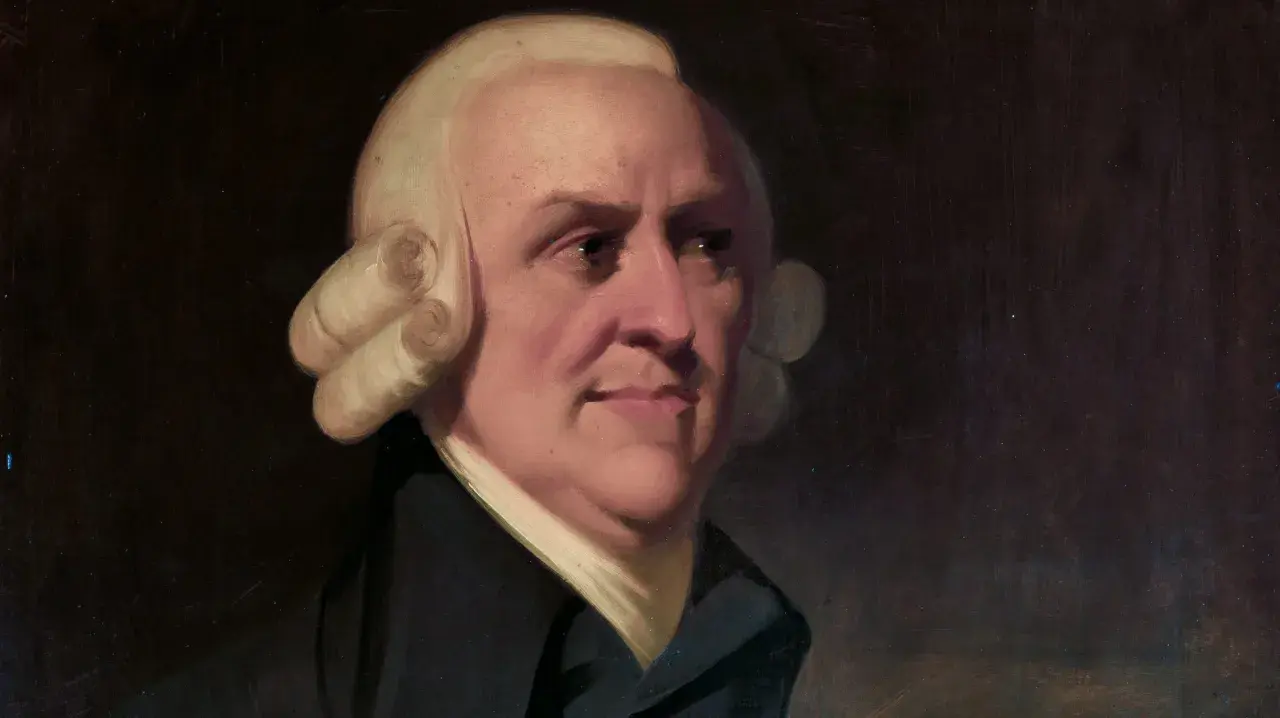
Adam Smith’s visual legacy is small, but it is not simple. The useful way to read an Adam Smith portrait is to treat it as a record of transmission: a medallion, an etching, and a later painted likeness all shaping how we imagine him. This article separates the main versions, explains what each one tells us, and shows how to judge which image is primary, derivative, or simply decorative.
The essential point is that Smith’s likeness survives as a small family of related works
- The most important early anchor is James Tassie’s 1787 glass paste medallion.
- The best-known painted version is the posthumous Muir portrait, probably made around 1795.
- John Kay’s etchings helped turn Smith into a widely circulated visual figure.
- Later prints “after” earlier works are part of the portrait’s history, not separate sittings.
- For authentication and publication, medium, date, and provenance matter more than visual drama.
How to read the image chain behind the portraits
The first mistake people make is assuming that there must be one definitive face hiding behind the archive. In practice, the visual record is thinner than that. The National Portrait Gallery records Smith in six portraits, which is enough to establish a tradition, but not enough to create the kind of overabundant iconography you see with later political or celebrity figures.
That scarcity matters. It means each image carries more weight than it would for a more heavily documented sitter, and it also means later copies can easily be mistaken for originals. When I evaluate a portrait of Smith, I start with three questions: who made it, when was it made, and is it an original likeness or a work after another model?
Once you use that lens, the whole group becomes easier to read. The portraits are not competing snapshots; they are a chain of interpretation, and that is exactly why the comparison is interesting. The clearest way to see that chain is to line up the main versions side by side.
The three versions I would compare first
| Version | Date and medium | What stands out | Why it matters |
|---|---|---|---|
| James Tassie medallion | 1787, glass paste medallion | Profile format, compressed surface, clean outline | It is the key visual anchor for later likenesses and the most useful starting point for attribution work. |
| John Kay etching | 1790, etching on paper | Sharper line, stronger public-image feel, more graphic than painterly | It shows how Smith was circulated as a readable print image, not just a private sitter’s portrait. |
| Muir portrait | About 1795, oil on canvas | Warmer modeling, softer expression, more human presence | It is the best-known painted likeness and the version most readers respond to as a “portrait” in the modern sense. |
I would add one caution here: a later 1818 etching after Kay shows how long Smith’s image stayed in circulation, but it should not be confused with a fresh sitting. That distinction is not pedantic; it changes how you interpret the work. A later print can be historically valuable and still be secondary evidence.
If you need a quick rule of thumb, use Tassie for the early visual source, Kay for the print tradition, and Muir for the most familiar painted character study. The Muir portrait deserves a closer look, because it tells a different story from the print versions.
Why the Muir portrait feels more human than the prints
The National Galleries of Scotland describes the Muir portrait as probably posthumous and based on Tassie’s medallion, and that detail changes how I read it. It is not a direct life study, even if it feels intimate. Instead, it is a later attempt to translate a compact medallion likeness into the richer language of oil paint.
That translation matters. Oil adds tonal variation, softens the edges of the face, and gives the sitter a less schematic presence. The result is a Smith who feels reflective rather than merely emblematic. The slight smile, which is absent in many stiff intellectual portraits, is doing a lot of work here. It makes him look approachable without turning him sentimental.
- The painting gives Smith a psychological warmth that line engraving cannot easily carry.
- Its likely posthumous date means it reflects memory as much as observation.
- The profile logic from the medallion still shapes the face, so the image remains linked to the earlier tradition.
- For viewers, it often reads as the most “complete” portrait even though it is not the earliest.
That combination of distance and familiarity is exactly why the Muir portrait is so useful. It sits at the point where documentary likeness turns into cultural memory, and that leads directly to the problem of reproduction.
What to check when a portrait is “after” another work
In portrait study, the word “after” is one of the most useful clues in the label. It tells you the artist was working from an earlier source, not from direct observation. That is not a flaw. It is a different category of evidence. A print after Kay or a portrait after Tassie belongs to the transmission history of Smith’s image, and that history is often what scholars and editors actually need.
When I assess a work like this, I look for five practical markers:
- Medium - etching, medallion, oil painting, or cast all signal different levels of proximity to the sitter.
- Inscription language - “by,” “after,” and “published by” tell you whether the work is original, reproductive, or commercial.
- Date - a posthumous date usually means the image is interpretive rather than observed firsthand.
- Provenance - ownership history can clarify whether a portrait is early, later, or simply a copied variant.
- Stylistic dependence - repeated profile shape, wig treatment, and facial proportions often reveal a borrowed source.
The practical payoff is simple: if a portrait is derivative, I do not dismiss it, but I do caption it differently and treat it differently. That is the point where a reference image becomes a research decision rather than a visual preference.
How I would choose a reference image for research or publication
If I were editing a piece on Smith, I would not choose the image that merely looks the nicest. I would choose the image that best matches the purpose of the text. For historical explanation, the Tassie medallion is the most honest starting point. For a general audience, the Muir portrait is often the most legible because it feels like a finished portrait rather than a relic. For print culture, Kay’s etchings are the right material because they show how the likeness entered wider circulation.
That gives you a straightforward decision grid:
- Use the Tassie medallion when you need the earliest secure visual anchor.
- Use the Muir portrait when you want the most readable painted likeness.
- Use Kay’s work when the topic is reproduction, engraving, or public circulation.
- Keep the caption specific, because “portrait of Adam Smith” is not precise enough for serious art-historical use.
I would also avoid one common habit: treating all surviving images as interchangeable. They are not. A medallion, an etching, and an oil portrait communicate different things about status, memory, and authorship. If you are writing for an art-conscious audience, those differences are the whole point.
What the surviving likenesses reveal about Smith’s public memory
The deeper story is not just about face shape or costume. It is about how a major thinker is turned into a visual type. Smith appears as a philosopher of calm authority, a public intellectual, and, in the painted version, a man with enough humanity to feel remembered rather than merely recorded. That shift from record to remembrance is what makes the portrait tradition worth studying in the first place.
For a reader interested in fine art history, the lesson is useful beyond Smith. Portraits are rarely neutral mirrors. They are edited objects, shaped by medium, date, copying practices, and the culture that later preserves them. If you know how to read that structure, you can evaluate not only this likeness, but any portrait that claims to represent a historical figure with authority.
In Smith’s case, the strongest interpretation is also the simplest: the visual record is small, but it is rich enough to show how a thinker becomes an image through repetition, adaptation, and selective memory. That is why the surviving portraits matter, and why the most careful reading is usually the most revealing one.
