
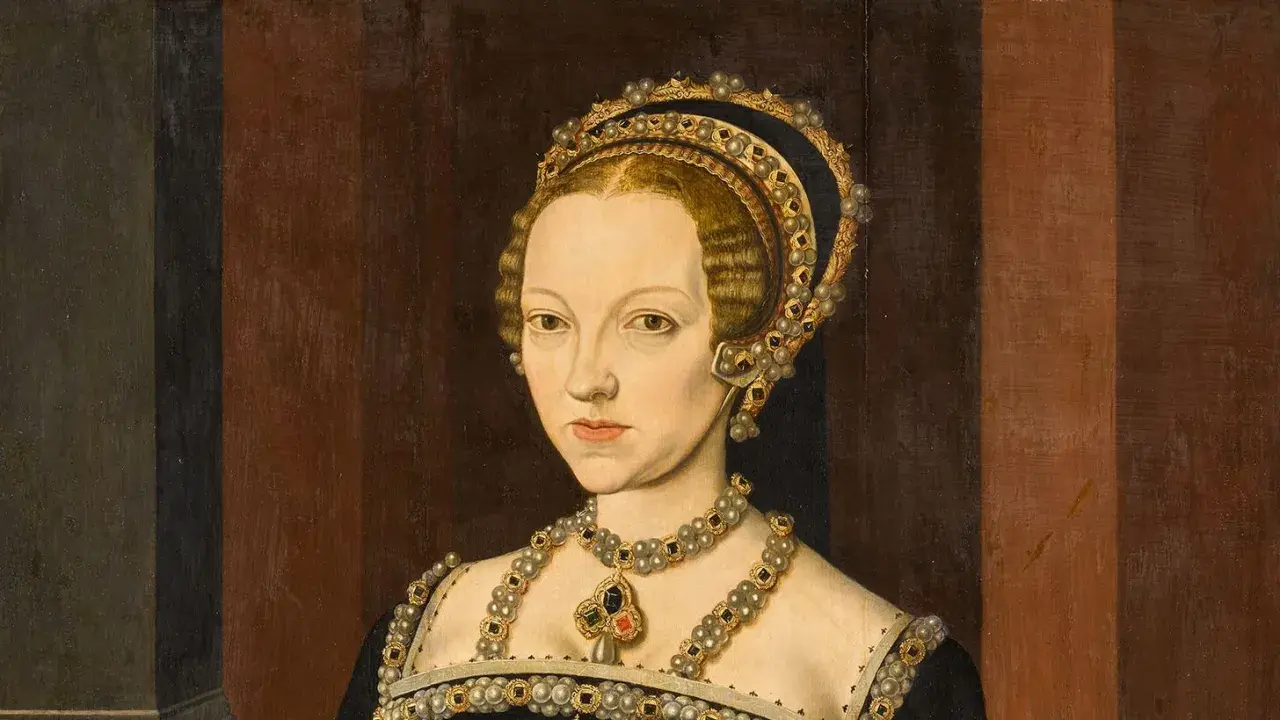
A Catherine Parr portrait is valuable because it does more than preserve a face: it shows how Tudor queens were staged, labeled, and later reinterpreted. I want to separate the secure evidence from the portraits that became confused with Lady Jane Grey or Mary Tudor, because the difference matters to anyone studying portraiture seriously. The best-known image also rewards close looking, since its costume, jewelry, and paint handling carry much of the identification.
The key points to keep in view
- The strongest painted likeness is the full-length Tudor panel usually cataloged as Katherine Parr, dated to around 1543.
- Identification depends on evidence, especially costume details and a crown-shaped brooch tied to an inventory of her jewels.
- Not every image labeled Parr is equally secure; some later panels are copies, and at least one miniature once linked to her is now thought to be Mary Tudor.
- Portraits of Parr are also records of status, showing how a queen consort could project learning, authority, and reform-minded politics.
- For authentication, provenance matters as much as style, and facial resemblance alone is a weak basis for attribution.
Why this likeness matters more than a royal face
I read a Tudor portrait like this as an argument, not just an image. Katherine Parr was Henry VIII's final queen, but she was also a published author, a political actor, and a woman who helped shape the succession story around Mary and Elizabeth. That means the painting is doing several jobs at once: presenting rank, reinforcing legitimacy, and turning court identity into something visible and durable.
That is why the portrait matters to historians and collectors alike. It is not simply about whether we can recognize Parr's features; it is about what a female royal image was allowed to say in the 1540s. The garment, jewelry, and pose all signal controlled authority, and that makes the painting a small but serious document of Tudor queenship. Once you see it that way, the next question becomes less romantic and more technical: how do we know the sitter is really her?
How museums identify the sitter
The strongest attribution rests on a combination of costume evidence, documentary comparison, and visual tradition. The National Portrait Gallery records the full-length panel as an oil painting from around 1543 and points to the crown-shaped brooch on the sitter's dress as a key clue, because that jewel can be matched to an inventory of Parr's jewels. That is the sort of evidence I trust in Tudor portrait work: it is specific, testable, and grounded in surviving records rather than in a general sense of resemblance.
There is also a technical side to the story. The painting uses silver and gold leaf, glazes, and oil pigment to imitate costly cloth and jewels, which is exactly the kind of material sophistication I expect in a court portrait meant to project rank. The work is associated with Master John, an active Tudor painter whose name is usually reconstructed from style and documentation rather than from a signed canvas. That is a reminder that attribution in this period is often an exercise in triangulation, not certainty. Once you understand that, the confusing later versions make more sense.
The portraits readers most often confuse
| Version | What it is | Why it matters | How I would read it |
|---|---|---|---|
| Full-length panel, around 1543 | The best-known painted likeness, with rich dress and a crown-shaped brooch | Usually treated as the primary reference image for Parr | Use this as the anchor point when comparing other images |
| Later small panel | A late-16th-century version that preserves her image in a more compact format | Shows how her portrait type circulated after her death | Useful as reception history, but not as strong primary evidence |
| Miniature long linked to Parr | A tiny court portrait once accepted as Parr, now reassessed as Mary Tudor | Shows how attribution can shift when jewelry and dress are rechecked | Do not use it as firm proof of Parr's facial features |
Recent reassessment has been especially useful because it keeps us honest. In late 2024, The Guardian reported that a miniature long thought to portray Parr was being identified instead as Mary Tudor, based on dress, jewelry, and comparison with other royal images. That does not weaken Parr's portrait record; it strengthens it by showing which objects are actually dependable and which ones need to be handled as provisional. Those differences matter because not every painted royal face is evidence of the same certainty.
What to look for in the painted likeness
If I were looking at the portrait closely, I would start with the visual language of rank. Parr is presented in a square neckline, a heavy textile that suggests wealth, fur-trimmed sleeves, and a restrained but unmistakably costly display of jewelry. The effect is not accidental. Tudor portraiture often uses fabric as a kind of social proof, and here the painter makes the cloth almost as important as the sitter.
- The crown-shaped brooch is the single most important identification detail.
- The expensive fabrics communicate access to court privilege and sumptuary rules.
- The composed pose keeps the image formal rather than intimate.
- The controlled surface finish makes the portrait feel polished, ceremonial, and deliberate.
That combination tells me the painting is not just showing a woman; it is building an image of queenship. The brooch and textiles do the hard work of status signaling, while the calm pose keeps the image politically disciplined. In practical terms, that is also why the portrait is so useful for authentication: the iconography is specific enough to be checked against records, which leads naturally to conservation and provenance research.
How historians and conservators test the attribution
When a portrait like this is studied properly, I would expect four things to be checked together: provenance, documentary evidence, technical examination, and comparison with related works. Provenance asks where the painting has been and when it first appears in a collection. Documentary evidence asks whether inventories, payment records, or jewel lists match what is depicted. Technical examination looks at support, underdrawing, paint layers, and later retouching. Comparison asks whether the sitter's clothing, pose, and accessories fit what is known of the period and person.
That process is more useful than people sometimes expect. A panel can be beautiful and still be a poor identification if the costume is anachronistic or the ownership trail is thin. Conversely, a copy can still matter as a record of how the image was received, even if it is not the best witness to Parr's actual appearance. The safest reading is usually the least dramatic one: follow the object, then follow the paperwork, and only then decide how much confidence the label deserves. That standard is what separates a plausible guess from a defensible attribution.
What this image still teaches about Tudor portraiture
The lasting value of Parr's portrait is that it makes Tudor image-making feel precise rather than generic. It shows how a queen could be represented through fabric, jewelry, and posture without losing political force, and it shows how easily later viewers can flatten that complexity into a simple name. For me, the lesson is straightforward: portraits from this period should be read as evidence systems, not decorative likenesses.
If you are cataloging, comparing, or conserving an image like this, the best habit is to keep the identification language cautious until costume evidence, provenance, and period context line up. That is especially important with Tudor royal portraits, where copies are common and reassignment is part of the field's history. A strong label is one that can survive scrutiny, not one that merely sounds familiar.
