
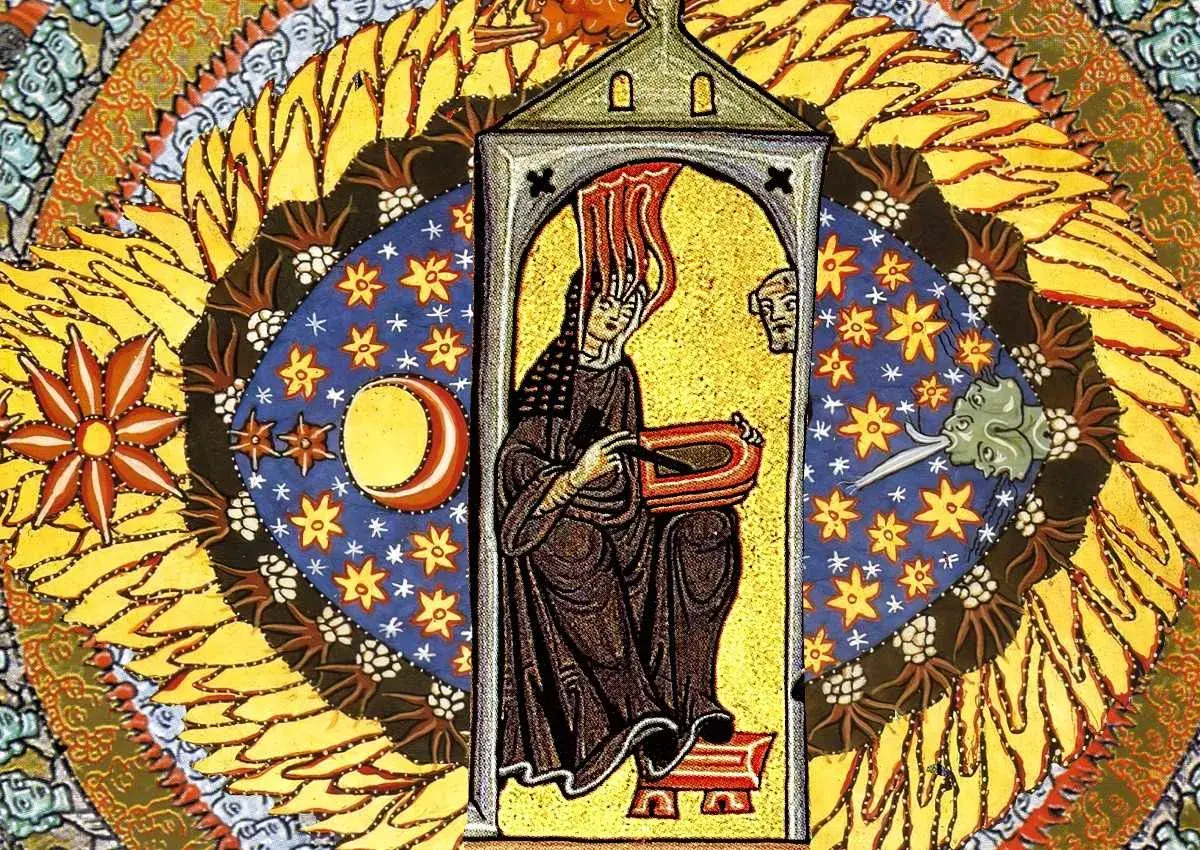
The images work as visual theology, not ornament
- Hildegard is best understood through her illuminated manuscripts, especially Scivias, rather than through standalone paintings.
- The famous 35 miniatures in Scivias are not decorative extras; they guide interpretation of the text.
- Her imagery sits in the world of Romanesque manuscript illumination, but it pushes toward diagram, symbol, and cosmology.
- The original manuscript tradition is partly lost, so facsimiles, copies, and photographs matter for study and authentication.
- For modern viewers, the real challenge is reading the images as structured arguments, not literal scenes.
What survives from Hildegard's visual legacy
I use “art” here in the medieval sense: image, text, and devotion are tightly linked. Hildegard was not a painter in the later studio tradition, and that is exactly why her surviving visual work is so interesting. Her legacy is concentrated in manuscripts that turn theology into form, especially the visionary books associated with her circle at Rupertsberg.
| Work or witness | Visual status | Why it matters |
|---|---|---|
| Scivias manuscript | 35 miniatures tied to Hildegard’s first major visionary text | The clearest expression of her image program and the best known visual source |
| Liber divinorum operum manuscript at Lucca | Later illustrated witness to her cosmological thought | Shows how her imagery was extended and reinterpreted by later monastic hands |
| Modern facsimiles and photographs | Surrogates for lost or inaccessible pages | Essential for studying color, layout, and image relationships today |
That distinction matters because Hildegard’s art is not a gallery category. It is a manuscript culture category, and that changes how I read it. The object is never just the picture; it is the picture inside a theological book, designed to move a reader through a chain of thought. That becomes clearest in Scivias, where the images do far more than illustrate the prose.

The Scivias miniatures that define her visual language
The 35 miniatures in Scivias are the core reason Hildegard still matters in art history. They are frequently described as illuminations, but that word can sound too small and too passive. I would call them visual arguments. They do not simply decorate the page; they organize revelation into a sequence the reader can study, remember, and interpret.
The broad scholarly view is that the manuscript belongs to Hildegard’s lifetime and to the Rupertsberg context, even if the exact division of labor between author, designer, and painter remains debated. That uncertainty is not a weakness in the topic. It is part of the history. Medieval manuscript production was collaborative, and Hildegard’s circle worked in a way that makes authorship feel shared without making it vague.
Why the images function as teaching tools
Hildegard’s visions are abstract by nature, and the images make them legible. A cosmic wheel, a radiant figure, a layered architectural form, or a series of enclosed spaces can translate a theological idea into something the eye can follow. That is why scholars often describe the miniatures as visual exegesis, meaning interpretation through image. In plain language, the pictures help the reader understand what the text is doing.
What recurs across the cycle
Several motifs return again and again: concentric circles, radiant fields, enclosed architectures, bodily figures placed inside symbolic structures, and scenes that compress creation, fall, redemption, and ecclesial order into one image. Hildegard is less interested in narrative realism than in cosmic structure. I find that especially revealing. She is not asking, “What did this look like?” She is asking, “How does this work in the order of divine meaning?”
Why the manuscript became more famous than the text
The images have become the easiest entry point for modern readers because they are striking, immediate, and unmistakably medieval. The Abbey of St. Hildegard notes that the miniatures helped make the book more famous than the written text alone, and that feels right to me. The cycle has a visual force that survives translation. Even when the Latin is not at hand, the structure of the thought still reads on the page. That leads directly to the question of how those forms are built.
How to read the symbols, color, and composition
The easiest mistake is to expect naturalism. Hildegard’s images do not aim for optical realism; they aim for conceptual clarity. When I look at them, I think less about perspective and more about layered meaning. The compositions are diagrammatic, but not sterile. They are ordered, but not mechanical. That tension is part of their power.
Circles and enclosure
Concentric forms, mandorlas, and nested fields often suggest the cosmos, divine containment, or the movement from one spiritual state to another. The circle is not just a shape here. It is a theological device. It tells the reader that reality is structured, not random, and that human history sits inside a larger sacred design.
Color and viriditas
Color does a lot of work in Hildegard’s visual world. Green, especially, can evoke viriditas, her idea of living greenness, vitality, and spiritual fertility. But I would avoid treating color as a fixed code. Medieval color is contextual. Red can signal fire, energy, sacrifice, or urgency. Blue can open onto heaven, but it can also function as a formal field within a larger composition. What matters is how the colors interact with the text and the shape of the image.
Read Also: Feminist Art - Beyond the Canvas: What You're Missing
Bodies, space, and architecture
Hildegard’s figures often sit inside symbolic architecture or appear scaled to emphasize hierarchy rather than anatomy. That is not a limitation; it is a choice. The body becomes a theological instrument. Buildings can stand for institutions, souls, or cosmic order. Space is compressed so that meaning stays visible. This is one reason the miniatures feel so different from later narrative painting. They are closer to a map of spiritual relations than to a scene from daily life.
Where Hildegard fits in art styles and movements
If I had to place Hildegard in a single art-historical frame, I would start with Romanesque art. That period, broadly the 11th and 12th centuries, values strong linear structure, patterned surfaces, symbolic compression, and a willingness to let image carry intellectual weight. Hildegard belongs to that world, but she also stretches it. Her vision images are more diagrammatic and cosmological than most surviving Romanesque manuscripts.
| Style or movement | What Hildegard shares with it | What feels distinct |
|---|---|---|
| Romanesque manuscript illumination | Bold color, strong contour, symbolic figures, decorative density | Her images are unusually conceptual and system-driven |
| Monastic book culture | Collaborative production, devotional reading, text-image unity | The authorial voice is unusually strong and directive |
| Early Gothic visual culture | Growing interest in narrative clarity and spiritual affect | Hildegard resists softer naturalism and keeps the cosmic diagram in focus |
That is why I would not force her into a neat stylistic box. She is Romanesque, but not routine Romanesque. She is monastic, but not anonymous in the usual sense. And she anticipates later visual habits without fully belonging to them. The next question, then, is what survives materially and how safely we can rely on what we see.
Preservation, attribution, and what the manuscripts ask of us
For researchers, collectors, and conservators, Hildegard is a good reminder that a manuscript can survive as an image tradition even when the original object does not. The Rupertsberg Scivias manuscript is not available in its original form today, so modern study depends on photographs, facsimiles, and later witnesses. That means every image you encounter may be one step removed from the medieval page.
That matters because reproduction is never neutral. A facsimile can preserve layout and color relationships very well, but it does not fully preserve parchment texture, pigment behavior, binding history, or the physical evidence of use. A digital scan is even more selective. It gives access, but it also flattens the object. If I am evaluating a Hildegard image, I want to know four things immediately: what witness it comes from, when that witness was made, whether the colors are original or reconstructed, and whether the image has been cropped, restored, or silently normalized.
- Check the witness so you know whether you are seeing an original, a facsimile, or a later copy.
- Read the manuscript context because Hildegard’s images are tied to text, sequence, and page design.
- Separate attribution from tradition since “Hildegard’s image” can mean direct supervision, monastic collaboration, or later reception.
- Watch for interpretive drift because later copies may preserve the form while changing the meaning.
The later illustrated tradition around her works is useful precisely because it shows that her imagery remained active, not fixed. A copied diagram can clarify one generation and confuse the next, which tells you something important about medieval visual culture: it was never just about preservation. It was also about transmission, misunderstanding, and repair. That is why the final value of Hildegard’s art goes beyond the manuscripts themselves.
Why her images still matter to art historians
Hildegard matters because she exposes a gap in the way people often imagine medieval art. Her images are neither mere ornament nor private fantasy. They are structured, public, and intellectually forceful. They show a woman authoring a visual theology inside a monastic environment, using the manuscript page as a place where words and images can do different kinds of work at the same time.
For art history, that has three lasting consequences. First, it reminds us that medieval women could shape image programs, not just receive them. Second, it shows that style is not only a matter of appearance; it is also a matter of purpose. Third, it demonstrates how fragile visual meaning becomes once an object survives through copies, facsimiles, and reproduction. I think that last point is especially relevant for anyone working in preservation or authentication, because it forces us to treat the manuscript as a chain of evidence, not a single isolated picture.
If you want the shortest possible reading of Hildegard’s visual legacy, it is this: the images are powerful because they turn doctrine into structure. Once you see that, her manuscripts stop looking like isolated medieval curiosities and start looking like one of the clearest visual minds of the twelfth century.
