
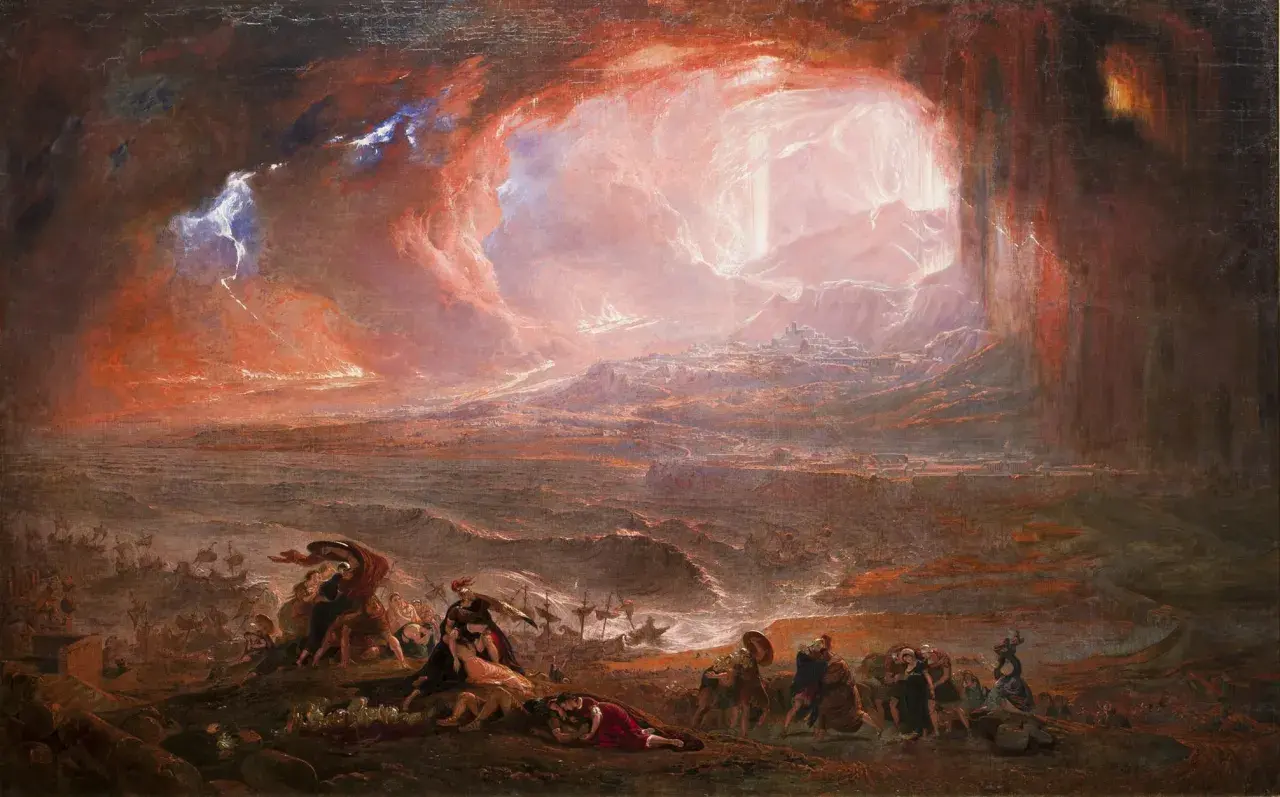
John Martin turned catastrophe into composition. His paintings are filled with collapsing architecture, biblical spectacle, and landscapes so large that people seem almost swallowed by them, yet the effect is never random. In this article I look at who Martin was, why his images remain memorable, which works define him, and how to approach his art with the attention it deserves.
The essentials behind Martin’s dramatic vision
- John Martin (1789-1854) was an English Romantic painter, printmaker, and illustrator known for biblical and apocalyptic subjects.
- His hallmark is scale: tiny human figures set against vast architecture, storms, and broken landscapes.
- Belshazzar’s Feast, The Destruction of Pompeii and Herculaneum, and The Great Day of His Wrath are among the key works to know.
- He also worked in mezzotint, etching, watercolor, and book illustration, which helped spread his fame.
- His reputation fell after his death, then recovered in the 20th century and remains strong today.
Why Martin still feels startlingly modern
I read Martin as a painter of scale and pressure. The real drama is not just the catastrophe but the way he arranges space so that architecture, weather, and light seem to overpower people. That formula anticipates later fantasy art, disaster imagery, and even the logic of cinema, where a single image has to carry both narrative and atmosphere.
What makes the work hold together is control. Martin did not simply paint “big” scenes; he choreographed perspective, contrast, and tiny figures so the eye keeps moving through the picture. The result is theatrical, but not shallow, and that is why his best canvases still reward slow looking. Scale is his signature, but composition is what makes the scale work. To understand how he arrived at that style, it helps to start with the long road from provincial training to Royal Academy exhibitions.
The career path that shaped his style
Martin was born in 1789 near Hexham in Northumberland and began with practical decorative work rather than academic fine art. He trained in heraldic and ornamental painting, then moved into china and glass painting in London before gaining access to the Royal Academy exhibition system in 1811. That background matters: the precision of decorative work never really left his handling of detail, even when the subject became monumental.
He was not an overnight success, but he did learn how to command attention. Early works such as Sadak in Search of the Waters of Oblivion helped establish his taste for the sublime, and later canvases made his ambition impossible to ignore. By the 1820s, he was producing the large, high-drama paintings that made his reputation, with Belshazzar’s Feast becoming the clearest early proof that the public would pay to see catastrophe rendered with architectural precision. The crucial point is that Martin built his style through exhibition culture, print culture, and spectacle, not through academy polish alone. That context is the best lead-in to the paintings themselves.

The paintings that define his reputation
| Work | Date | Why it matters |
|---|---|---|
| Belshazzar’s Feast | 1820 | The breakthrough image: monumental architecture, dense crowding, and a theatrical use of light that made Martin famous beyond specialist circles. |
| The Destruction of Pompeii and Herculaneum | 1822 | A classic example of his ability to turn historical disaster into almost cinematic spectacle, balancing archaeology, panic, and scale. |
| The Seventh Plague of Egypt | 1823 | One of the most direct expressions of his apocalyptic imagination, with human vulnerability set against overwhelming force. |
| The Great Day of His Wrath | 1851-53 | A late masterpiece that condenses his lifelong interest in judgment, collapse, and divine scale into one of his most memorable compositions. |
| The Deluge | 1834 | Important for the way it treats catastrophe as environmental, not just narrative, with nature itself becoming the subject. |
When I look at these paintings together, the recurring device is obvious: Martin reduces the human figure so the viewer feels the full weight of the setting. That is not a trick, it is the central idea. The architecture is not background; it is a pressure system. The storms are not decoration; they are the argument. If you remember one thing about his best work, remember that the sense of awe comes from composition first and subject second. That also explains why his prints and watercolours matter so much.
His prints and watercolours widened the audience
Martin was not only an oil painter. He also produced engravings, mezzotints, and watercolours, and that wider practice helped make his imagery portable. In print, his drama became easier to circulate, collect, and discuss, which is one reason his reputation spread far beyond exhibition rooms.
This is also where collectors and historians need to be careful. Martin’s images exist in multiple forms, and not every dramatic sheet or dark print is an original masterpiece. Medium, edition history, and condition all matter. That takes us naturally to the practical question of identification and preservation.
| Medium | What it gives Martin | Practical reading tip |
|---|---|---|
| Oil on canvas | Maximum scale, strong contrasts, and dense architectural staging | Look first at perspective and the placement of tiny figures, not only at the central event. |
| Mezzotint and etching | Deep blacks, luminous highlights, and sharper public circulation | Expect an emphasis on light breaking through darkness rather than color complexity. |
| Watercolor and gouache | More atmospheric movement and quicker shifts of tone | Watch how he simplifies form while keeping the same sense of vast space. |
How to judge a genuine Martin work without guessing
With Martin, I would never rely on style alone. He is too influential, too widely copied, and too often represented by later prints or derivatives. A serious reading starts with provenance, medium, and support. If a work is said to be by Martin, ask first whether it is an oil, watercolor, mezzotint, or an “after” print, because those categories have very different values and conservation needs.
For preservation work, the main risks are familiar but important. Oils can suffer from darkened varnish, abrasion, and old restoration that flattens the contrasts he depended on. Works on paper can be vulnerable to foxing, handling damage, and fading if the highlights were originally built to stand out against a darker ground. Exhibition labels, inscriptions, studio notes, and old catalogue entries can make a real difference in attribution, especially with works that circulated in public exhibitions or were later reproduced. I would treat the following checks as the minimum starting point:
| Check | What it tells you | Why it matters |
|---|---|---|
| Provenance | Who owned or exhibited the work | Strong provenance reduces the chance of misattribution. |
| Support and medium | Canvas, paper, watercolor, mezzotint, or print | Martin worked across several media, so the material evidence must match the claim. |
| Condition | Varnish, tears, fading, abrasion, or paper damage | Condition can change the reading of his light-dark contrasts dramatically. |
| Exhibition history | Whether the work appears in old catalogues or museum records | Documented display history is often stronger than visual impression alone. |
The practical takeaway is simple: Martin’s market and scholarship reward documentation. A convincing visual resemblance is useful, but it is not enough on its own. Once you know how to separate original work from later reproduction, the next question is why his reputation fell so sharply, and why it recovered.
Why his reputation fell, then came back
Martin was widely admired in the early 19th century, then pushed aside as taste changed. Mid-Victorian criticism was especially hard on him, and by the 1920s many of his major works had lost much of their market value. That decline tells us less about the quality of the paintings than about changing ideas of seriousness, finish, and good taste. His art was too theatrical for some critics, but that same theatricality is now one of the reasons it feels fresh.
Recent scholarship has traced how his reputation was rebuilt after the Second World War through dealers, collectors, and museum interest. The larger point is that Martin never really disappeared; he kept returning in different contexts, especially when artists and viewers wanted images that could hold grandeur, fear, and spectacle in one frame. That is why he is still worth studying in 2026, whether you are approaching him as a historian, a collector, or a viewer who simply wants to know why these vast, storm-filled images are so hard to forget. He is not just a painter of ruins; he is a painter of attention, and that is the final thing I would want a reader to carry away from him.
