
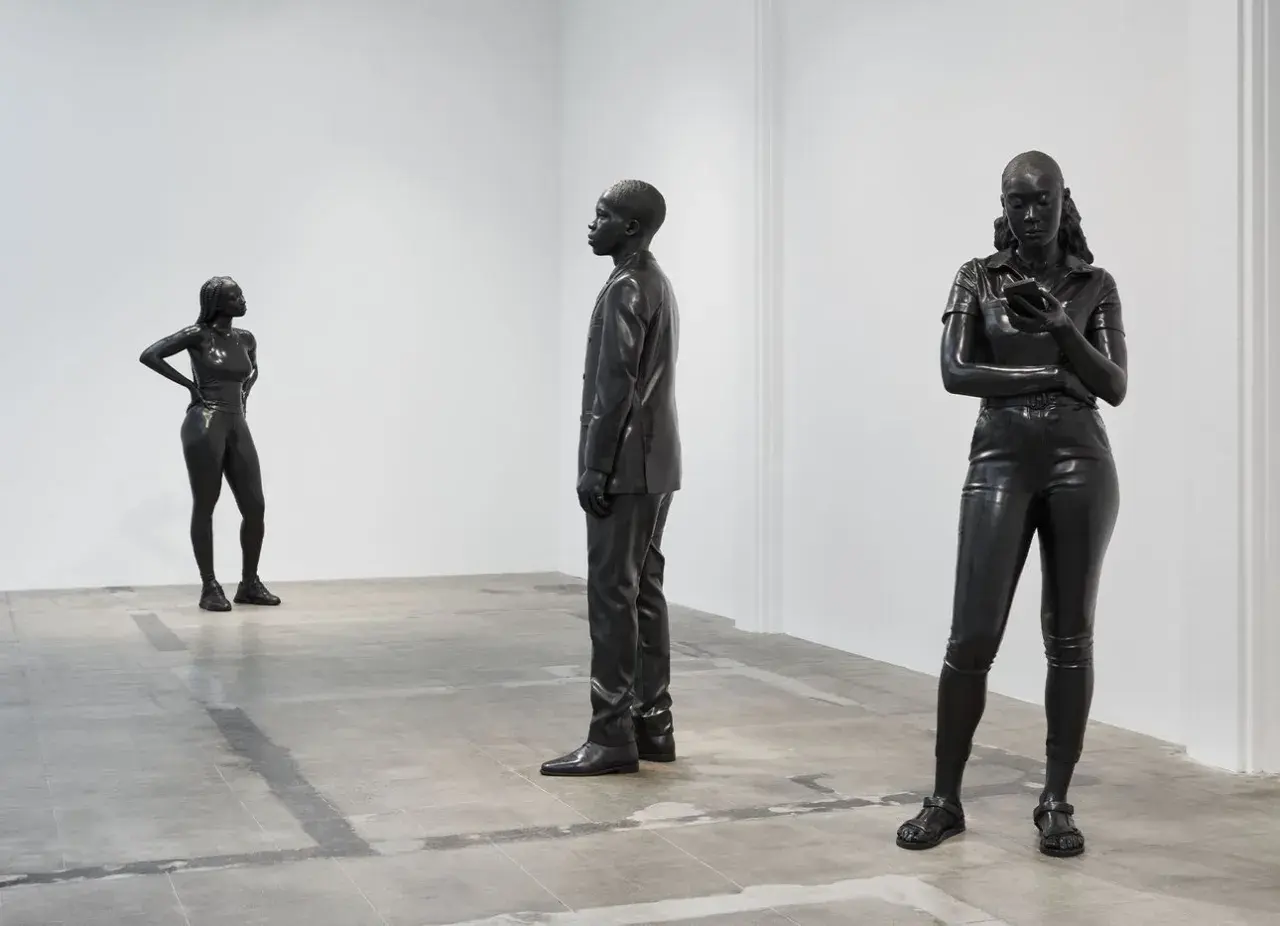
A Thomas J. Price sculpture rarely behaves like a conventional monument. His bronzes turn ordinary gestures, clothing, and posture into something weighted with presence, which is why they keep showing up in public squares, museum forecourts, and major exhibitions. Here I focus on what his sculptures are actually doing, which works matter most, how the figures are built, and what to notice if you are studying, preserving, or trying to understand them properly.
What to know before looking closely at Thomas J. Price’s sculptures
- Price works mainly with large-scale figurative bronzes that feel both familiar and deliberately monumental.
- His figures are usually fictional, but they are built from observations, scans, and real-world visual material.
- The strongest works are not just about likeness; they are about visibility, dignity, and who gets represented in public space.
- For a first reading list, start with The Distance Within, Moments Contained, Grounded in the Stars, and A Place Beyond.
- For preservation and authentication, the key evidence is provenance, fabrication records, condition history, and the material behavior of bronze.
What makes Thomas J. Price’s sculpture distinct
What first sets his work apart is the tension between everyday subject matter and monumental scale. Price does not build heroic statues in the old sense. He makes figures that look like people you could pass on a street corner, at a transit stop, or in a museum lobby, and then places them at a size that forces a different kind of attention.
He often works from observations of daily life, 3D scans, and sourced images, which gives the figures a strange but convincing blend of specificity and distance. They are not straightforward portraits of named individuals. I read them as psychological portraits: sculptures that feel emotionally precise without pretending to be biographical records.
That matters because the work is doing more than describing a body. It is asking who gets made visible, who gets enlarged, and who has historically been denied the visual authority that monuments usually confer. Once you see that, his sculptures stop looking like isolated objects and start reading as arguments about public memory. That logic becomes much clearer when you look at the key works side by side.

The works I would start with
If I were introducing someone to Price’s sculpture in the shortest possible way, I would start with a small group of works that show the range of his practice without losing the common thread. The table below gives the clearest entry points.
| Work | Date | What to notice | Why it matters |
|---|---|---|---|
| The Distance Within | 2021 | A nine-foot bronze figure of a young Black man looking down at his phone in Marcus Garvey Park. | It shows how an everyday posture can become monumental without being turned into propaganda or spectacle. |
| Moments Contained | 2022 | A 2.7-meter bronze figure of a casually dressed young woman, calm on the surface but tense in the hands. | It is one of the clearest examples of his “psychological portrait” approach. |
| Grounded in the Stars | 2025 | A 12-foot bronze figure placed in Times Square, built from images, observations, and open calls. | It pushes his monument critique into one of the most visible public spaces in the United States. |
| A Place Beyond | 2026 | An 18-foot bronze figure outside V&A East Museum, constructed from daily observations, 3D scans, and sourced images. | It shows how far his public language can scale while still feeling intimate. |
| Numen (Shifting Votive 1-3) | 2016 | Emblematic heads on marble columns, made with lost-wax casting and aluminium. | It reveals his interest in classical display, power, and the politics of elevation. |
The Studio Museum in Harlem framed The Distance Within as part of Price’s exploration of Blackness and Black masculinity, and that remains a useful reading key because it keeps the piece from being reduced to a simple portrait. In his best work, the figure is never only a figure; it is also a test of how space assigns value.
From here, the next question is obvious: what changes when these figures leave the museum wall and enter the city?
Why public space changes the meaning
Price is at his most interesting when the sculpture has to compete with traffic, architecture, and public attention. In a gallery, a bronze figure can command silence. In a plaza, it has to negotiate noise, motion, and distraction. That change is not incidental; it is part of the work’s meaning.
In Grounded in the Stars, for example, the figure stands in Times Square, a place built on speed, signage, and constant visual interruption. Times Square Arts presented the piece as a 12-foot figurative bronze sculpture, and that context matters because the work does not behave like a billboard or a conventional memorial. It asks for attention on its own terms, through posture, stillness, and the quiet authority of scale.
Public placement also changes how the viewer measures the body. A figure at ground level feels closer to you, less ceremonial, and more vulnerable to inspection. At the same time, the size gives the body weight and duration. That combination is central to Price’s practice:
- Scale turns ordinary presence into something harder to ignore.
- Placement determines whether the figure reads as isolated, communal, or confrontational.
- Posture softens the monument language and makes the work feel psychologically alive.
- Clothing and gesture anchor the sculpture in contemporary life instead of myth.
Once you understand that public logic, the material choices start to make more sense, because the finish is never just finish. It is part of how the sculpture speaks.
Materials and process behind the finish
Price’s figures are visually refined, but they are not inert. The surfaces often retain enough evidence of making to keep the work from becoming too polished or too idealized. I think that balance is one of the reasons the sculptures feel contemporary instead of merely grand. They are carefully finished, but they still carry the trace of construction.
His practice combines traditional sculpting with digital tools, especially 3D scanning for body and clothing detail. That hybrid method matters because it allows him to preserve the look of the everyday without flattening the figure into a generic body type. It also lets him move between different registers of sculpture, from monumental bronze to smaller editioned works and more experimental pieces.
| Material or process | What it signals | Why I pay attention to it |
|---|---|---|
| Bronze | Durability, authority, permanence | It borrows the language of traditional monuments, then redirects it toward ordinary people. |
| 3D scanning and sourced imagery | Contemporary realism and layered authorship | It helps explain why the figures feel believable without being literal portraits. |
| Visible seams or modelling traces | Evidence of fabrication | These details remind the viewer that the image was made, not simply discovered. |
| Marble or oak in some works | Shifts in tone, weight, and historical reference | Different support materials change the emotional register of the sculpture. |
That process is not just aesthetically important. It is also relevant to conservation, because bronze, marble, wood, and mixed-media components age differently. If you are looking at a Price sculpture in a collection, that material complexity is one of the first things I would document carefully.
And once you start looking for those traces, the next step is to slow down and read the work the way it was meant to be read.
How to read one in person without missing the point
When I stand in front of one of Price’s figures, I read it in four passes. That approach sounds simple, but it prevents the usual mistake of treating the work as either purely political or purely formal. It is both, and the details matter.
- Start with the silhouette. Ask how the figure holds space before you worry about expression.
- Look at the stance. A slight shift in weight, a dropped shoulder, or a hand in a pocket can carry more meaning than a face.
- Read the clothing. Everyday dress is not incidental here; it is part of the sculpture’s claim to the present tense.
- Step back and then move closer. The work changes when you compare texture, scale, and surface distance.
This is also where the psychological aspect becomes visible. A clenched hand or downcast gaze can suggest guardedness, concentration, fatigue, or self-possession, depending on the rest of the composition. Price gives the viewer enough information to feel the figure’s interior life, but not so much that the image becomes fixed or closed.
That way of looking is useful for scholars, visitors, and conservators alike, because it turns observation into evidence. It also sets up the practical question of what keeps these works stable over time.
What preservation and authentication depend on
For Price’s sculpture, authenticity is not just a signature issue. It is a documentation issue. The most reliable record usually combines provenance, edition information where relevant, fabrication records, exhibition history, and condition reports. In public commissions, installation photographs and maintenance logs matter just as much as the visible object because they explain how the work was intended to exist in space.
Bronze is durable, but it is not maintenance-free. Outdoor works face weathering, pollution, moisture, accidental impact, and the slower problem of neglected surfaces. I would pay attention to these points first:
| Risk | What it affects | Practical response |
|---|---|---|
| Overcleaning | Patina, texture, and surface depth | Use conservative cleaning and document the surface before any treatment. |
| Moisture and salts | Bronze, bases, and joints | Inspect drainage, coatings, and vulnerable contact points regularly. |
| Transport or installation stress | Seams, anchors, and structural alignment | Keep fabrication notes, crane plans, and condition reports together. |
| Mixed materials | Different aging rates in bronze, marble, or wood | Track each component separately instead of treating the sculpture as one uniform object. |
| Weak records | Provenance and attribution | Retain invoices, edition data, conservation reports, and loan paperwork. |
For editioned works, the paperwork is especially important because size, proof status, and fabrication context are part of the object’s identity. For public bronzes, the same rule applies in a different way: the sculpture is not complete without the record of how it was installed, maintained, and interpreted. That is where conservation and authentication start to overlap.
Why these bronze figures still matter in 2026
What keeps Price relevant is that he refuses the easy split between aesthetics and social meaning. His sculptures are visually immediate, technically disciplined, and conceptually pointed all at once. They do not preach, but they do insist that the ordinary body deserves the scale and seriousness usually reserved for kings, founders, and military heroes.
In 2026, a work like A Place Beyond makes that point especially well. It takes the vocabulary of a public monument and places a young, contemporary figure at the center of it, without forcing the figure into historical costume or mythic pose. That is the core of Price’s achievement: he gives public space a different kind of subject, and he does it with enough formal control that the sculpture can hold up under close looking.
If you want the shortest possible takeaway, I would put it this way: his bronzes are not just about representation, and they are not just about scale. They are about how a body becomes legible in space, how memory is built visually, and how sculpture can still challenge inherited ideas of who matters enough to be monumentalized.
