
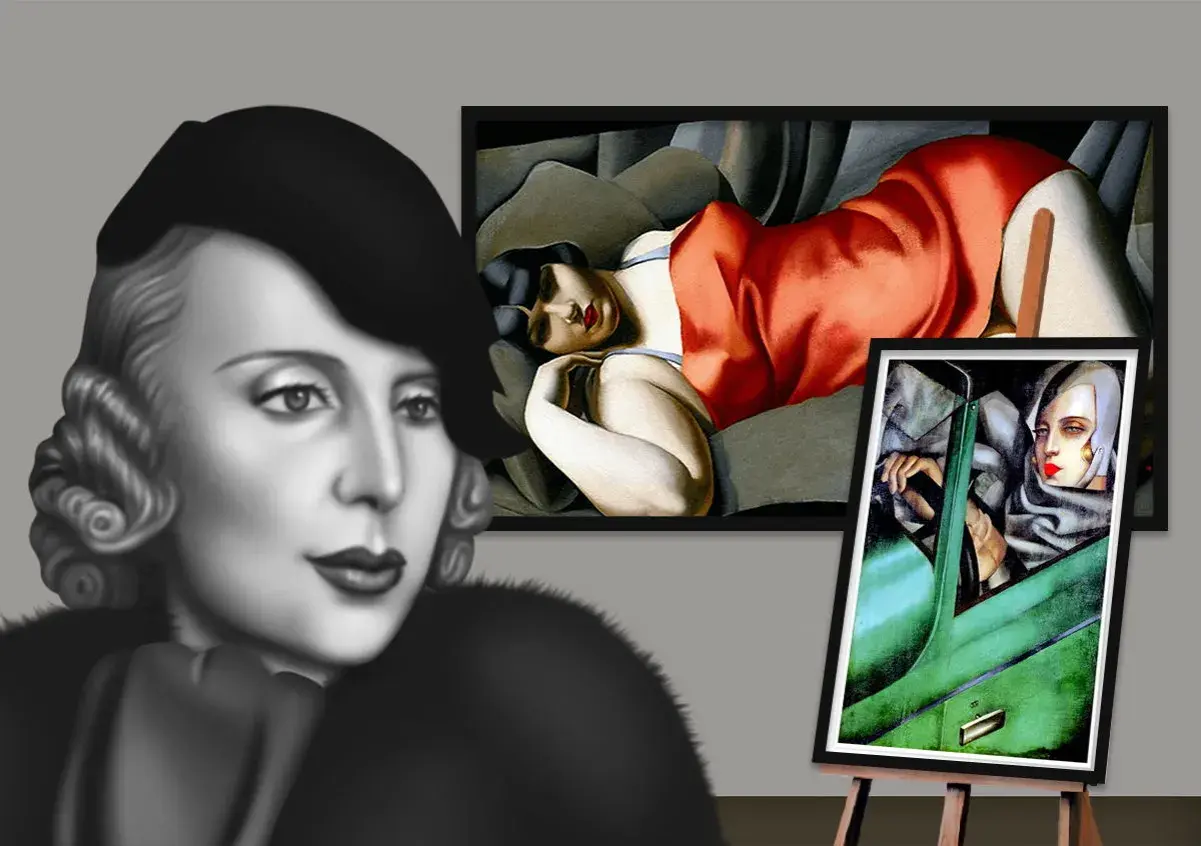
Kizette de Lempicka is the key to reading one of Tamara de Lempicka’s most revealing portrait cycles: the images of her only child, painted with the same polish the artist gave to aristocrats, models, and social icons. In this article I focus on who Kizette was, which portraits matter most, how to read their composition and style, and what provenance details matter if you are comparing museum records, catalogues, or private listings. That mix of biography and object-level detail is exactly where art history becomes useful rather than decorative.
The most useful facts to keep in view
- Kizette was Tamara de Lempicka’s daughter, born Marie Christine in 1916 and known throughout the family story as Kizette.
- The core portrait group includes Kizette in Pink (1926), Kizette on the Balcony (1927), and Sleeping Woman (Kizette) (1935).
- These works are not casual family snapshots. They are carefully staged Art Deco portraits built from pose, geometry, and atmosphere.
- For identification, the most useful checks are title, date, medium, dimensions, and provenance.
- The paintings matter because they connect a private subject to public museum collections and to the larger record of Tamara’s career.
Who Kizette was and why she matters
The Tamara de Lempicka Estate records her birth in 1916 as Marie Christine, nicknamed Kizette, and that detail helps keep the story grounded. She was not just a biographical footnote attached to a famous mother. She became one of the most repeated subjects in Tamara’s painting, which means her image can be used to trace changes in style, mood, and composition across more than a decade.
I think that is why Kizette matters to readers who care about artists and artworks rather than celebrity lore. Her presence gives us a stable reference point inside a career that moved between Paris, the United States, and later Mexico. Tamara even moved to Houston in 1963 to be closer to her daughter and family, which shows how long that bond remained part of the artist’s life. Once you see that, the portraits stop looking like isolated family keepsakes and start reading like milestones.
That leads naturally to the paintings themselves, because they are the clearest evidence of how Tamara framed her daughter.

The portraits that define her image
The portrait sequence is small, but it covers a surprising amount of ground. Size, pose, and setting change the meaning more than the name alone does, so I always compare the physical details before I talk about theme.
| Work | Year | Size / status | What to notice |
|---|---|---|---|
| Kizette in Pink | 1926 | 116 x 73 cm, Musee d'arts de Nantes, France | A formal, luminous portrait that makes childhood look composed and deliberate. |
| Kizette on the Balcony | 1927 | 130 x 81 cm, Centre Pompidou, Paris | A larger, more cinematic work that places the sitter at a literal threshold between interior and city. |
| Sleeping Woman (Kizette) | 1935 | 31 x 41 cm, private collection | A quieter, more intimate study where the mood turns inward and the scale becomes restrained. |
The paintings do not repeat a formula. The earliest one feels ceremonial, the balcony picture opens the space outward and introduces urban tension, and the sleeping figure compresses the subject into a quieter, more private register. If you are comparing catalogue descriptions, these shifts in scale and mood are often more revealing than the titles themselves. That formal variation is what makes the next section so important.
How Lempicka turned a family subject into Art Deco
Lempicka handled her daughter the way she handled many of her strongest sitters: she turned the body into architecture. The surfaces are polished, the contours are clean, and the faces often look composed rather than emotionally exposed. In art-historical terms, the pose in Kizette in Pink leans toward figura serpentinata, an S-shaped twist that makes a figure feel animated even when she is seated. That movement keeps the painting from becoming static.
- Kizette in Pink uses pale color and a near-iconic pose to make childhood look deliberate, almost ceremonial.
- Kizette on the Balcony places the figure at a literal threshold, with the city beyond her and the room behind her, which creates narrative tension.
- Sleeping Woman (Kizette) reduces the scene to rest and contour, so intimacy replaces display.
I would read these works as portraits of modern self-presentation, not as casual family scenes. That interpretation matters, because it leads directly to the questions curators and collectors ask next: who owns the work, how was it recorded, and has the title stayed stable over time?
What provenance records reveal
This is where the paper trail matters. The Metropolitan Museum of Art records a 1939 Lempicka painting as a gift from her daughter, which is the kind of object-level proof that keeps family history attached to an artwork instead of drifting into legend. The estate records also give exact dimensions and current locations for major Kizette portraits, which makes them useful benchmarks when you are comparing catalogue entries or auction listings.
When I verify one of these works, I check the same five things every time:
- Title and whether the catalogue uses an alternate wording.
- Date, especially if the same subject appears in more than one decade.
- Medium and size, because those are the fastest way to separate distinct works.
- Provenance, including museum ownership, estate records, or prior sales.
- Condition notes, because retouching, cleaning, and relining can change how the image reads.
For authentication, I trust a stable chain of records more than a dramatic story attached to a portrait. That caution is what keeps the final section practical rather than romantic.
What I would check before cataloguing a Kizette portrait
If a work is being presented as one of the Kizette portraits, I would treat the listing as provisional until the following details line up:
- The image matches a documented composition, not just a similar pose.
- The dimensions align with the known work.
- The support, medium, and surface finish fit Lempicka’s technique.
- The ownership trail does not jump over major gaps without explanation.
- The title is consistent across more than one reputable record.
That approach may sound conservative, but it is the right filter for an artist whose popularity has brought a flood of reproductions, title variants, and loosely described sales listings. The real value of the Kizette portraits is that they sit at the intersection of biography, style, and documentation, which makes them unusually good study pieces for anyone who cares about art history and authentication. They are also some of the clearest windows into how Tamara de Lempicka turned private life into enduring modern image-making.
