
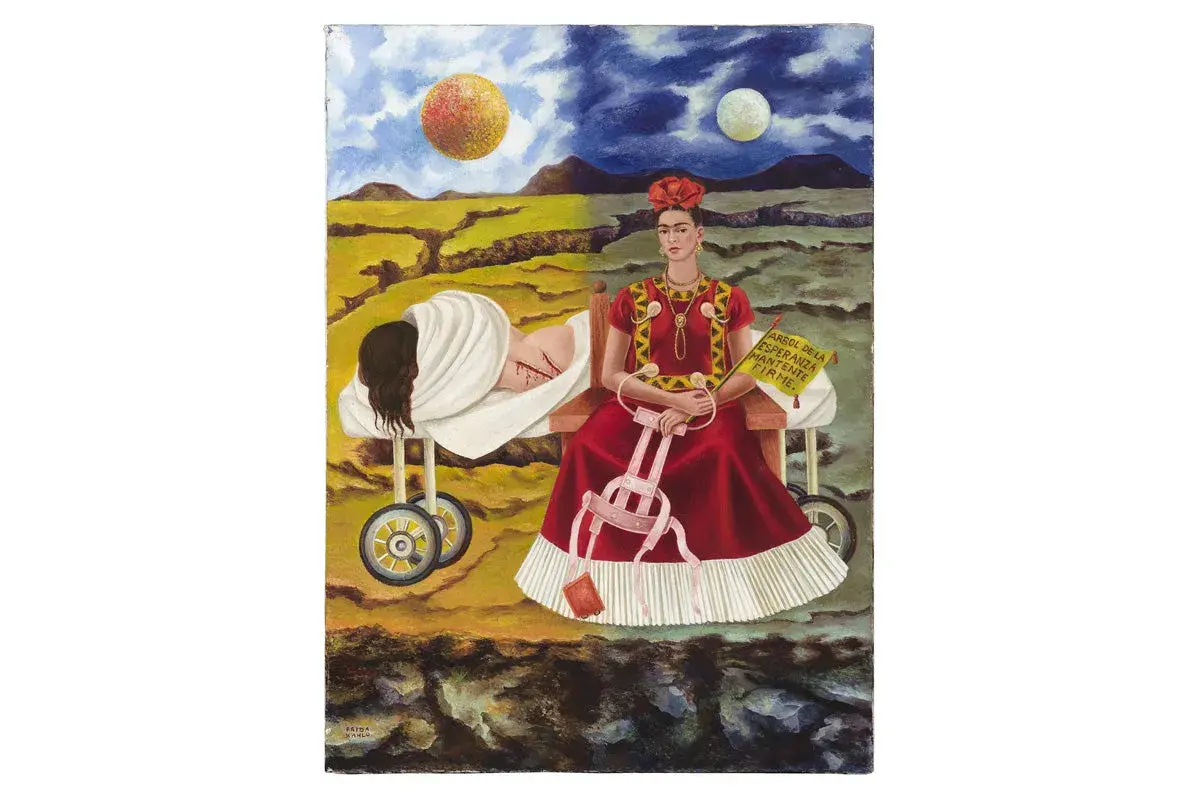
Frida Kahlo's work is instantly recognizable because it turns autobiography into visual structure. Her paintings mix direct portraiture, Mexican folk traditions, symbolic objects, and a blunt emotional register that makes even small canvases feel large in meaning. This article explains what defines Frida Kahlo style, how to read its recurring motifs, where the language came from, and why it still matters for art history and authentication.
Key points that explain her visual language
- Her strongest signature is self-portraiture used as psychological narrative.
- She favors frontal poses, flat space, intense color, and highly legible symbols.
- Mexican folk art, especially ex-votos, shaped her direct storytelling.
- Her imagery is personal first, but it also speaks about gender, pain, identity, and Mexican cultural pride.
- Style helps identify a Kahlo-like work, but provenance and materials still matter more than resemblance.
What actually defines her painting style
The easiest mistake is to reduce her to a few familiar accessories. In reality, Kahlo built a disciplined pictorial language: frontal composition, controlled space, and symbols that behave like evidence rather than decoration. One museum source counts 55 self-portraits, and that number makes sense when you look at her career as a long investigation into identity, injury, love, and memory.
The National Museum of Women in the Arts describes her early paintings as deliberately naive self-portraits with bright color and flattened forms, which is a useful shorthand. I would add one nuance: the apparent simplicity is intentional. The paintings look direct because she wanted the viewer to read them quickly, but their meaning deepens as soon as you notice how the body, background, and objects are staged.
That balance between clarity and ambiguity is the core of her style, and it leads naturally to the visual signs that make her work easy to recognize.

The visual signs that make it unmistakable
When I look at a Kahlo painting, I usually scan for a few recurring features. They do not appear in every work, but they form a dependable visual grammar.
| Element | What it often signals | Why it matters |
|---|---|---|
| Direct frontal gaze | Self-possession, confrontation, or emotional exposure | The viewer is not watching a scene from a distance; they are being addressed |
| Tehuana dress and floral adornment | Mexicanidad, cultural pride, and carefully performed identity | The clothing is part of the message, not costume dressing |
| Animals such as monkeys, dogs, birds, or deer | Companionship, desire, vulnerability, or symbolic doubles | Animals often carry the emotional burden that words cannot |
| Roots, thorns, or exposed anatomy | Pain, attachment, or the body as a site of struggle | Her figures often look physically tethered to the world |
| Doubling or mirrored selves | Conflict, separation, or a split identity | She uses repetition to show psychological fracture without relying on dramatic movement |
| Flat backgrounds and enclosed spaces | Interior focus and staged intimacy | The absence of deep perspective keeps attention on the body and the symbol |
What matters is not collecting motifs like a checklist. A flower in one painting may feel celebratory, while the same kind of floral detail in another work can sharpen the contrast between beauty and suffering. That is why her visual language stays interesting even after the first glance.
Once you know the surface language, the next question is what those symbols are doing emotionally.
What the symbols are doing emotionally
Kahlo's symbolism is usually read too quickly as either confession or fantasy. I think it works better as structured feeling: she organizes pain, desire, grief, and pride into images that have clear visual logic.
Pain without spectacle
In works such as The Broken Column or Henry Ford Hospital, pain is not abstracted into a mood. It is given shape, scale, and anatomy. That is important. She does not simply describe suffering; she makes it visible in a way that feels medically specific and emotionally direct at the same time.
Identity as doubling
In The Two Fridas, the doubled self is not a gimmick. It is a picture of relational and emotional division, and it shows how Kahlo could turn psychological conflict into composition. She often uses mirrors, paired figures, or repeated faces to suggest that identity is unstable, negotiated, and never entirely private.
Read Also: Mughal Miniatures - Uncover Their Secrets & Authenticity
Mexico as subject, not backdrop
Her cultural references are not ornamental. Mexican dress, folk imagery, plants, animals, and devotional forms all help her claim a specific place in visual history. Mexicanidad, the assertion of Mexican identity through culture and image, sits at the center of that project. She is not decorating herself with heritage; she is making heritage part of the painting's structure.
That emotional clarity came from more than biography, which is why the next section matters: her style was assembled from several traditions at once.
Where the language came from
Kahlo's style did not appear in isolation. It drew from family photography, Mexican popular art, religious votives, and the modernist circles around her. The result is a hybrid language that feels personal but is built from recognizable visual sources.
An ex-voto is a small votive painting offered in thanks after surviving illness, injury, or danger, and that devotional, matter-of-fact format is one of the clearest precedents for her work. Retablos, the broader devotional panels that include ex-votos, also helped shape her preference for plain storytelling and compressed space.
| Influence | What it contributes | How it shows up |
|---|---|---|
| Studio photography | Controlled pose, frontal framing, and attention to likeness | Her portraits often feel staged and deliberate rather than spontaneous |
| Ex-votos and retablos | Direct storytelling, flattened space, and narrative immediacy | Scenes of injury, survival, or emotional crisis are presented with almost devotional clarity |
| Mexican folk art | Bright color, strong outlines, and handmade directness | Her surfaces often look clear and graphic instead of painterly in a European academic sense |
| Pre-Hispanic and indigenous imagery | Earth connection, symbolic animals, and a non-European sense of body and landscape | Roots, vegetation, and body-land relationships appear again and again |
| Modernist and surrealist circles | Permission to distort, displace, and symbolize | Impossible pairings and dreamlike tensions enter the work, even when she rejected the label |
A useful way to think about this is that Kahlo borrowed structure from folk traditions and intensity from lived experience. She did not need elaborate perspective or grand narrative space because the image itself already carried the drama. That distinction becomes clearer when her work is compared with the movements people most often place around it.
How it differs from surrealism and muralism
Kahlo is frequently discussed alongside surrealism because her images can look dreamlike or impossible. She was also admired by surrealists in her lifetime. But the match is imperfect, and I think it matters to say that plainly: her paintings are not built from unconscious free association in the way surrealist theory often imagines.
| Movement or mode | What it tends to do | How Kahlo differs |
|---|---|---|
| Surrealism | Stresses the dream, the unconscious, and visual rupture | Her images usually feel grounded in biography, body, and cultural reference rather than pure dream logic |
| Mexican muralism | Uses large public narratives, history, and political messaging | Her work is intimate, portable, and centered on individual experience rather than public spectacle |
| Folk or naïve art | Relies on directness, flattened space, and plain storytelling | She borrows the clarity, but the symbolism is more psychologically dense and self-aware |
This is why her own statement that she painted her reality, not dreams, still feels useful. It does not mean the work is literal. It means the distortions are rooted in lived conditions, not just invention. When you read her paintings this way, the images stop looking eccentric for their own sake and start looking exact.
That exactness is also the reason her work can be studied carefully by curators, conservators, and appraisers.
How I would read a work like a curator
If I were examining a Kahlo painting in a museum or a collection, I would begin with context before style. Style tells you how the work speaks; context tells you whether you are listening to the right artist, period, and material history.
- Start with the body. Ask whether the figure is frontal, self-contained, wounded, doubled, or tethered to objects.
- Read the symbols as narrative evidence. Thorns, hair, roots, corsets, animals, and clothing usually mean something specific, not just decorative ambiance.
- Check the painting's scale and surface. Many Kahlo works are intimate, controlled, and visually compressed rather than expansive or gestural.
- Separate influence from authorship. A work may feel Kahlo-like without being by Kahlo, which is why provenance, materials, inscriptions, and exhibition history matter so much.
That last point matters more than many people expect. In attribution, style is a clue, not a verdict. A convincing visual echo can be produced by homage, imitation, or later reference, so a serious reading always combines connoisseurship with documentary evidence.
When the style is copied too loosely, the result usually loses what made it powerful in the first place: the tight connection between image, memory, and self-knowledge.
The details I would check before calling something Kahlo-like
The easiest way to flatten her legacy is to turn it into a look. Flowers, braids, brows, and bright dresses can all be copied, but that does not recreate the structure underneath. If I were evaluating a work or even reading an inspired contemporary piece, I would ask three practical questions.
- Does the image carry a specific emotional argument, or is it only borrowing the surface of her iconography?
- Do the symbols fit together with internal logic, or do they feel pasted on for style?
- Is there any material or documentary support that places the work in the right maker, period, and context?
The reason this matters is simple: Kahlo's lasting power comes from coherence. The body, the symbols, the composition, and the cultural references all pull in the same direction. When they do, the painting feels unavoidable; when they do not, the image becomes a costume, and the meaning goes flat.
That is the point I would leave readers with: the most important part of her style is not the obvious imagery, but the precision with which she used it to make private experience visually legible.
