
Understanding el greco meaning starts with a nickname, but it quickly opens into something larger: how a Greek-born painter turned religious subjects, portraits, and landscapes into some of the most charged images in European art. In this article, I break down what the name refers to, why his figures look so unusual, how to interpret the symbolism in his best-known works, and why condition, restoration, and attribution matter when you are reading his paintings today.
The short version is that El Greco turns theology into atmosphere
- El Greco means “the Greek” in Spanish, and the nickname points to Domenikos Theotokopoulos’ origin, not to a school or technique.
- His stretched bodies, sharp contrasts, and unstable space are deliberate expressive tools, not simple mistakes in proportion.
- His major works are easier to read when you separate subject matter, composition, and spiritual intent.
- Condition matters: varnish, overpaint, and old restorations can change how his color and light are perceived.
- The paintings still feel modern because they privilege inner intensity over naturalistic description.
What the name tells you and what it does not
El Greco is a Spanish nickname that literally means “the Greek.” It identifies Domenikos Theotokopoulos, the artist’s birth name, and points to his Cretan background. That detail matters because he began in the world of Byzantine icon painting, where images are meant to guide devotion rather than imitate everyday vision. I think that origin explains a great deal: even when he later absorbed Venetian color and Roman ambition, he never fully abandoned the idea that a painting should do more than look correct.
His name is biographical, not stylistic. It does not mean “Greek style” or “Greek school,” and it certainly does not reduce his work to ethnicity alone. He signed some works with his full Greek name, which makes the nickname feel even more like an outside label than a self-chosen identity. That tension, between the name given by others and the visual language he built for himself, is part of the story behind his art. From there, the more interesting question becomes how his style turns that identity into meaning.
Why his figures feel stretched, luminous, and unsettled
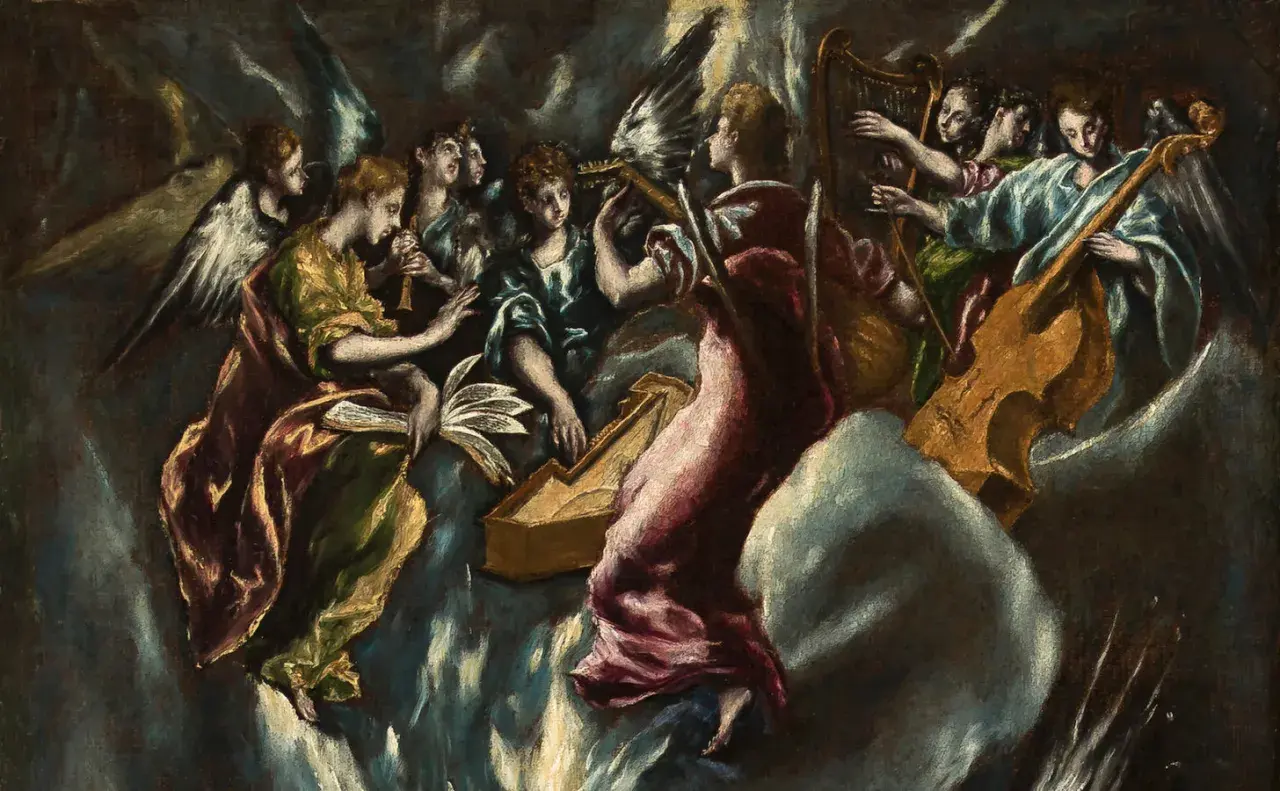
The first thing most people notice in El Greco is the distortion: long limbs, narrow faces, bodies that seem lifted out of ordinary gravity. I would resist calling this merely “unrealistic.” In his best paintings, elongation is a strategy. It takes human figures away from the ordinary and makes them feel devotional, visionary, or spiritually strained. That is why his bodies often look less like anatomical studies and more like instruments of inner emotion.
This is where Mannerism helps as a term. Mannerism was a late-Renaissance style that favored tension, elegance, and complexity over calm balance. El Greco uses it differently from many of his contemporaries. He pushes it toward intensity. Hands become eloquent. Eyes point upward. Fabrics flare like flames. Space compresses, then suddenly opens. The effect is not decorative. It tells you that the scene is not being recorded; it is being interpreted.
Color works the same way. His skies often seem charged with weather or revelation, and his greens, blues, and whites do more than model form. They create a spiritual temperature. When I look at an El Greco painting, I rarely ask first whether the anatomy is “correct.” I ask what emotional and religious pressure the image is trying to hold. That leads directly to his major works, where the symbolic language becomes much easier to see.

How to read his major paintings without flattening them
El Greco’s meaning becomes clearest when you treat each painting as a visual argument, not just a scene. Some works are devotional images, some are portraits, and some are almost philosophical statements about heaven, earth, and the role of the city. The Met has described View of Toledo as a kind of spiritual portrait of the city, and that phrase is useful because it captures his method: he begins with reality and then alters it to express conviction.
| Work | What stands out | What it suggests |
|---|---|---|
| View of Toledo | Storm-dark sky, rearranged skyline, heightened contrast | The city as a sacred vision rather than a literal map |
| Christ Carrying the Cross | Isolated figure, close emotional focus, upward gaze | Suffering framed as willing sacrifice and inward endurance |
| The Burial of the Count of Orgaz | Split between earthly burial and heavenly presence | A bridge between human virtue, ritual, and divine reward |
| Opening of the Fifth Seal | Writhing figures, urgent color, apocalyptic energy | Ecstasy, revelation, and the instability of the physical world |
| Portrait of an Old Man | Direct presence, spare background, psychological density | Portraiture as character study, not social display |
These works are easier to interpret if you separate iconography from composition. Iconography is the subject and its traditional symbols; composition is how those symbols are arranged. In El Greco, both matter. A cross, a saint, or a burial scene has its normal religious meaning, but the way he frames the body, light, and space changes the emotional force of the image. That is why the same subject can feel serene in one painter and severe or ecstatic in El Greco. Once you see that distinction, the next step is to ask whether the painting you are looking at still reflects the artist’s hand as intended, or whether later changes have altered its effect.
Why condition and conservation change interpretation
For an artist like El Greco, preservation is not a side issue. It is part of interpretation. Darkened varnish can mute his blues and greens. Overcleaning can make forms seem harsher than he intended. Old retouching can hide transitions in drapery or sky. If you are trying to understand his work, you have to remember that what reaches the eye in a museum may not be the raw original surface.
This is also where authentication becomes relevant. Curators and conservators do not rely on style alone. They look at the support, pigments, brushwork, provenance, and technical imaging. A technical study can reveal pentimenti, which are the artist’s earlier changes preserved beneath the final layers of paint. Those revisions matter because they show thought in motion. In El Greco’s case, they can help confirm authorship and, just as importantly, clarify how the image was built.
I would be cautious with any reading that ignores condition. A painting that has been heavily restored may still be authentic, but its tonal balance can be distorted. That is not a small technical point; it changes the mood of the work. Once you know that, it becomes easier to understand why El Greco can look radically modern in one reproduction and far softer in another. That leads to the question of why his art keeps feeling contemporary at all.
Why his work still feels modern in 2026
El Greco is often discussed as a precursor to Expressionism or even Cubism, and there is a reason for that. He does not treat the visible world as something to copy neutrally. He bends it to reveal tension, vision, and belief. That approach matters now because modern viewers are used to art that can be psychological, subjective, and intentionally unsettled. He fits that way of seeing with surprising ease, even though he worked centuries earlier.
What I find most enduring is his refusal to separate form from feeling. The sky in a landscape is never only weather. A portrait is never just likeness. A saint is never only a saint. Every major element carries emotional and theological weight. That is why his paintings still reward slow looking. They do not give up their meaning at a glance, and they do not reduce themselves to one simple interpretation. Instead, they ask the viewer to read shape, color, gesture, and context together.
That is also why his reputation remains strong in museums, scholarship, and conservation practice. His paintings are not only famous objects; they are tests of how carefully we look. The more accurately we read them, the less likely we are to mistake intensity for error.
What I would look for first in front of an El Greco
If I were standing in front of one of his paintings, I would start with three things: the subject, the direction of movement, and the quality of light. First, ask whether the work is devotional, narrative, portrait-like, or civic. Second, notice where the bodies and gazes lead you. El Greco is an expert at making the eye rise, bend, or hover instead of settling. Third, look at how light is used. In his hands, light is rarely just illumination; it is often the sign of another realm pressing into the scene.
Then I would ask a practical question: what might have changed since the painting left his studio? Condition, varnish, and restoration can alter the reading, and that is especially important with an artist whose color and atmosphere do so much of the interpretive work. If you keep that in view, the meaning becomes more precise and less mystical in the vague sense. You are not guessing at symbolism. You are tracing how the painting constructs belief, emotion, and space. That is the most reliable way to understand El Greco, and it is the reason his work still feels alive rather than merely historical.
