
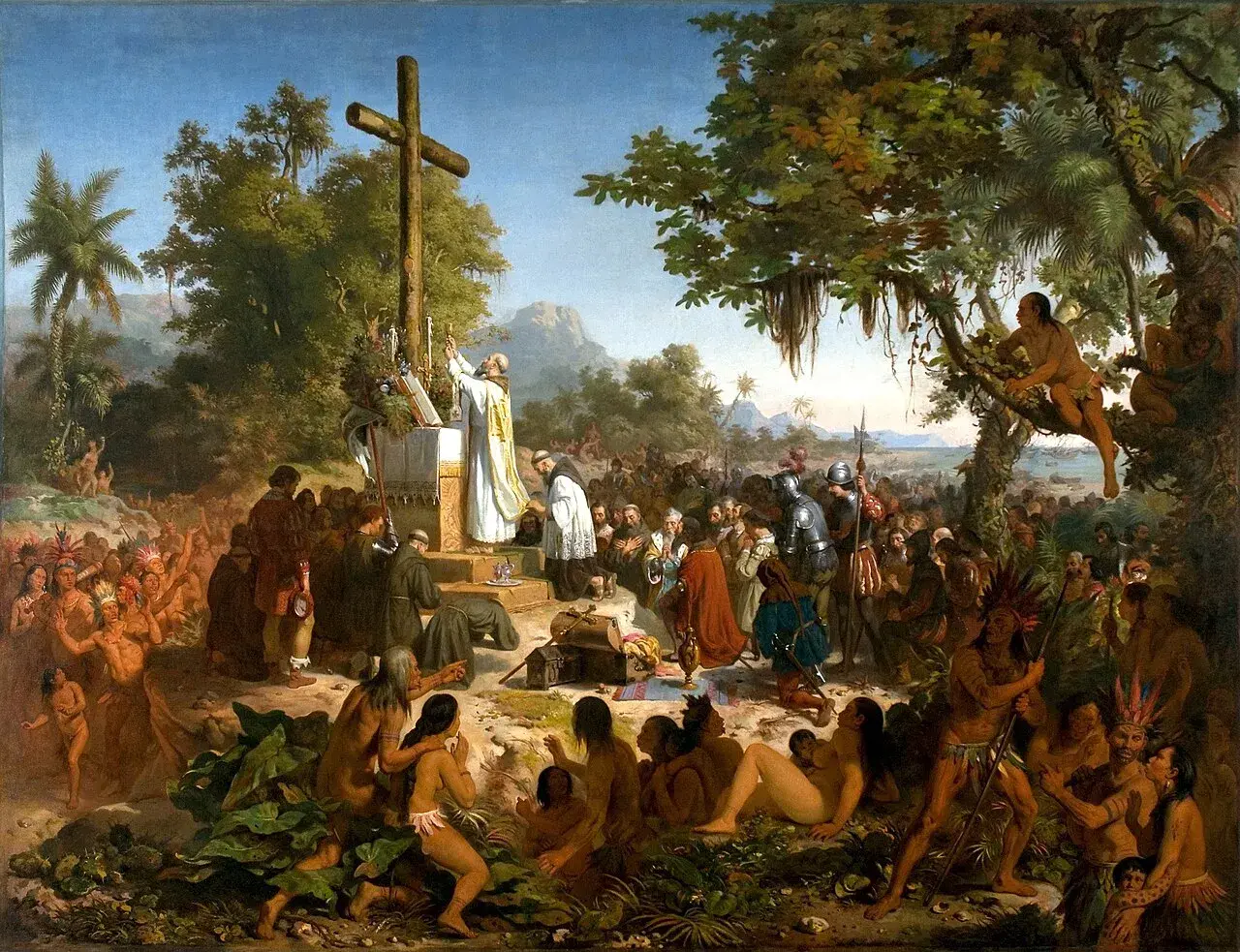
I read Brazilian visual culture as a history of translation rather than imitation. In art in Brazil, Indigenous traditions, colonial Baroque, modernist rebellion, and contemporary experimental practice all matter at once, and that mix is what gives the country’s art such range. This article maps the major styles and movements, explains how they differ, and gives you a practical way to read or evaluate the work.
The movements that matter most at a glance
- Brazilian art does not begin with modern painting; it starts with Indigenous visual systems, then colonial religious art, then academic institutions.
- The 1922 Modern Art Week in São Paulo marked a decisive break from academic imitation and pushed artists toward a distinctly Brazilian modernism.
- Concretism favored geometry and visual logic, while Neo-Concretism brought the body, touch, and participation back into the work.
- Political pressure in the 1960s and 1970s made Brazilian art more conceptual, performative, and openly critical.
- Contemporary practice is plural: Indigenous, Afro-Brazilian, urban, environmental, and installation-based work all sit inside the current field.
- For preservation and authentication, provenance, materials, and condition matter as much as style.
Brazilian art begins with layered traditions, not one origin
When I trace the visual history of Brazil, I do not see a single founding style. I see layers. Indigenous communities created ceramics, body painting, feather work, weaving, and ritual objects long before the colonial period, and those traditions remain fundamental because they treat art as part of social life rather than as isolated decoration. Later, Portuguese colonial rule introduced churches, altarpieces, gilded carving, and imported academic ideals, especially in the Baroque period, which dominated the 17th and 18th centuries.
The useful way to read this early period is to look at function as much as form. Religious art served catechesis and public display; elite portraiture helped build status; and Indigenous forms preserved knowledge, identity, and ceremony. Even when European models were copied, they were often adapted to local labor, local materials, and local belief systems. That is why Brazilian art history is best understood as a conversation between imported styles and local reinvention.
| Period | Visual language | What it tells you | Common materials |
|---|---|---|---|
| Indigenous traditions | Pattern, body, ritual, symbolism | Art as social memory and lived practice | Clay, pigment, fibers, feathers, wood |
| Colonial Baroque | Drama, ornament, religious intensity | Art as persuasion, devotion, and power | Wood, gold leaf, stone, painted surfaces |
| Academic period | Order, realism, hierarchy, portraiture | Institutional art and European training | Oil on canvas, sculpture, drawing |
Once you see these foundations, the later movements make more sense, because Brazilian modernism did not appear out of nowhere. It reacted against them, borrowed from them, and in some cases tried to overturn them entirely.

Modernism made Brazilian identity the subject
The real rupture came in the 1920s, especially with the Semana de Arte Moderna in São Paulo in 1922. That event did not simply introduce new styles; it announced that Brazilian artists could stop measuring themselves against European academic standards. Painters, sculptors, writers, and architects began to insist that Brazilian life, language, landscape, and social tension were worthy subjects in their own right.
MoMA has described Tarsila do Amaral’s 1920s production as pivotal to modernism in Brazil, and that is the right place to start if you want a clear visual anchor. Her work, along with Anita Malfatti, Di Cavalcanti, and Victor Brecheret, helped move Brazilian art away from polished imitation and toward compressed forms, bold color, and local imagery. Tarsila’s Abaporu became a symbol not because it was merely unusual, but because it condensed a larger idea: Brazil could absorb outside influence and transform it into something new.
That idea was sharpened by Oswald de Andrade’s Anthropophagic Manifesto of 1928. The metaphor of “cannibalizing” foreign influence is often misread as provocation for its own sake. I think that is too shallow. The point was strategic: Brazil would not reject Europe outright, but it would digest, rearrange, and reissue European forms on its own terms. In practice, that meant modern Brazilian art often looks hybrid on purpose.
- What changed visually: flatter shapes, brighter color, simplified figures, and a stronger connection to Brazilian landscapes and social types.
- What changed conceptually: art stopped being a test of European correctness and became a tool for cultural self-definition.
- What beginners miss: Brazilian modernism is not a copy of French modernism with tropical motifs; it is a different argument about identity.
That modernist turn also opened the door to experimentation beyond painting, which is why performance, sculpture, and installation become so important in the next phase.
Concretism and Neo-Concretism changed what a work could be
If modernism asked what Brazil looked like, Concretism asked how far art could be stripped down before it became pure structure. The movement favored grids, serial forms, hard edges, and precise geometry. It was intellectually rigorous and, at its best, extremely disciplined. The Guggenheim Bilbao notes that Neo-Concretism emerged as a reaction against the rigidity of Concrete Art, and that distinction matters because it explains the next turn in Brazilian art history.
Neo-Concretism did not abandon geometry so much as make it human again. Artists such as Lygia Clark, Lygia Pape, Hélio Oiticica, and the poet Ferreira Gullar pushed beyond the flat picture plane and asked the viewer to handle, move through, or complete the work. In other words, the art stopped pretending that vision was the only sense that mattered.
| Movement | Main idea | What the viewer does | Why it matters |
|---|---|---|---|
| Concretism | Geometry, clarity, serial order | Looks and reads | Turns art into a precise visual system |
| Neo-Concretism | Embodiment, tactility, subjectivity | Touches, enters, completes | Makes art an event rather than a static object |
From a preservation standpoint, this is where things get complicated. A Neo-Concrete work may depend on instructions, installation logic, or audience participation rather than a single fixed object. If I were cataloging such a piece, I would not stop at medium and dimensions. I would want fabrication notes, display history, photographs of prior installations, and any artist-approved reconstruction details. Without that context, the work can be misread or badly restored.
Political pressure pushed Brazilian art toward concept and action
The 1964 military coup changed the atmosphere around visual culture. As censorship tightened, many artists stopped relying on straightforward depiction and moved toward coded imagery, conceptual strategies, performance, and public intervention. This was not just an aesthetic trend. It was a response to constraint.
Hélio Oiticica’s Tropicália is a good example because it sits at the intersection of color, environment, and social critique. It is often discussed as installation, but it is also part of a wider cultural attitude: vivid, improvised, urban, and politically aware. Artists such as Cildo Meireles and Rubens Gerchman used circulation, language, and ordinary materials to challenge official narratives. The work became less about a finished object hanging quietly on a wall and more about how meaning moved through the public sphere.
- Common strategies: performance, text, found materials, repetition, and participation.
- Common themes: censorship, inequality, mass culture, and state power.
- Frequent mistake: treating Brazilian conceptual art as a local variation of European minimalism. The politics are different, and so is the emotional temperature.
One detail I always find useful is this: Brazilian political art is rarely only negative or purely accusatory. Even when it is sharp, it often keeps a sense of color, wit, or bodily presence. That tension is part of what makes it distinctive.
Contemporary Brazilian art is broader than one national style
Today, I would be cautious of anyone who tries to summarize Brazilian art with a single visual formula. The field is too diverse. Indigenous self-representation has become much more visible, Afro-Brazilian artists are reshaping how memory and power are discussed, and artists working in the cities often mix painting, photography, video, sound, embroidery, and installation without worrying about whether the result fits one clean category.
That shift is not only stylistic. It is institutional. More than 300 Indigenous peoples live in Brazil, and their growing presence in galleries and museums has pushed curators to rethink who gets to define national art history. The same is true of Afro-Brazilian practices, which have become more prominent in discussions of heritage, repatriation, and cultural memory. What matters now is not just that these artists are visible, but that they are changing the framework itself.
- Recurring themes: land, extraction, race, urban inequality, ritual, climate, and belonging.
- Common media: installation, performance, video, photography, textile work, and public intervention.
- What collectors and readers should notice: contemporary Brazilian art often resists a single “Brazilian look” on purpose.
For me, that refusal is one of the healthiest signs in the field. It means the art is not trapped in a postcard version of national identity. It can be local, critical, experimental, and specific at the same time.
How to evaluate Brazilian works without flattening their context
If you are looking at Brazilian art through a preservation or authentication lens, style is only the first layer. The better question is whether the object, its materials, and its documentary trail make sense together. A convincing attribution is not built on a dramatic signature or a familiar subject alone. It depends on the whole evidence chain.
Provenance
Ask where the work has been, who owned it, when it was exhibited, and whether there are archival references, invoices, labels, or catalog entries. For modern and contemporary works, that paper trail can be as important as the image itself. For older colonial works, church inventories, restoration records, and regional scholarship matter just as much.
Materials
Materials should match the supposed period and movement. A 1930s modernist canvas should not behave like a recent acrylic imitation unless there is a clear explanation. A Baroque devotional object should show the logic of its era, including the right support, gilding practices, and surface wear. If a work claims to be participatory or installation-based, the artist’s own instructions become part of the material record.
Read Also: American Realism Art - A Guide to Its History & Meaning
Condition
Brazil’s climate has always made conservation a real issue, especially for paper, textile, wood, and mixed-media works. As a practical rule, stable conditions matter more than perfect numbers, but a relative humidity around 45-55 percent and temperatures near 18-22°C are generally safer than swings. Too much cleaning can erase original texture, while too little care can leave a work unstable. In a market where Brazilian works can travel quickly between private and institutional settings, that balance is not cosmetic; it is evidentiary.
If I had to give one final rule, it would be this: read Brazilian art slowly. Do not force it into a European timeline, and do not reduce it to color, tropicality, or political slogan. The strongest work rewards attention to context, material, and history, and that is where its real intelligence usually sits.
