
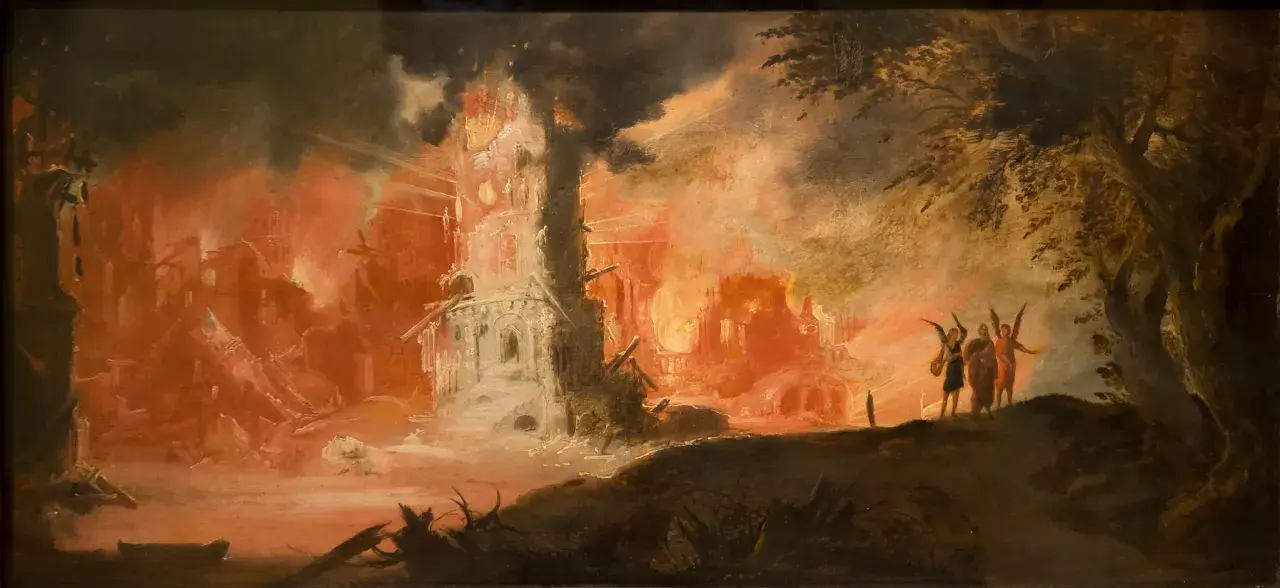
A painting of the destruction of Sodom and Gomorrah is rarely just a spectacle of fire. In a destruction of Sodom and Gomorrah painting, the real subject is often the boundary between judgment, rescue, and memory: who escapes, who looks back, and what the viewer is meant to feel about both. I read these works as visual theology with a landscape problem, because artists have to turn a biblical warning into something the eye can follow in a single glance.
The image usually balances judgment, rescue, and memory
- The core story comes from Genesis 19, but artists usually compress it into one decisive instant.
- Lot’s wife is the moral hinge, often shown as a pillar of salt, a frozen figure, or a vertical white form.
- Fire, red skies, lightning, and smoke usually signal divine judgment, while angels and paths mark mercy and escape.
- The best works use scale and placement to separate the doomed city from the surviving family.
- Medium matters: panel, canvas, tempera, and later revisions can change how clearly the symbols read.
What the biblical story contributes to the image
Artists almost never illustrate the whole chapter at equal weight. They usually choose one of three moments: the warning before destruction, the catastrophe itself, or the aftermath when Lot’s family has already crossed into exile. That choice matters, because it tells you whether the painting is trying to narrate an event, stage a moral lesson, or frame the story as an apocalypse.
For that reason, I start by asking what the painter gives the most space to. If the city is tiny and the sky is huge, the work leans toward judgment as cosmic force. If Lot and his daughters are closer to the foreground, the emphasis shifts to rescue and survival. And if Lot’s wife is isolated, the image becomes a warning about looking back, not just a record of disaster.
That basic structure is what lets the same scriptural passage support very different kinds of paintings, from late medieval landscapes to 19th-century Romantic drama. Once that is clear, the next layer is the visual grammar that makes the story instantly readable.
How artists build symbolism into the composition
I usually read these scenes from the largest forms downward. The broadest shapes tell you the moral hierarchy before the details do, and that hierarchy is what makes the image work.
| Visual cue | What it does in the image | What it usually means |
|---|---|---|
| Burning city | Pushes the eye toward the catastrophe and anchors the whole composition | Divine judgment, corruption made visible, the end of a civic order |
| Angels | Create direction and movement, especially when they lead the family away | Mercy, intervention, and the difference between the saved and the condemned |
| Lot’s wife | Freezes motion and interrupts the flow of escape | Disobedience, memory, punishment, and the cost of looking back |
| Red sky or smoky cloud | Sets the atmosphere before the viewer even sorts out the figures | Irreversible loss, apocalyptic scale, and the emotional temperature of the scene |
| Mountain, road, cave, or tent | Separates the rescued family from the destroyed city | Exile, survival, and the uneasy continuation of family history |
| Diagonal flash of light or lightning | Slices the canvas and directs attention across the danger zone | A structural divider between the doomed background and the surviving foreground |
What matters is not the symbol alone but the placement. A pillar of salt in the center is not the same as one shrinking at the edge, and a red sky behind the family is not the same as fire engulfing the family’s route. The composition decides whether the scene reads as terror, warning, or a hard-won escape. That is why the most successful paintings feel organized rather than merely dramatic.
How major painters changed the emphasis over time
Early Northern landscape painters such as Joachim Patinir and Herri met de Bles established a pattern that later artists kept reshaping: the biblical event becomes part of a wider world rather than a stage scene with a painted backdrop. In that tradition, the landscape is not decorative. It is the narrative engine.
| Work | Visual emphasis | Symbolic effect | Why it matters |
|---|---|---|---|
| Joachim Patinir, Landscape with the Destruction of Sodom and Gomorrah, c. 1520 | The burning city is absorbed into a sweeping landscape, while the rescue scene remains small and controlled | Nature becomes a moral stage; the biblical event feels distant but unavoidable | It shows how early landscape painting can carry theology without crowding the canvas with figures |
| Camille Corot, The Burning of Sodom, 1843 and 1857 | An angel hurls fire and brimstone while another leads Lot and his daughters away; Lot’s wife is already a pillar of salt | The story reads clearly as a sequence of warning, destruction, and consequence | The revised version shows how a painter can tighten the narrative and make the moral arc more direct |
| John Martin, The Destruction of Sodom and Gomorrah, 1852 | The center becomes a swirling inferno, with lightning and a strong split between background ruin and foreground escape | Apocalypse, terror, and the sense that the sky itself has turned against the city | Martin turns the biblical scene into a Romantic catastrophe without losing the theological structure |
| Henry Ossawa Tanner, Destruction of Sodom and Gomorrah, 1929-1930 | A greenish-blue sky, smoky conflagration, and barely visible figures reduce the story to atmosphere | The event feels inward, distant, and almost spiritual rather than theatrical | It shows how modern biblical painting can rely on color and restraint instead of narrative clutter |
The big shift across centuries is from narration to mood. Patinir asks the viewer to read the event inside a landscape; Corot keeps the story legible; Martin enlarges it into spectacle; Tanner pares it down until color and atmosphere do most of the theological work. I find that progression useful because it shows the subject is never fixed; it responds to the artist’s idea of what divine judgment should feel like. Tanner returned to the theme more than once, which tells you how elastic the motif remained for modern biblical painting.
Why medium and condition change what you read
This is where preservation and iconography meet. On older panel paintings, the support itself can matter: wood movement, craquelure, and darkened varnish can reduce the contrast that makes fire, smoke, and tiny figures readable. In other words, the surface is not just a technical issue. It affects whether the symbolism lands at all.
Oil on panel often preserves sharp detail, which helps when the artist hides Lot’s wife or the fleeing family in a corner of the composition. Oil on canvas can support broader atmospheric effects, which suits painters who want the sky to dominate. Tempera and varnish, as in Tanner’s late work, can create an unusual luminosity that pushes the scene away from literal illustration and toward something more interior.
Revisions matter too. Corot’s decision to cut down and repaint his canvas changed the visual balance, not just the frame size. That is a reminder I return to often: when a biblical subject depends on relationships of scale, light, and distance, even a later restoration or trimming can alter the meaning you think you are seeing.
So when I move from interpretation to assessment, I start asking which parts of the image are original to the artist’s design and which parts may now be distorting that design.
What I check first when I assess this subject
When I look at one of these works, I ask five practical questions before I start interpreting it too broadly:
- Is the rescue route visible, or has the artist hidden it inside the landscape?
- Does Lot’s wife stand apart from the moving group, or is she absorbed into it?
- Is the fire literal, meteorological, or nearly abstract?
- Does the city burn in the distance, or does it occupy the center of the drama?
- Do the figures remain legible at the intended viewing distance, or has condition swallowed the narrative?
If those answers are clear, the symbolism usually is too. The strongest versions of the subject do not just show destruction; they organize hope, warning, and aftermath in the same frame, then force you to notice where your eye wants to rest. For conservation or authentication, I add one more test: whether the paint surface still supports the intended hierarchy of light, distance, and movement. When that hierarchy survives, the image remains readable; when it breaks, the scene turns into generic fire and loses its theological edge.
