
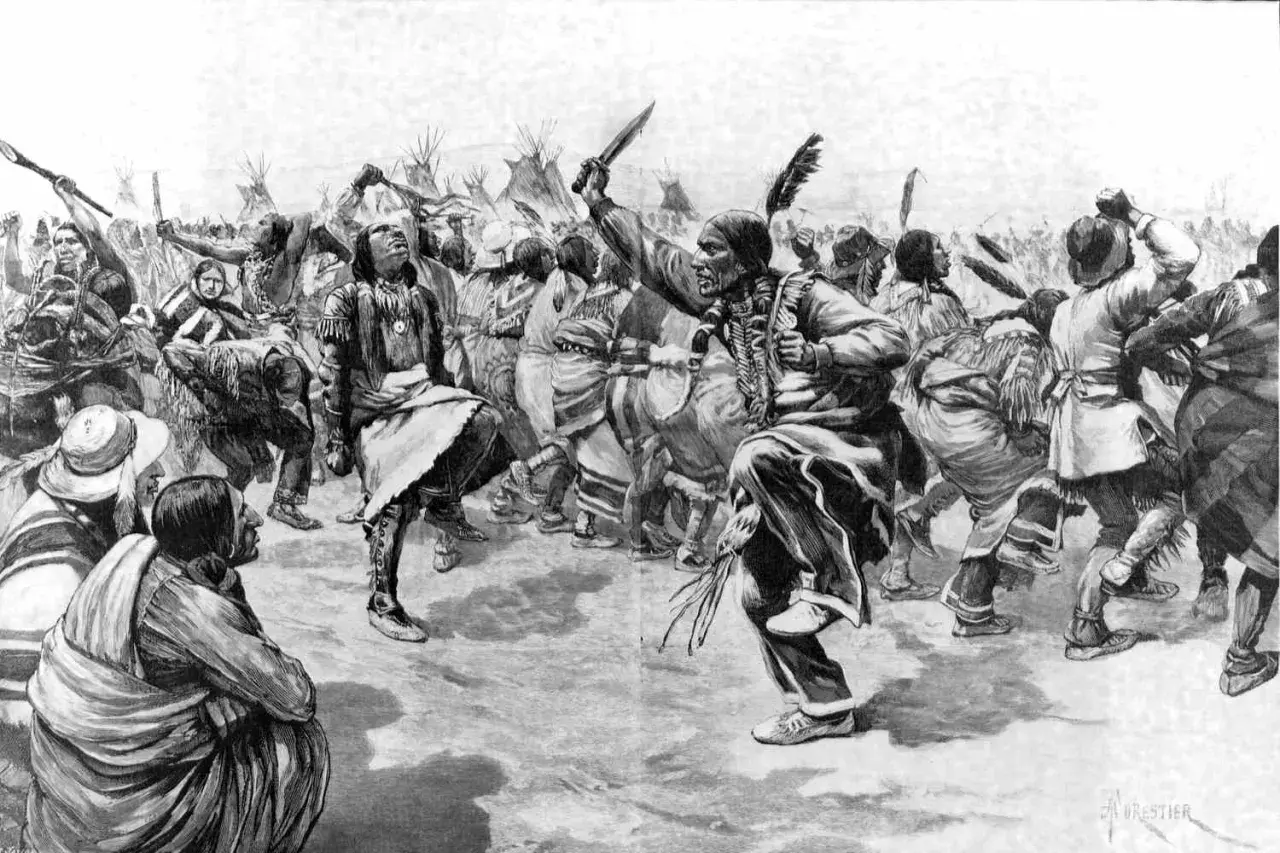
The visual language of the Ghost Dance is compact but powerful: circles, center poles, feathers, sky motifs, and garments painted for spiritual protection. To understand ghost dance symbols, I start with the ceremony itself, because the imagery makes sense only when it is read as part of a religious movement, not as isolated decoration. This article breaks down the main motifs, explains how they functioned in ritual, and shows how to read the surviving objects with the care they deserve.
What matters most about the Ghost Dance is its language of renewal and protection
- The Ghost Dance was a spiritual movement, so its imagery worked as ritual language rather than ornament.
- Its core visual system centered on the circle, a central pole or tree, feathers, and sky-related motifs.
- Ghost shirts and dresses were sacred garments; for some Lakota believers, they were also protective amulets.
- Symbol meanings were not fixed across all Native nations, so tribal context matters.
- In museum collections, provenance and material details are as important as the design itself.

The movement turned belief into a visible form
In art-history terms, the Ghost Dance is not a formal style in the way that Impressionism or Cubism is a style. It is a religious revival movement with a strong visual code, and that is exactly why it matters to historians of art and material culture. The imagery points toward restoration: the return of ancestors, the renewal of the land, and a moral order that had been damaged by violence, hunger, and forced assimilation.
That is why the iconography never feels casual. The visual signs were carrying spiritual weight, social memory, and political urgency at the same time. When I read these objects, I see a people building hope into material form, not just making something beautiful to look at. That distinction is essential, because the next layer is the ceremony itself, where the visual system becomes even clearer.
The circle, the pole, and the song gave the ceremony its structure
The best-known image associated with the Ghost Dance is the ring of dancers holding hands and moving clockwise. That circle was not a decorative choice; it organized the ritual and made community visible. In many accounts, the dance was performed without drums, which matters because it shifts attention toward the body, the voice, and the surrounding visual field rather than toward percussion.
Some communities placed a pole or young tree at the center of the circle, while others used a different marker or none at all. That central vertical element acts almost like an axis in the composition, tying earth to sky and the gathered group to a sacred center. Dancers might also focus on a feather or cloth waved within the circle, a practical aid for trance and vision, which shows how closely movement, attention, and symbol were linked.
One of the more interesting details is the occasional use of an American flag at the center or within the circle. Read badly, that can look like contradiction. Read carefully, it shows how the ceremony could absorb local realities and turn them into part of the ritual field. That flexibility becomes even more obvious when the focus shifts from the dance space to the garments themselves.
Ghost shirts and dresses were wearable sacred objects
Ghost shirts and dresses were not costumes in the modern theatrical sense. They were ritually prepared garments, usually painted and sometimes fringed or adorned with feathers, made to participate in the ceremony rather than merely depict it. In the Smithsonian collections, the object records for these garments emphasize exactly that material specificity: cotton cloth, paint, feather attachments, and sewn or fringed construction.
Designs often came to individuals in visions during ceremonies, which means the imagery could be deeply personal while still belonging to a wider spiritual movement. That is one reason the garments feel so alive in the historical record. They were meant to hold a vision, not simply display one. In some Lakota contexts, believers also attributed protective power to the shirts, which is why later observers called them “bulletproof” and often misunderstood the point. The belief was defensive and sacred, not a sign that the movement was organized around aggression.
The safest way to read these garments is to treat them as ritual artworks: objects where painting, sewing, feathers, and bodily movement all work together. That makes the iconography easier to interpret, but it does not make it universal. For that, you have to look at how different Native communities adapted the same movement in different ways.
Different tribes used the same vocabulary in different ways
One mistake I see often is the assumption that the Ghost Dance had a single fixed symbol set. It did not. The movement spread across Native nations, but each community filtered it through its own ceremonial traditions, visual habits, and historical pressures. That is why the same image can mean one thing in an Arapaho garment, another in a Lakota dance, and something slightly different again in later artistic reinterpretations.
| Motif | Where it appears | Common meaning | Interpretive caution |
|---|---|---|---|
| Circle of dancers | Dance grounds and ceremony photos | Community, continuity, shared prayer | Not just a choreographic shape; it organizes the ritual itself |
| Center pole or young tree | Some Lakota and related ceremonies | Centering, connection between worlds | Often borrowed or adapted from nearby ceremonial forms |
| Feathers and eagle-wing fans | Held in the dance and attached to garments | Prayer, attention, messenger imagery, trance support | A feather can signal different things depending on placement and tribe |
| Stars and moon | Painted shirts and dresses | Sky world, renewal, hope for a restored order | Do not assume a single fixed meaning across all communities |
| Turtle | Especially noted on Arapaho examples | Spirit world and protection | Its meaning is tribal and should not be generalized too quickly |
| Eagle, crow, magpie | Painted garments and related imagery | Messengers to the heavens | Bird symbolism often overlaps, so context matters |
| American flag | Some dance circles and ritual settings | Local adaptation, negotiation with colonial reality | Not a simple sign of loyalty; it can function as ritual repurposing |
The point of the table is not to freeze meaning. It is to show how the movement built a shared spiritual grammar while leaving room for local accents. That is the real lesson for art historians: the symbol may travel, but its meaning is still made on the ground. Once that is clear, the question becomes how to handle the surviving objects without flattening them.
How I read Ghost Dance objects in a museum collection
When I inspect a Ghost Dance object, I start with provenance before I start with aesthetics. Who collected it, where was it made, and under what circumstances did it leave the community? Those questions matter because the same shirt can read very differently as a ceremonial object, a war souvenir, a museum accession, or a contemporary artwork. The history of removal is part of the object’s meaning.
I also look closely at material evidence: paint consistency, feather attachment, fringe, repairs, wear patterns, and whether the construction fits the claimed date. This is where authentication and preservation overlap. A truly useful object record will tell you not just what the symbol is but how the object was handled, worn, and stored. A repaired seam may say as much about use and reverence as a pristine surface says about display.
The Brooklyn Museum’s label for Jaune Quick-to-See Smith’s Ghost Dance Dress is a good reminder that later Native artists have also used the image of the dress to speak about survival, settler pressure, and cultural memory. That contemporary layer does not replace the historical one; it shows how the iconography keeps working in new visual contexts. For curators and collectors, that is a warning against lazy reading and a reason to document objects with more care, not less.
If I were building a collection note, I would record four things first: tribal affiliation, date range, materials, and acquisition history. Without those, the design floats free, and once that happens the object is already being misunderstood. That brings me to the last issue, which is the one most readers actually need to hear.
Why this iconography still resists easy labels
Ghost Dance imagery is often described too quickly as “mystical,” “tragic,” or “militant,” and all three labels miss the point. The movement was about restoration, not spectacle. Its visual forms were functional, devotional, and adaptive, and they carried different meanings for different Native nations. That is why ghost dance symbols remain so important to interpret carefully: they are evidence of lived belief under pressure, not generic frontier folklore.
- Do not separate the image from the ceremony that gave it force.
- Do not assume every motif meant the same thing everywhere.
- Do not read protective garments as theatrical props.
- Do not ignore provenance when you evaluate a shirt, dress, or painted object.
When I look at Ghost Dance imagery now, I look first for context: who made it, for whom, and what ritual logic shaped it. That order keeps the work grounded in history and prevents the symbols from collapsing into vague “Native” decoration. If you want to understand the movement honestly, begin there, because the imagery is strongest when it is allowed to remain specific.
