
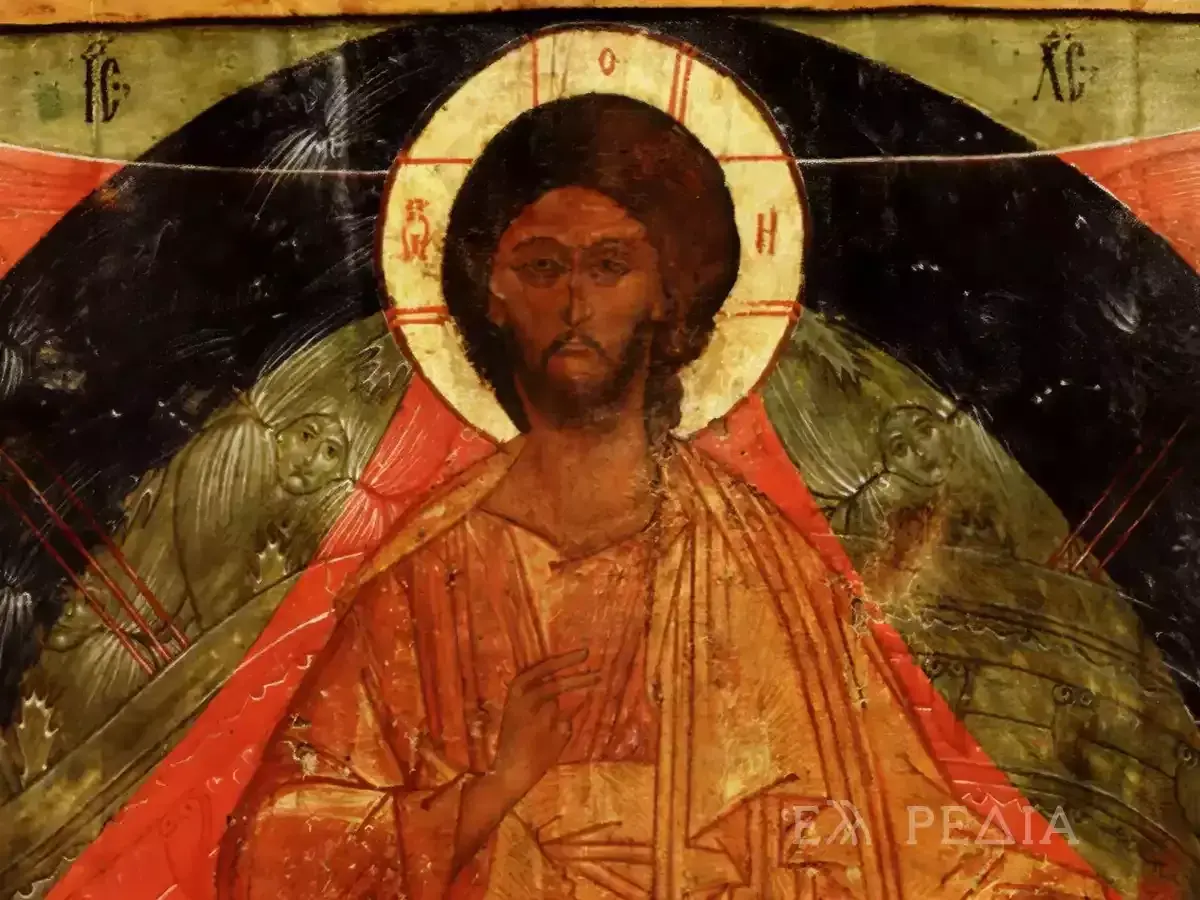
The image known as Christ the Pantocrator condenses a great deal of theology into a single frontal figure: authority, mercy, judgment, and teaching all sit inside one iconographic formula. I want to show how to read those symbols, why the image is usually placed where it is in a church, and what makes the earliest surviving examples so important for art history and preservation. For anyone studying Byzantine and Eastern Christian art, this is one of the clearest cases where style, placement, and meaning cannot be separated.
The Pantocrator image presents divine authority through gesture, gaze, and placement rather than through worldly regalia
- Pantocrator means “ruler of all,” so the image is about sovereignty, not portrait likeness alone.
- The two strongest visual signals are the blessing hand and the Gospel book.
- Its placement in a dome or apse turns the icon into a statement about cosmic order and liturgical presence.
- The oldest surviving panel icon from Sinai matters because it preserves an early visual standard and a complex conservation history.
- Modern copies can be devotional, decorative, or scholarly, but they do not all carry the same iconographic precision.
What the image says about Christ’s authority
At its core, the Pantocrator image is a claim about rule. I read it as a visual form of divine kingship, but not the kind that depends on a crown, a throne room, or an imperial procession. Christ is shown frontally, meeting the viewer directly, which gives the icon a confrontational clarity that is rare in Western religious art. The message is simple and demanding: Christ is not one figure among many, but the one who orders the whole cosmos.
That is why the image feels so different from a narrative scene. It does not describe an event; it establishes a presence. In Eastern Christian tradition, that distinction matters. The icon does not merely illustrate belief, it functions as a compressed theological statement about mercy, judgment, and authority held together in one face. The closest Western equivalent is usually Christ in Majesty, but the Pantocrator is usually more intimate, more frontal, and more immediately liturgical.
What I find most effective is that the image refuses to separate power from compassion. Christ is ruler, but also teacher and blessing giver. That tension is the key to the icon, and it becomes much clearer once you start reading the visual code built into it.
How to read the symbols in the face, hands, and book
The Pantocrator is not understood through one feature alone. It is a system of signs. The face, hand, halo, inscriptions, and book all work together, and each one matters.
The face and gaze
The face is usually severe but not cold. The eyes are large and steady because the icon is meant to look back at the viewer. That direct gaze is part of the theology. It says that Christ is not distant, even when he is shown as cosmic ruler. In many icons, the features are slightly asymmetric, and later interpreters have sometimes read the two halves of the face as a reference to both human and divine nature. I would treat that as a useful interpretive tradition, not a rigid rule for every example.
Read Also: Venus and Mars Painting - Uncover Hidden Meanings
The hands and the book
The right hand usually gives a blessing, while the left hand holds the Gospel book. Together they define Christ as judge and teacher. The blessing is not decorative. It is a liturgical gesture, and the book reminds the viewer that authority is tied to revelation, not force. If the book is closed, the emphasis is on Christ’s sovereignty and mystery. If it is open, the image leans more strongly toward teaching and scriptural proclamation.
Many icons also use a cruciform nimbus, a halo marked with a cross, often with the Greek letters that identify Christ. In some works, the hand gesture itself reinforces the initials. These small details matter because they show that the image is not generic religious art. It is a highly coded visual language with fairly strict rules.
Once those signs are clear, the next question is where the icon is placed and why that position changes the way it is read.
Why church placement changes the meaning
In Byzantine and Eastern Christian churches, the Pantocrator is often placed in the central dome, the half-dome of the apse, or another elevated focal point. That placement is not incidental. It makes Christ the visual center of the building, almost like the architectural axis of the liturgy. The viewer does not simply stand before an icon, but beneath it.
I think of that placement as a form of spatial theology. The dome becomes a cosmic surface, and the figure within it appears to hover above ordinary time. A dome image of Christ does not only say “he is important.” It says that the structure of worship, heaven, and created order all radiate from him. In that sense, the icon is less like wall decoration and more like an organizing principle for the entire church interior.
This also explains why the Pantocrator is so often associated with solemnity. It is meant to be seen in prayer, not casually consumed. That architectural logic becomes easier to appreciate when you look at the earliest surviving icon and the conservation history around it.
The Sinai icon still sets the standard for early images
The best-known early example is the sixth-century panel preserved at Saint Catherine’s Monastery at Mount Sinai. It is important not just because it is old, but because it survived when so many other early Byzantine images did not. The icon was painted in encaustic, a wax-based medium that gives the surface a particular depth and richness. In preservation terms, that medium matters because it ages differently from tempera or fresco, and it can preserve an astonishing amount of original detail when conditions are stable.
The Sinai panel is also a reminder that conservation history is part of art history. At one point, later repainting obscured much of the original surface, and the underlying image was only properly recognized after cleaning in the twentieth century. That kind of intervention is important for anyone working in authentication or preservation because it shows how easily a later layer can alter the reading of an object. An icon may be ancient in origin but layered in condition, and those layers are often as informative as the first paint campaign.
There is also a broader historical point here. The image survived the iconoclastic conflicts of the eighth and ninth centuries, which makes it more than a devotional object. It is evidence. It tells us how early Byzantine artists balanced authority, restraint, and realism before later conventions hardened. And once that early standard is clear, the natural comparison is with other Christ images that look related at first glance but do different work.
How it differs from related Christ images
People often use “Pantocrator” as a catch-all term for any majestic Christ image, but that flattens useful distinctions. The differences are not cosmetic. They change the message.
| Image type | Main pose | Core message | Common setting |
|---|---|---|---|
| Pantocrator | Half-length or frontal, blessing hand, Gospel book | Christ as ruler, judge, and teacher | Dome, apse, icon panel |
| Christ in Majesty | Enthroned or full-length, often within a mandorla | Cosmic kingship and eschatological glory | Western church portals, manuscripts, altarpieces |
| Christ the Teacher | Open book, teaching gesture | Instruction and proclamation of the Gospel | Panels, liturgical images, educational contexts |
| Deesis Christ | Central figure flanked by intercessors | Mercy, judgment, and supplication | Icon screens, mosaics, church programs |
What I watch for here is discipline in naming. If the book is open, the figure may be closer to Christ the Teacher than to a strict Pantocrator. If the composition is enthroned and surrounded by a mandorla, the emphasis shifts toward Christ in Majesty. The iconographic grammar is precise, and once you start using the terms carefully, the artwork becomes much easier to read.
That precision also matters when you are assessing a modern icon, a restoration, or a panel that may have been heavily repainted.
What I check when I evaluate a copy, restoration, or modern icon
When I look at a Pantocrator image today, I do not start with style alone. I start with whether the iconographic signals still hold together. If they do, the image can remain legible even when it is a later copy. If they do not, the work may still be devotional, but it is weaker as an iconographic statement.
- Gesture - Does the blessing hand follow the traditional pattern, or has it been simplified into a generic raised hand?
- Book - Is the Gospel book closed, opened, or omitted, and does that choice fit the claimed type?
- Halo and inscriptions - Are the cruciform halo and Christogram present, and are they consistent with the style of the work?
- Surface condition - Are there signs of overpainting, heavy retouching, abrasion, or later varnish that may have changed the reading?
- Material logic - Does the panel, pigment, or mosaic technique match the supposed date and origin?
- Context - Is the image built for worship, collection, reproduction, or decoration? The setting often tells you how literally to read the symbolism.
For museums, collectors, and churches, the practical lesson is the same: do not confuse visual familiarity with authenticity. A modern icon can be respectful and well made, but the older tradition has a stricter internal structure than many viewers realize. The strongest examples still do what the best sacred art always does, they compress meaning without losing clarity. That is why the Pantocrator remains one of the most durable images in Christian art, and why it still rewards slow looking, careful attribution, and close conservation work.
