
Chinese art is best understood as a long conversation between ritual objects, brush painting, calligraphy, court taste, workshop craft, and modern reinvention. When I read the field this way, the important question is not just what it looks like, but what purpose it served and what visual language it was speaking. This guide walks through the major styles and movements, the media that define them, and the clues I use when I want to judge a work’s quality, period, or authenticity.
Key points to keep in mind about the tradition
- The tradition is broader than painting, because bronzes, jades, ceramics, lacquer, sculpture, and calligraphy all sit at the center of it.
- Brushwork matters more than realism in many periods, and a strong line can tell you more than surface polish.
- Major movements often emerge from court patronage, scholar-official taste, religious practice, or later revivalism, not from isolated schools in the Western sense.
- Modern Chinese artists did not simply abandon the past, they argued with it through oil, ink, print, photography, installation, and performance.
- For study or collecting, the safest evaluation starts with materials, inscription logic, provenance, and conservation history.
What the tradition includes and why it is not one style
What I call the Chinese visual tradition is not a single aesthetic block. It includes imperial commissions, literati works made for educated circles, temple and funerary art, luxury objects for daily use, and regional practices that absorbed influences from Central Asia, Tibet, Southeast Asia, and maritime trade. That breadth matters, because a bronze vessel, a landscape scroll, and a porcelain bowl are all part of the same culture, even when they were made for completely different audiences.
This is why style alone can be misleading. A work can be conservative in subject but inventive in brushwork, or highly decorative while still carrying old ritual ideas. In practical terms, I always ask three things first: who commissioned it, who was supposed to see it, and what kind of authority it was meant to project.
Once those questions are clear, the earliest objects stop looking like isolated relics and start reading as the foundation of everything that came later.
The earliest language was ritual, not decoration
The oldest surviving objects from China, including Neolithic jades and Shang and Zhou bronzes, were rarely made as simple decoration. They worked inside systems of ceremony, burial, and status, which is why they still feel so controlled and intentional. Liangzhu jades, for example, are not just polished stones; they are carefully shaped prestige objects tied to burial and cosmology.
Bronze is even more revealing. Early Chinese bronze vessels were cast with piece-mold technology, which means the form was built in sections rather than by the lost-wax method more familiar in many Western traditions. That technical difference matters because it helps explain the sharpness of line, the crispness of relief, and the highly planned visual order of early ritual wares. The object was meant to work in a ritual system, but it also announced political power.
By the time Buddhist sculpture and wall painting spread more widely, the visual language had expanded. Sacred figures, cave murals, and tomb goods made the field far more cosmopolitan than a narrow dynastic story would suggest. That broader religious and regional mix leads directly into the medium that shaped the tradition most profoundly, painting and calligraphy.

Painting and calligraphy gave the tradition its visual grammar
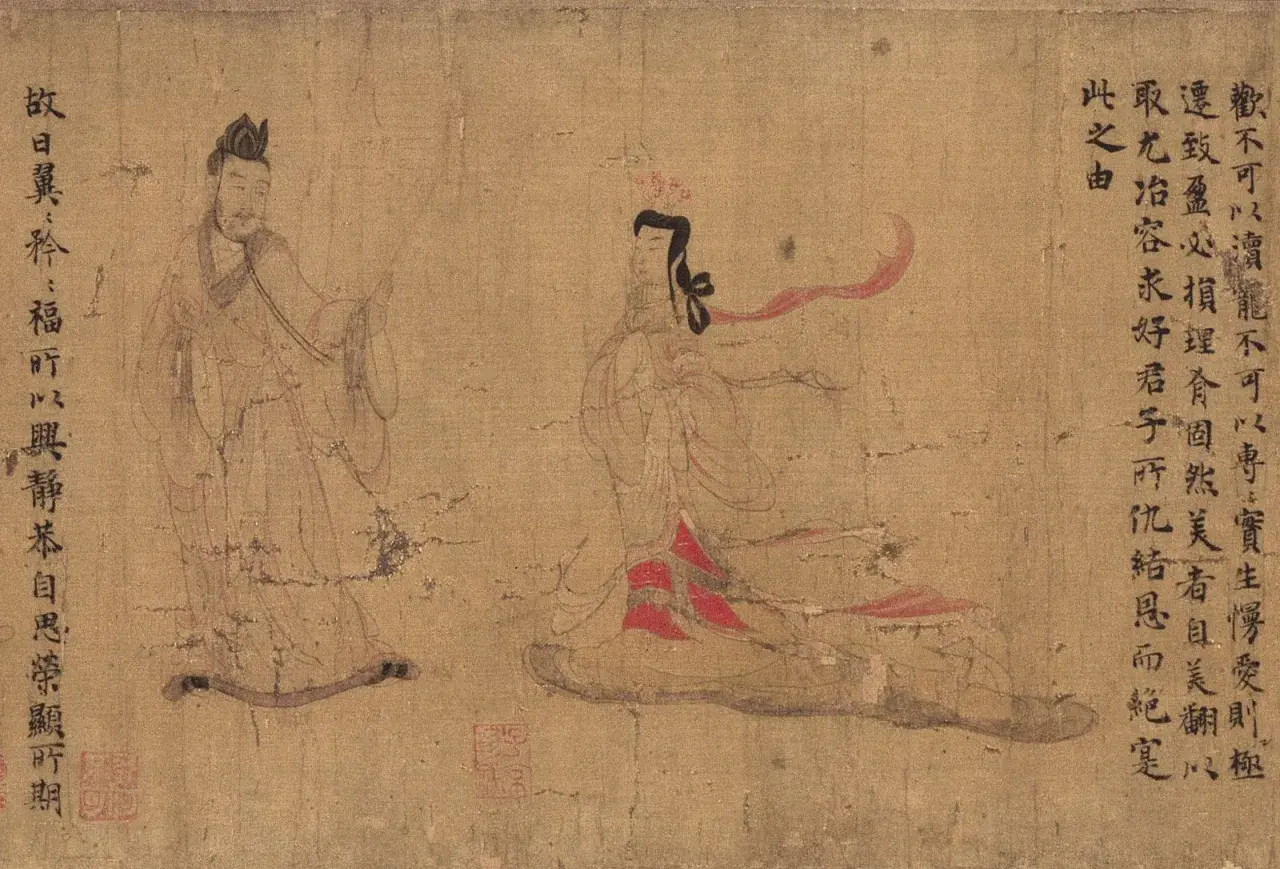
In traditional China, the written line was not a side note. Calligraphy was treated as the clearest proof of a cultivated mind, and painting shared its tools, its discipline, and much of its status. That is why I never read a scroll only as an image. I read it as handwriting, composition, and intellectual posture at once.
Two technical terms are worth keeping straight. Gongbi means meticulous brushwork, built from careful line and controlled detail. Xieyi means freehand expression, where the painter allows the brush to move more quickly and openly so the spirit of the subject comes through. Neither is better, but they tell you different things about training, intent, and audience.
Formats matter too. A handscroll is experienced gradually, so pacing becomes part of the meaning. A hanging scroll demands a single, frontal encounter, while an album leaf compresses feeling into a small, intimate field. Seals, inscriptions, poems, and later collector marks are not clutter; they are part of the work’s social life. If I am checking a piece for authenticity or condition, I look at brush pressure, ink absorbency, mounting transitions, and whether the written matter fits the style of the image rather than fighting it.
Museum surveys such as those at the Met make the same basic point: brush and ink bind painting and calligraphy so closely that one helps explain the other. Once you see that, the next step is to place the major styles on a timeline rather than treating them as separate islands.
The main styles and movements read better as a timeline
The easiest way I know to read the field is to compare what each period values most. The table below is simplified on purpose, but it captures the visual logic that repeats across dynasties.
| Period | Dominant media | What it tends to look like | Why it matters |
|---|---|---|---|
| Tang, 618-907 | Court painting, Buddhist art, sculpture, tomb imagery | Rich color, broad forms, cosmopolitan figures, monumental scale | Shows a confident empire open to outside influence |
| Song, 960-1279 | Landscape painting, album leaves, refined ceramics | Careful structure, atmosphere, balance, often restrained color | Landscape becomes philosophical, not just descriptive |
| Yuan, 1271-1368 | Literati painting and calligraphy | Expressive brushwork, spare compositions, strong personal voice | Scholarship and style become closely linked |
| Ming, 1368-1644 | Painting, porcelain, lacquer, revival bronzes | Refinement, confident ornament, technical control, historical quotation | Revival can be creative, not derivative |
| Qing, 1644-1911 | Orthodox painting, individualist painting, imperial workshops | Either disciplined emulation or highly personal invention | Shows the tension between canon and innovation |
| 20th century to 2026 | Ink, oil, print, photography, installation, performance | Reformist, realist, avant-garde, conceptual, hybrid | Tradition becomes an active debate rather than a fixed model |
What matters here is not that one period replaces another. Revival is often the point. In Qing art, for example, looking backward could be a deliberate way of claiming legitimacy, scholarship, or resistance to dull convention. Regional identities matter too, since centers such as Suzhou, Yangzhou, and later the Lingnan circle shaped their own versions of refinement. That habit of conscious return to the past remains one of the strongest signatures of the tradition.
From there, the medium changes, but the same logic of status, taste, and technical ambition carries into ceramics, bronzes, and lacquer.
Ceramics, bronzes, and lacquer show status in material form
If painting is the most visible part of the field, ceramics and lacquer are the parts that quietly prove how technically sophisticated it was. These objects were used, displayed, traded, gifted, and stored, which means they tell us a great deal about taste, economy, and social hierarchy.
Porcelain turned craftsmanship into a global language
Blue-and-white porcelain became one of the most recognizable forms because it combined technical control with visual clarity. Under the Ming and Qing dynasties, porcelain moved from elite court use into wider trade networks, so the style began to circulate far beyond China itself. For me, that makes porcelain a perfect example of how a local tradition can become internationally legible without losing its own grammar.
Later bronzes were revivals, not just copies
From the 12th through the 19th centuries, bronze casting often looked back to archaic forms on purpose. This is where the idea of fugu, a return to antiquity, matters. A later bronze that borrows an ancient shape is not automatically weak or secondary; sometimes it is making a political or scholarly claim. In authentication work, that distinction is critical, because revival style and true age are not the same thing.
Lacquer rewards patience more than flash
Lacquer demands layer upon layer of work, and that slow build gives finished objects a depth that photographs rarely capture well. Screen panels, boxes, and imperial furnishings often combined lacquer with gilding, inlay, or carved decoration, so the object had to balance surface beauty with structural discipline. When the material story is right, lacquer looks almost internal, as if the finish belongs to the object rather than sitting on top of it.
Taken together, these media show that the tradition was never limited to hanging on a wall. It also lived in the hand, on the table, and inside ceremonial space, which is exactly why modern artists later found so much material to argue with.
Modern and contemporary artists turned inheritance into debate
The 20th century changed the terms of the conversation. Artists were asked to reconcile ink tradition, oil painting, nationalism, commercial modernity, and later socialist realism and avant-garde practice, often at the same time. That pressure produced some of the most inventive work in the whole field.
Reform came before rupture
In the early 20th century, many artists tried to modernize painting rather than replace it. Some absorbed Western perspective and anatomy; others preserved brush traditions while changing subject matter and scale. Xu Beihong is often discussed in this context because he used academic drawing to sharpen, not erase, classical concerns. The larger point is that modern did not always mean abandoning the past.
After 1980, experimentation became a language of its own
From the mid-1980s onward, artists pushed into installation, photography, performance, and politically charged conceptual work. At that stage, brush-and-ink tradition became one resource among many, not the only legitimate one. I find this period especially interesting because citation, parody, and reversal become part of the style itself. A work may look traditional on the surface while actually questioning memory, authority, or consumer culture.
Today, the strongest work usually knows the canon well
Contemporary artists working in or around these traditions are often strongest when they know exactly which convention they are borrowing, stretching, or disrupting. That is true whether the medium is ink on paper, photography, video, or large-scale installation. The old language still matters, but it now shares the stage with global contemporary concerns, and that tension is where much of the best work lives.
This modern arc matters because it changes how I evaluate a piece. I do not ask only whether it is traditional or contemporary; I ask whether the artist understands the tradition deeply enough to make the departure meaningful.
How I would evaluate a work in practice
If I am standing in front of a work and need to decide whether it deserves deeper study, the process is simple but strict. I begin with the material, then the style, then the history of ownership and display. That order saves time, and it prevents me from being impressed by a surface that does not hold up under scrutiny.
- Start with the medium. Bronze, porcelain, ink, silk, and lacquer each obey different technical rules, so a work must make material sense before it makes stylistic sense.
- Check the function. Ask whether the object was made for ritual, scholarship, display, trade, or experiment, because those uses shape the form.
- Read inscriptions carefully. Seals, dates, and signatures should fit the object, not overpower it.
- Expect copying in older traditions. Imitation can be a form of learning or homage, so resemblance alone is not proof of anything.
- Look for historical consistency. Aging, wear, restoration, and mounting should all tell the same story.
If I suspect a forgery, the first warning signs are usually small mismatches: a signature that feels too eager, seals that float unnaturally, aging that looks uniform, or brushwork that copies the surface of old work without its internal rhythm. For paper and silk, I also pay attention to mounting quality and whether the condition lines up with the supposed age of the piece. Perfect surfaces are often more suspicious than imperfect ones.
That is the approach I trust most: start with material logic, then style, then history, and only at the end ask what label the object should carry. Once you do that, the field opens up fast, and the connections between early ritual, brush painting, decorative arts, and contemporary practice become much easier to see.
