
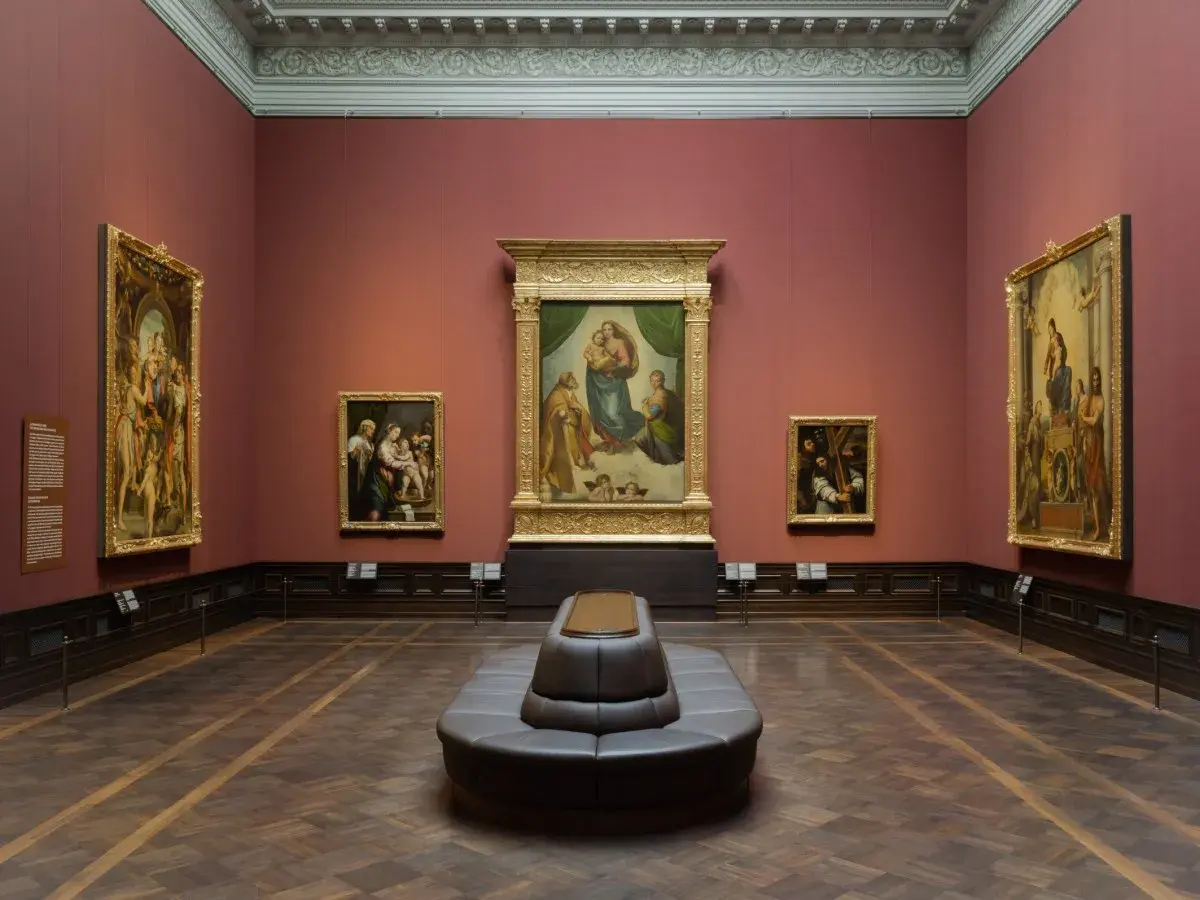
Raphael’s Sistine Madonna is one of those paintings that looks serene until you start reading it closely. The figures, the curtain, the clouds, and even the two little putti at the bottom work together as a compact visual argument about intercession, sacrifice, and the moment heaven becomes visible on earth. In this article, I focus on the iconography and symbolism that make the altarpiece so enduring, and on the details that usually matter most when you want the image to make sense rather than merely look famous.
What the painting communicates at a glance
- The work is a church altarpiece, so its symbolism is tied to worship, not just to portrait-like beauty.
- Mary appears as both mother and heavenly mediator, moving toward the viewer instead of remaining distant.
- Saint Sixtus and Saint Barbara give the scene its devotional framework and connect it to martyrdom, papal authority, and prayer.
- The putti are part of the meaning, not a decorative afterthought; they define the painting’s lower threshold.
- Color, gesture, and the opening curtain do more symbolic work than overt attributes do.
Why the title points to a real church commission
The title matters because it tells you how to read the work. This is not a generic Madonna image and it is not named after the Vatican’s Sistine Chapel; it belongs to the church of San Sisto in Piacenza and was commissioned for a specific devotional setting under Pope Julius II. That context changes everything. The painting is built as an altarpiece, so it is meant to be encountered in relation to the altar, the liturgy, and the saints who stand between the viewer and the sacred scene.
Once that is clear, the composition stops feeling like a floating vision and starts reading like a carefully staged revelation. Raphael opens a kind of curtain for the worshipper, as if the image is being shown rather than merely displayed. That theatrical reveal is not accidental; it is the visual equivalent of making doctrine visible, which is why the figures themselves become so important.
The central figures and what each one contributes
The symbolism in the center is remarkably efficient. Raphael does not overload the panel with objects; he lets posture, direction, and gaze do the interpretive work. Mary, Christ, Saint Sixtus, and Saint Barbara form a devotional structure that is at once intimate and ceremonial.
| Figure | Visual cue | Symbolic role | What it adds to the reading |
|---|---|---|---|
| Mary | She advances through the clouds, wrapped in blue and red, holding the Child | Virgin, queen of heaven, and mediator between heaven and earth | She is not static; she appears to cross the boundary into the viewer’s world |
| Christ Child | Small, alert, and solemn rather than merely playful | The Incarnation and the future Passion | The child is already tied to sacrifice, not only to tenderness |
| Saint Sixtus | Papal vestments, outward gesture, kneeling posture | Patron saint, papal authority, and intercessor for the faithful | He grounds the vision in the church and directs attention toward devotion |
| Saint Barbara | Quiet, inward pose, lowered gaze, restrained presence | Martyrdom, contemplation, and the peaceful acceptance of death | She balances Sixtus by turning the scene inward and contemplative |
I read this triangle of figures as a theology of movement. Mary comes forward, Sixtus addresses the viewer, Barbara withdraws into contemplation, and Christ sits at the center of the entire emotional and doctrinal structure. That combination gives the painting its force. It is not only about who is present; it is about how sacred presence is staged. The saints make the image legible, but their meaning becomes sharper when you look at their individual iconographic signals.
How Saint Sixtus and Saint Barbara sharpen the meaning
Saint Sixtus is not there simply because the title requires him. He is the patronal saint who anchors the altarpiece in a church setting and reminds the viewer that this is an image for prayer, not a private fantasy. His papal identity matters as well. It links the scene to authority, apostolic continuity, and the public life of the church. In the painting, his gesture feels almost like an invitation: he is presenting the vision to the faithful while also acknowledging it himself.
Saint Barbara works differently. In Christian art she is often associated with the tower and the chalice, symbols of martyrdom and the sacrament, but Raphael does not depend on those objects here. Instead, he compresses her identity into calm posture and a reflective gaze. That makes her easier to miss if you only skim the image, but harder to forget if you slow down. She embodies inward devotion, the acceptance of suffering, and the idea that holiness can be quiet rather than dramatic.
The two saints are therefore not symmetrical decorations. They create a double frame around Mary and the Child: one outward-facing, one inward-facing. That is why the lower edge of the painting becomes so important next.
The putti are not decoration
The two putti at the bottom are probably the most reproduced detail in the whole composition, and for good reason. They sit on the edge of the painted world as if they have just paused to watch the apparition above them. That placement is brilliant. Raphael turns the border of the painting into a symbolic threshold, so the little figures feel like witnesses standing between sacred vision and ordinary space.
I would not call them a throwaway flourish. They soften the solemnity of the altarpiece, but they also sharpen it. Their relaxed boredom creates a striking contrast with the grandeur above, and that contrast makes the entire scene feel more human. The Gemäldegalerie Alte Meister notes that these angels have been copied countless times, and that popularity makes sense: they are memorable on their own, but they become more meaningful when you see them as the bottom register of a much larger devotional structure.
There is also a subtle theological effect here. By placing the putti at the frame, Raphael suggests that heaven is not sealed off from the viewer. It leans in. It watches back. That idea becomes even clearer once you pay attention to the color choices and the way the space opens around the figures.
Color, gesture, and space do the heavy symbolic lifting
Raphael’s symbolism is not loud, but it is disciplined. Mary’s blue mantle and red garment follow long-standing Marian color conventions: blue signals purity and sacred status, while red keeps the Passion in view. In other words, the palette already tells you that the tender mother and the suffering future of Christ belong together. If you miss the color, you miss half the argument.
That same logic shapes the rest of the composition. Sixtus’s white and gold vestments cue papal dignity, Barbara’s quieter tones keep her in a contemplative register, and the green curtain above acts like a visual threshold rather than a backdrop. The clouds matter too. They are not just atmosphere; they function as a stage for a vision. Raphael creates the feeling that Mary is not seated in a room but advancing out of a heavenly opening toward the altar and the viewer.
The result is a controlled tension between intimacy and distance. The figures feel close enough to touch, but the composition never collapses into sentimentality. That balance is one reason the painting remains so persuasive, even when seen in reproduction. The symbolic structure is what holds it together.
How I read the painting when I want the symbolism to click
When I want to teach or study this altarpiece efficiently, I start from the frame and move upward. First, I look at the putti, because they establish the boundary between image and viewer. Then I follow the saints, because they explain why the apparition has this particular church setting. Only after that do I settle on Mary and the Child, because their central role makes full sense once the devotional framework is already in place.
- Check the lower edge first, because cropping or poor reproductions can erase the ledge that gives the putti their meaning.
- Track the direction of the gestures, especially Sixtus’s outward presentation and Barbara’s inward calm.
- Look at the color relationships instead of isolating single figures; the blue-red Marian pairing is not accidental.
- Notice how the curtain and clouds create a threshold, because that is what turns the scene into an apparition.
- Remember that iconography and composition work together; if one is flattened in a copy, the whole reading weakens.
That is also why the painting is useful for preservation and authentication-minded readers: iconography gives you a quick way to test whether a reproduction still preserves the logic of the original. A faithful copy may repeat the figures, but if it loses the spatial hierarchy, the symbolic reading becomes thin very quickly. That practical test leads naturally to the last question: why does the image still feel so immediate?
Why the image still feels immediate from the museum floor
The lasting power of Raphael’s Sistine Madonna is that its symbolism never sits on top of the image like an explanation. It is built into the way the figures enter space, look at one another, and address the viewer. That is rare. Many religious paintings tell you what they mean; this one makes you feel the meaning first and then notice how carefully it has been constructed.
For a modern viewer, the best way to approach it is slowly and in order: frame, putti, saints, Mother, Child, and finally the open heaven above them. That sequence keeps the altarpiece intact as an experience rather than a set of famous details. And once you read it that way, the painting’s reputation makes sense for a very simple reason: Raphael does not just illustrate devotion here. He organizes it into a vision that still holds its shape centuries later.
