
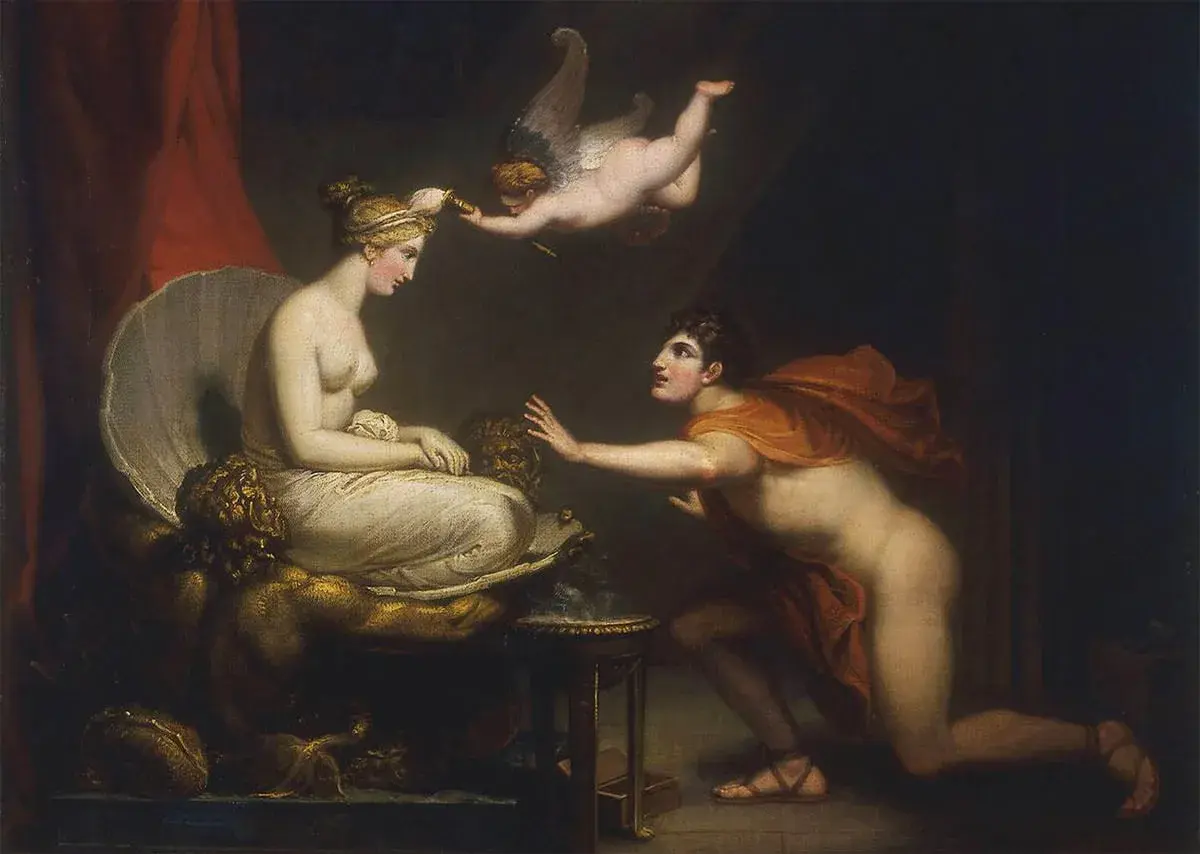
The myth of Pygmalion and Galatea is one of the clearest stories in Western art about creation, desire, and the uneasy boundary between image and life. In paintings and sculpture, it is rarely just a love scene; it is a visual argument about ideal beauty, the power of the artist, and the moment when matter seems to become animate. Here I focus on the iconography that identifies the subject, the symbols that carry its meaning, and the reading mistakes that make the image feel flatter than it is.
What matters most when you read the myth in art
- The scene is usually identified by a statue becoming alive, not by a crowded cast of characters.
- Ivory, marble, tools, chips of stone, and the sculptor’s touch are the strongest visual clues.
- Divine figures may appear, but they are often later iconographic additions rather than core elements of the original story.
- The subject often shifts from romance to an allegory of artistic making, idealisation, and control.
- In modern art, the story becomes a way to think about the artist’s own authority and uncertainty.
How the myth turns a studio scene into transformation
In Ovid’s version, the sculptor carves an ivory woman so convincing that he falls in love with his own work, then asks Venus to give him a bride equal to that ideal. That is why I read the subject as a studio myth before I read it as a love myth. The setting matters: the whole story begins with making, shaping, and revising, which is why the workshop, the pedestal, and the finished surface are never just background details.
One small but useful clarification helps immediately: in this context, Galatea is the woman made in stone or ivory, not the sea nymph from other classical stories. That distinction matters because artists often borrow the wrong associations when they want to make the scene look more mythological than it really is. Once that is clear, the next step is to identify the visual cues that separate this subject from every other classical nude or studio fantasy.
The visual clues that identify the scene
When I identify the scene quickly, I look for a cluster of signals rather than a single attribute. The more of these appear together, the more likely the artist is staging the myth rather than simply showing a beautiful figure in a studio.
| Motif | What it usually signals | What to check before assuming |
|---|---|---|
| Ivory, marble, or pale stone | An idealised body made by art rather than born naturally | It may also be a formal way to contrast flesh and surface finish |
| Sculptor’s tools, chisels, or a rough base | The studio setting and the act of creation | Some academic paintings reuse the same tools in generic atelier scenes |
| Touch, embrace, or kiss | The instant when the statue becomes living presence | Later artists often intensify this more than Ovid himself does |
| Venus or Cupid | Divine approval, love, or the supernatural cause of animation | These figures are common in later images but are not always required by the poem |
| Stone chips or unfinished blocks | The tension between inert matter and completed form | They can also be a compositional device for showing texture and depth |
| The figure’s head turning or skin warming | The first signs of life and response | Artists vary widely in how literally they show the transformation |
The Metropolitan Museum of Art notes that Gérôme added Cupid to one of his late treatments even though Ovid does not require him there. I find that very revealing: later images often make the myth easier to read by adding signs the poem leaves implicit. That habit of clarification, and sometimes over-clarification, shapes the symbolism more than many viewers realise, which brings us to what the symbols are actually saying.
What each motif usually stands for
I read the iconography less as decoration and more as a chain of arguments. Every object tells you whether the artist wants the scene to feel devotional, erotic, theatrical, or self-aware.
| Symbol | Usual meaning | Why it matters |
|---|---|---|
| White marble or ivory | Purity, ideal beauty, technical control | It frames the figure as something perfected by art rather than found in life |
| The sculptor’s touch | Animation, possession, intimacy | It is the myth’s most charged gesture because it joins creation to desire |
| Venus | Grace, sanctioned love, divine intervention | She shifts the scene from private fantasy to mythic fulfillment |
| Cupid | Desire made visible | He often acts as a shorthand for the emotional force behind the transformation |
| Unfinished stone | The threshold between object and person | It keeps the image focused on becoming, not only on arrival |
| Gifts, drapery, or adornment | Courtship and idealisation | These details can make the scene feel more domestic, but they also raise the question of whether the figure is being loved or made into an ideal |
For me, the deepest symbolism is not “a man falls in love with a statue” but art trying to cross the boundary into life. That is why the subject keeps coming back in periods obsessed with realism, finish, and the status of images. The best versions do not simply narrate the myth, they expose the artist’s wish to make form so persuasive that it acquires a pulse.
Why later artists made the scene more explicit
In academic and neoclassical art, the story became a test of control. Gérôme’s late version pushes the scene toward polished surfaces, theatrical lighting, and a highly legible instant of awakening. The Metropolitan Museum of Art notes that he produced both painted and sculpted versions of the theme, and that matters because the subject becomes a conversation between media as much as between characters. The sculpture is not just represented, it is almost being re-created inside the painting.
| Artist | Visual emphasis | Interpretive effect |
|---|---|---|
| Gérôme | Highly finished surfaces, clear narrative, theatrical presentation | The myth feels like a spectacular moment of fulfilled desire |
| Rodin | Visible tool marks, unfinished stone, bodily emergence from matter | The myth feels like process, not just outcome |
Rodin goes in the opposite direction. His version lets the stone remain visibly stone, so life seems to rise out of the material itself instead of being imposed from outside. That difference is more than style. It tells you whether the artist wants to emphasise miracle, craft, or the uneasy overlap between the two, and that overlap is where iconography becomes a serious reading tool rather than a checklist.
How iconography helps with attribution and condition
For preservation and authentication, subject matter is not just interpretation; it can be evidence. I look at whether the relationship between sculptor, figure, and transformation still holds together, because a cropped Cupid, a repainted pedestal, or a softened stone edge can change the reading of the entire work. A scene that once read clearly as an animated statue can start to look like a generic atelier image if key attributes are lost.
- Missing tools can make the work feel less like a creation myth and more like an unnamed studio scene.
- Heavy varnish or overpainting can flatten the contrast between marble and flesh, which is central to the subject.
- Broken inscriptions or altered bases can matter, especially in sculptural works where the pedestal often carries the artist’s own commentary.
When I catalogue a work, I ask a simple question: does the image still contain the transition from object to living figure? If it does, the iconography is probably intact. If it does not, the meaning may have shifted through damage, restoration, or the artist’s own revision, and that is exactly the kind of detail that can change how a work is dated, compared, or attributed.
Why the story still rewards close looking
What keeps the myth alive is not just romance, but the tension between mastery and surrender. The best images never tell you that art wins cleanly; they ask whether the work has become too alive for its maker to control. That question still feels current, whether I am looking at a museum painting, a marble group, or a later reinterpretation that uses the old story to comment on the power of images themselves.
If I had to leave one practical rule for this subject, it would be simple: follow the point where the stone stops behaving like stone. That is usually where the artist has hidden the strongest symbolism, the clearest iconographic choice, and the most revealing clue about how the work was meant to be read.
