
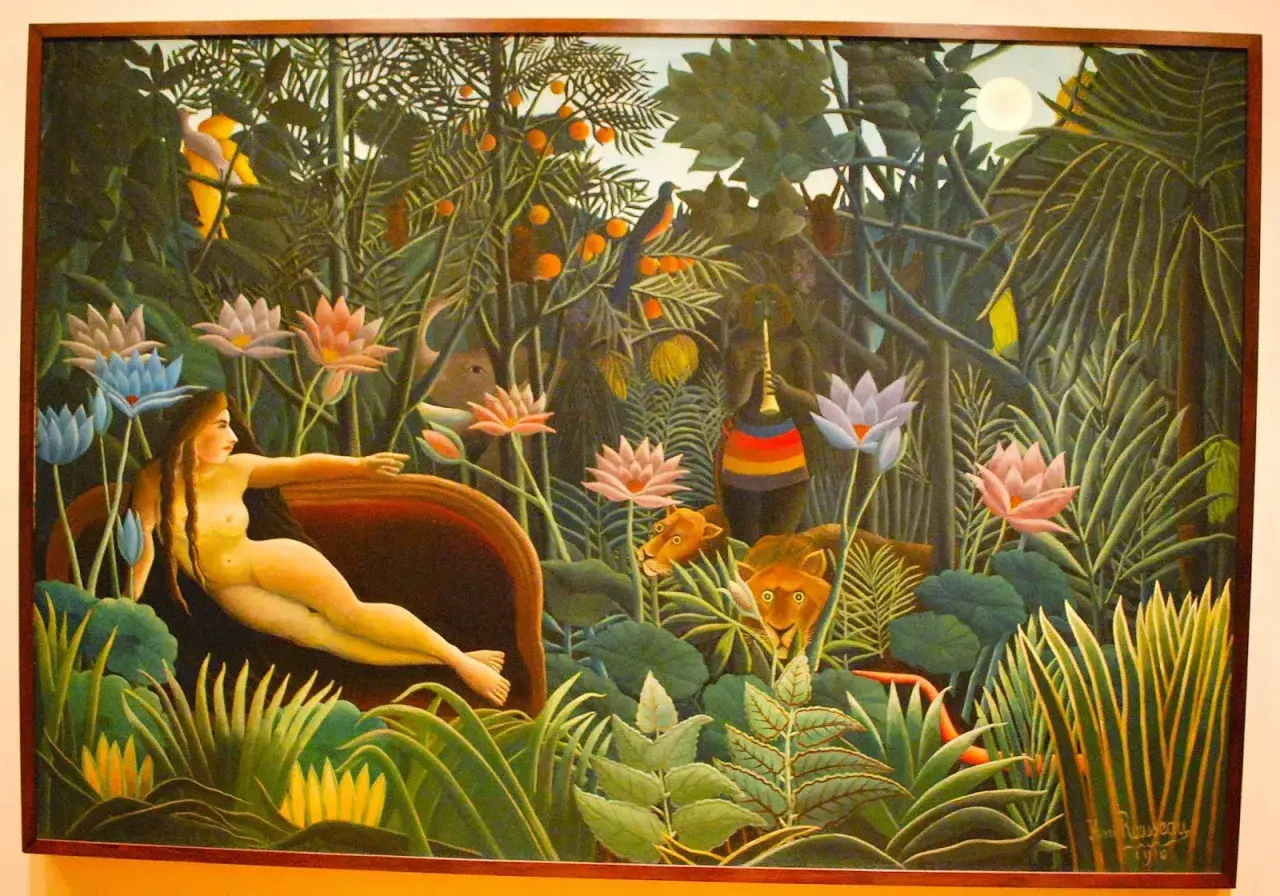
Henri Rousseau's jungle paintings look like fantasies, but they are built with unusual discipline. I focus here on what makes them visually distinctive, which canvases matter most, how he constructed the illusion of tropical density, and why authenticity and preservation still matter when people study or collect these works.
What you need to know about Rousseau's jungle pictures
- He never visited a tropical jungle; the imagery came from Paris botanic gardens, zoo displays, travel books, and popular illustration.
- The best-known works include Surprised!, The Repast of the Lion, Fight Between a Tiger and a Buffalo, and The Dream.
- The paintings feel flat and theatrical on purpose, with crisp outlines, layered leaves, and a dreamlike stage space.
- Their appeal comes from tension, not realism: animals, humans, and plants are arranged to feel both calm and dangerous.
- For collectors and researchers, provenance, surface quality, and exhibition history matter more than a dramatic story attached to the image.
Why Rousseau's jungles feel imagined rather than observed
I read these works as urban dreamscapes. Rousseau never left France, yet he treated the Jardin des Plantes, the Paris Zoo, illustrated books, and colonial-era print culture as raw material for invention, then transformed those fragments into dense, self-contained scenes. That is why the foliage looks convincing at a glance but fails any attempt at real-world botany: the plants are assembled for mood, rhythm, and scale, not field accuracy.
He was self-taught and took painting seriously, which explains the odd mix of innocence and control. The images can look naive because they reject academic perspective, but I do not think they are amateurish in the careless sense; the compositions are too deliberate for that. I usually tell readers to look for the sources of the imagery, not as trivia, but as evidence of how carefully he edited the world around him. Once you see that process, the jungle cycle becomes much more interesting than a simple fantasy of the exotic.
- Botanical gardens supplied the shapes of leaves, fronds, and hothouse plants.
- Zoo displays and taxidermy helped him stage animals as if they were part of a theatrical scene.
- Travel books and journals gave him the aura of distance without requiring travel.
- Compositional control turned those borrowed fragments into a believable visual world.
That visual logic matters more than botanical accuracy, which is where the key paintings become useful.
The paintings that define the cycle
Across roughly two dozen jungle pictures, Rousseau returned to the same problem: how do you make an invented wilderness feel complete? The answer changes from one canvas to the next, and that is why a short comparison is more helpful than a blanket description.
| Work | Date | Why it matters |
|---|---|---|
| Surprised! | 1891 | The first jungle picture and the clearest proof that Rousseau was building an invented world, not recording one. |
| The Repast of the Lion | c. 1907 | A strong example of how he turned the jungle into a dramatic feeding scene with tightly packed vegetation. |
| Fight Between a Tiger and a Buffalo | 1908 | Shows his taste for improbable action and compressed space, including details that feel almost stage-managed. |
| The Dream | 1910 | The best-known late jungle image, with its strange blend of reclining figure, horn player, and lush growth. |
I would add that these works are not interchangeable. Surprised! is about suspense; The Repast of the Lion pushes toward narrative; Fight Between a Tiger and a Buffalo tilts into spectacle; and The Dream turns the jungle into a fully dreamlike stage. That progression matters, because it shows Rousseau refining the same visual language rather than repeating a single gimmick. The next question is how he made that language feel so physically present on canvas.
How he built the strange sense of depth
Rousseau's space is always shallow, yet it never feels empty. He builds depth by stacking leaf shapes, repeating silhouettes, and letting branches cut across the foreground like curtains. The effect is theatrical: the viewer looks into a scene that is both a room and a dream.
- Crisp contours make animals and plants read as cut-out forms before they settle into the whole image.
- Layered vegetation replaces conventional perspective, so the eye moves by pattern rather than vanishing point.
- Unexpected scale makes leaves and fronds feel oversized, which amplifies the sense of danger.
- Mechanical tracing, including the pantograph he used on some works, helps explain the clean outlines and the slightly suspended feeling of some figures.
He also worked section by section, which helps account for the compact, almost mosaic-like surface. In practical terms, that means the paintings reward close viewing: the composition is bold from across a room, but the real interest is in the way each leaf, stripe, and shadow is pinned in place. I think that is one reason the jungle scenes still hold up in museum galleries. You register the whole world first, then start noticing how constructed it is.
What the imagery means beyond the naive label
The usual mistake is to treat Rousseau as either a primitive dreamer or a secret symbolist. I think both labels flatten him. His jungle scenes are smarter than they first appear: they borrow the public imagination around exotic travel, but they strip it of realism and replace it with eerie stillness.
That stillness is the key. In Surprised!, the tiger could be stalking prey or reacting to lightning; in The Dream, the horn player and reclining figure belong to the same impossible atmosphere without needing a rational link. Rousseau keeps the action just unresolved enough to keep the viewer inside the picture. He is not explaining the jungle; he is staging a mood where beauty and threat sit beside each other.
- The plants are lush, but they never feel decorative alone.
- The animals are vivid, but they often seem oddly suspended.
- The human figures are calm, yet the setting quietly destabilizes them.
How to judge an original, a reproduction, or a later copy
For museums, collectors, and anyone comparing versions online, the distinction matters. Rousseau has been widely reproduced, and the market has no shortage of prints, decorative copies, and works that borrow his jungle vocabulary without being by his hand. I would focus on five things: medium, surface, provenance, size, and exhibition history.
| Check | What to expect | Why it matters |
|---|---|---|
| Medium | Most key works are oil on canvas | It helps separate an original painting from a print or modern decorative version. |
| Surface | Dense, deliberate paint handling with crisp edges and layered vegetation | Reproductions usually flatten the subtle build-up of the surface. |
| Provenance | A traceable ownership history | Essential for attribution and for understanding how the work entered collections. |
| Exhibition record | Documented appearances in museum or salon histories | Strong exhibition history supports scholarship and authentication. |
| Scale | Many jungle paintings are large and immersive | Size affects both conservation handling and the viewer's experience. |
Condition also matters. Rousseau's darker passages can be vulnerable to varnish discoloration, and later retouching can make foliage look less coherent than it originally did. If I were assessing a work seriously, I would want clear documentation rather than a dramatic story about discovery. With Rousseau, paperwork is usually more convincing than romance, and that is a useful rule whether you are studying an original or just trying to read a reproduction carefully.
What these jungles still teach us about looking
Rousseau's jungle pictures still matter because they prove that invention can be more persuasive than observation when the structure is strong. The paintings influenced modern artists precisely because they were not afraid of looking artificial; they turned that artificiality into an aesthetic position.
If you are looking at one in a museum, give yourself time in front of it. Step back first to catch the composition, then move closer to read the leaves, fur, and odd spatial gaps. That two-distance approach is the best way to understand Rousseau: at a distance, the jungle feels inevitable; up close, you see how much intelligence went into making it feel that way.
