
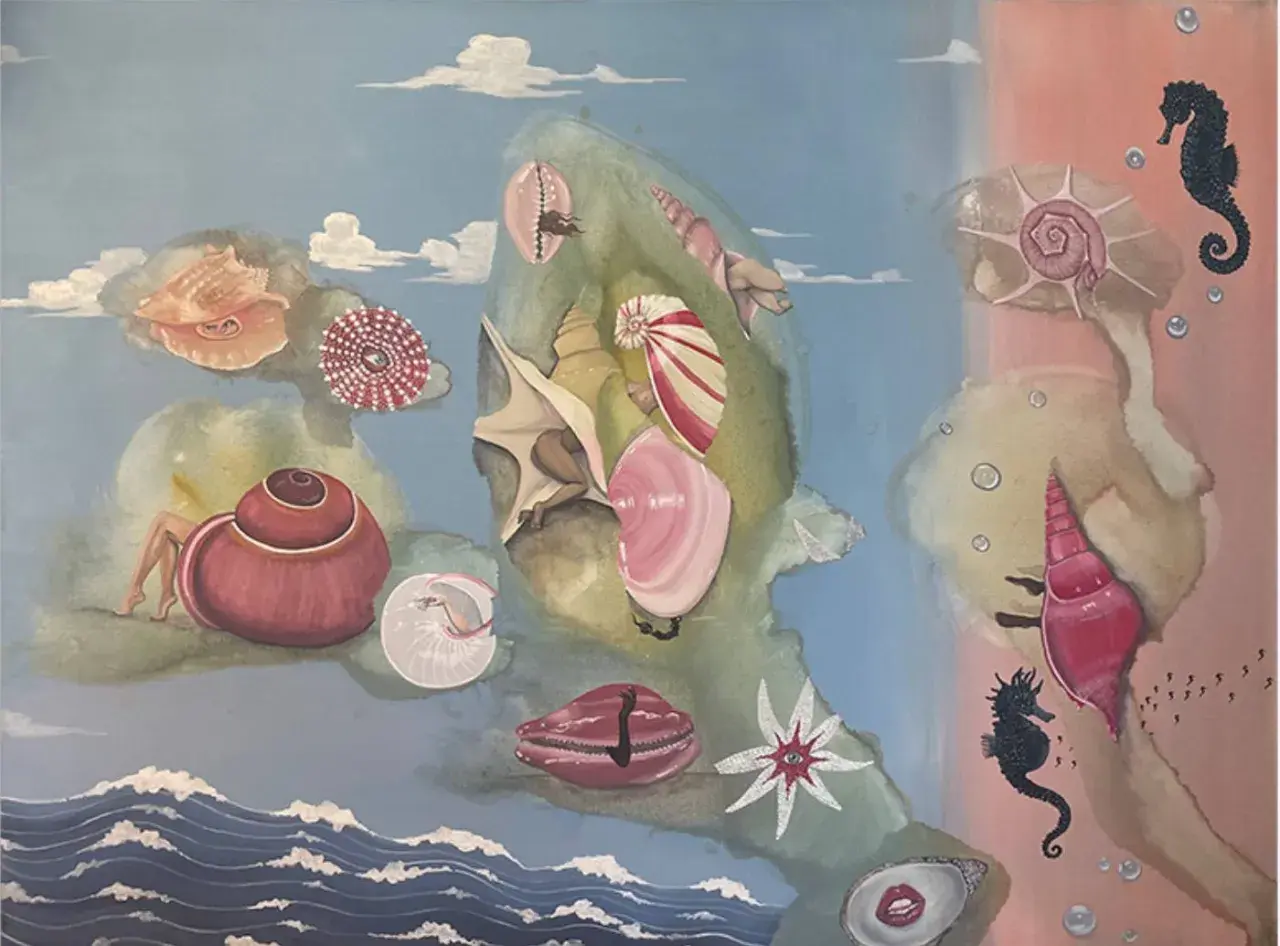
The most useful way to approach female surrealist painters is to see them as major builders of Surrealism, not side notes to it. Their work turns dreams into structure, personal memory into symbolism, and the body into something stranger, sharper, and more self-aware. This guide highlights the artists and artworks readers usually want first, then shows how to read their recurring themes, media choices, and authenticity clues with more confidence.
What matters most about women’s Surrealist painting
- These artists did not simply repeat Surrealist formulas; they used the movement to examine identity, power, exile, and the body.
- Not every artist commonly grouped here accepted the Surrealist label, so context matters as much as style.
- The strongest names to start with are Leonora Carrington, Remedios Varo, Dorothea Tanning, Leonor Fini, Kay Sage, and Frida Kahlo.
- Many of the most important works are not just paintings in a narrow sense; the field also includes object art, photomontage, and prints.
- If you are studying, collecting, or cataloging these works, medium, provenance, and edition history matter as much as imagery.
Why these artists matter in Surrealism
The easiest mistake is to treat women in Surrealism as a decorative footnote to a male-led movement. I think that view misses the point completely. These artists helped expand Surrealism from a set of dream images into a more searching language for biography, desire, politics, myth, and psychological space.
Surrealism was born in the 1920s, but the story most museum visitors inherited was narrowed later, often around a few famous men. That is why the women matter so much: they show how the movement changes when it is used to think about selfhood from the inside. Instead of presenting the unconscious as spectacle, they turn it into a private system of symbols that keeps returning across a career.
That shift is not subtle. It changes what counts as a Surrealist image. A floating object, a doubled self-portrait, a woman-figure with animal features, or a barren interior can become a way of thinking about autonomy rather than just a visual trick. Once you see that, the field becomes much richer and much less predictable. Once that frame is clear, the individual artists become easier to place and compare.

The names and works worth starting with
If I were building a compact reference list, I would start with these artists and the works most often used to understand their place in the movement. The point is not to flatten them into one style, but to see how each artist developed a distinct visual language.
| Artist | Work to know | Why it matters |
|---|---|---|
| Leonora Carrington | I am an Amateur of Velocipedes (1941) | Her paintings mix humor, animals, alchemy, and private mythology. She is one of the clearest examples of Surrealism becoming a personal cosmology rather than a borrowed style. |
| Remedios Varo | Embroidering the Earth’s Mantle (1961) | Varo turns women’s labor, ritual, and cosmic transformation into a single image system. Her work feels meticulously constructed, almost like illustrated metaphysics. |
| Dorothea Tanning | On Time Off Time (1948) | Tanning often makes domestic space uncanny. Her interiors, figures, and recurring motifs such as smoke, flames, and sunflowers create tension between intimacy and threat. |
| Kay Sage | Tomorrow Is Never (1955) | Sage’s barren architectures and restrained palettes give Surrealism a colder, more austere psychological register. Her landscapes feel like mental chambers. |
| Leonor Fini | Little Hermit Sphinx (1948) | Fini paints women as complex, powerful, and often sphinx-like beings. The work is theatrical, intelligent, and resistant to easy classification. |
| Frida Kahlo | The Two Fridas (1939) | Kahlo is essential even though she rejected the Surrealist label. Her self-portraits are among the clearest examples of identity split into symbols, wounds, and doubles. |
If you widen the lens beyond painting, Meret Oppenheim belongs in the conversation because her 1936 fur-covered cup is one of the movement’s most famous object works. Dora Maar also matters, but through photography and photomontage rather than oil paint, which is exactly why strict lists can become misleading. The broader Surrealist world was always more media-fluid than the word “painter” suggests, and that fluidity explains a lot of the movement’s power.
The common thread here is not one style, but one habit: each artist keeps returning to symbols until those symbols become a private grammar. That is where the real reading begins.
The recurring ideas that connect their work
The most rewarding way to read these artists is to look for recurring ideas instead of isolated dream images. I usually group the themes this way:
- Split identity and doubling. Kahlo makes this explicit in The Two Fridas, but the same logic appears more quietly in Carrington, Sage, and Tanning. A doubled figure can stand for pain, transition, or a self that refuses to stay singular.
- Hybrid bodies and animal forms. Carrington is especially important here. Her figures often move between human, animal, and mythic states, which gives her work a kind of sly intelligence rather than simple fantasy.
- Domestic space turned uncanny. Tanning does this superbly. A room, corridor, or house is never just a room in her paintings; it becomes a stage where interior life is made visible and slightly unstable.
- Alchemy, ritual, and occult systems. Varo and Carrington both build worlds that feel organized by hidden knowledge. These works reward close looking because every object seems to belong to a larger symbolic order.
- Female power without apology. Fini is a strong example. Her women are not passive dream figures; they are assertive, enigmatic, and often more powerful than the viewer expects.
- Psychological landscape. Sage strips the world back until the architecture itself feels like thought. Her empty spaces are not empty at all; they are emotionally charged structures.
These recurring ideas are why the art remains readable even when the imagery becomes strange. The symbols are not random. They are sustained, disciplined, and personal, which is what gives the work depth instead of novelty. That thematic range also explains why medium matters so much, because Surrealism looks very different in oil, paper, print, and object form.
Why the medium matters as much as the image
For preservation and authentication, the medium changes everything. A Surrealist painting, a photomontage, a lithograph, and a found object do not age in the same way, and they should not be evaluated with the same assumptions. I would break the material questions down like this:
| Medium | What it changes | What to check |
|---|---|---|
| Oil on canvas | Allows layered glazing, slower revisions, and more atmospheric surfaces. | Craquelure, overpainting, cleaning history, stretcher changes, and signature placement. |
| Works on paper and photomontage | Usually feel more immediate and experimental, with sharper edges and fragile surfaces. | Paper tone, foxing, adhesive failure, trimming, mount history, and light sensitivity. |
| Prints and lithographs | Make distribution possible, which means multiple impressions can exist. | Edition number, publisher, printer, paper type, plate wear, and whether the impression is lifetime or later. |
| Objects and assemblages | Shift Surrealism into tactile, three-dimensional space. | Replacement materials, reassembly, condition of fur or textiles, and documentation of how the object was constructed. |
This is where many readers overestimate the image and underestimate the object. A Surrealist-looking work is not automatically a Surrealist work, and a beautiful image is not automatically an original one. If a label does not clearly explain the medium, edition, or provenance, I would treat that gap as important rather than minor. Those material differences are exactly what matter when you start checking attribution, authorship, and condition.
How to read or authenticate a work without overclaiming
When I evaluate a Surrealist work, I start with the basics and stay skeptical of surface-level impressions. Style helps, but style alone never settles authorship. The safer order is: artist, medium, provenance, exhibition history, condition, and only then interpretation.
- Check whether the artist actually worked in that medium. Carrington, Varo, Tanning, Sage, and Fini are painters, but the broader Surrealist field also includes photographers and object makers.
- Read the title carefully. Titles often point toward the artist’s intended symbolism, and they can be more revealing than the image at first glance.
- Look for provenance before you lean on visual resemblance. Ownership history, gallery records, and exhibition labels help separate original works from later copies or loosely attributed pieces.
- Treat signatures as evidence, not proof. Placement, handwriting, surface wear, and consistency with the artist’s known practice all matter.
- For prints, verify the edition details. A numbered impression, a later pull, and a reproduction are not the same thing.
- Read condition reports with care. Restoration, relining, and surface cleaning can alter the look of a work more than casual viewers expect.
The most common mistakes are surprisingly consistent: calling every dream image Surrealist, assuming Kahlo accepted the label she was given, and treating museum visibility as automatic proof of originality. None of those shortcuts are reliable. If you keep the technical facts in view, the interpretation becomes stronger, not weaker. With that discipline in place, the next question is practical: where should you begin if you want a focused entry point into the field?
A practical route through the canon
If you want a fast, useful path through the subject, I would start in clusters rather than trying to learn every name at once. That makes the differences easier to remember.
- For mythology and animal symbolism: start with Leonora Carrington, then move to Leonor Fini.
- For cosmic labor and ritual imagery: start with Remedios Varo.
- For psychological interiors and tension inside the domestic sphere: start with Dorothea Tanning.
- For architectural emptiness and inward space: start with Kay Sage.
- For selfhood, pain, and the power of the double: start with Frida Kahlo.
If you remember only one practical rule, make it this: the strongest works in this field are rarely the ones that look most obviously “surreal.” They are the ones that sustain a private logic over time, so that image, medium, and meaning keep tightening around each other. That is what makes these artists essential, not just to Surrealism, but to the broader history of modern art.
