
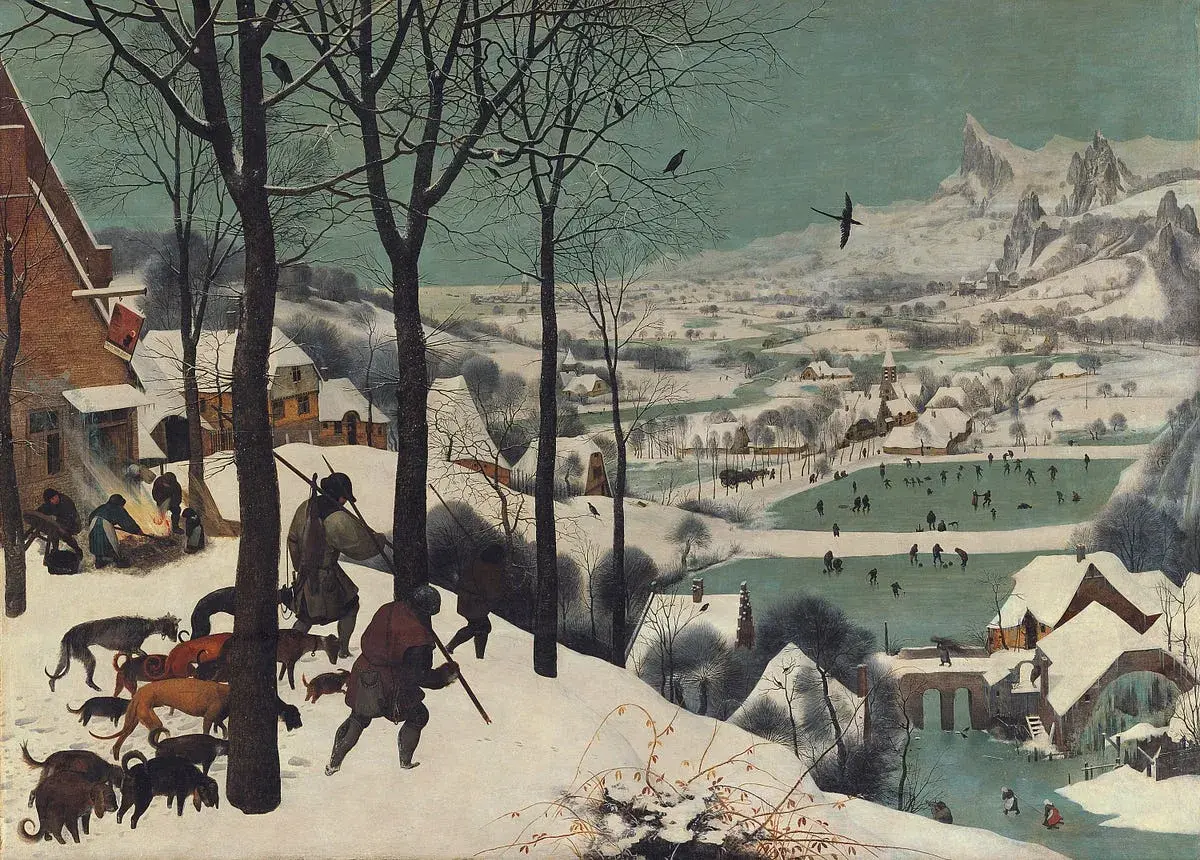
Pieter Bruegel the Elder’s The Hunters in the Snow is one of the clearest winter scenes in European art, but its power comes from more than atmosphere. I want to show what is actually happening in the panel, how it fits Bruegel’s larger seasonal cycle, why the composition feels so exact, and what conservators and historians look for when they study a work this famous.
A winter scene that is also about labor, scale, and endurance
- Painted in 1565 as an oil on oak panel, it is now in the Kunsthistorisches Museum in Vienna.
- It belongs to Bruegel’s larger seasons cycle, a major Northern Renaissance project for a wealthy Antwerp patron.
- The image mixes hunting, village work, and frozen recreation, so winter feels social rather than merely scenic.
- Bruegel uses a high viewpoint, long diagonals, and restrained color to make the cold feel physical.
- The panel still matters because it is both a landmark artwork and a useful case study in preservation and authentication.

What the painting shows at first glance
When I look at this panel, I do not see a single hunting party. I see a whole winter world compressed into one view: tired men coming down the hill, dogs trailing behind them, a fox hanging from one spear, smoke rising from the village below, and small figures skating on frozen water in the distance. The title foregrounds the hunters, but Bruegel refuses to make them the whole story.
| Element | What you see | Why it matters |
|---|---|---|
| Hunters and dogs | A small group returns downhill with exhausted hounds | The mood is effort and fatigue, not triumph |
| The fox | Only a modest result from the hunt hangs on a spear | It keeps the scene realistic and slightly unsentimental |
| The village | Smoke, roofs, and people working near the inn | Winter is shown as daily life, not a decorative backdrop |
| The frozen valley | Skaters and small figures on ice far below | Bruegel contrasts hardship, leisure, and survival in one frame |
The point is not to count details for their own sake. It is to notice how Bruegel lets every part of the picture speak to the same season, and that larger design leads directly into the work’s original purpose.
How the panel fits Bruegel’s seasons cycle
The Kunsthistorisches Museum dates the panel to 1565 and places it in Vienna, but the painting was never meant to stand alone. The Metropolitan Museum notes that Bruegel painted a seasons cycle for the Antwerp merchant Niclaes Jonghelinck, and five of those six works survive. That matters because the picture belongs to a tradition called the Labours of the Months, a calendar-based format that linked each part of the year to seasonal work and rural life.
Bruegel takes that older convention and makes it much more specific. Instead of idealized allegory, he gives us a believable weather system, a believable village, and believable people trying to get through the season. I think that is one reason the painting still feels modern: it does not behave like a myth. It behaves like observation.That broader context explains why the composition is so disciplined, because Bruegel had to make an entire season readable at a glance.

How Bruegel turns cold into composition
Bruegel’s technical control is the real engine of the painting. He works from a high viewpoint, which makes the viewer feel perched above the valley rather than safely outside it. In art history, that kind of gradual softening and distance is called aerial perspective, and Bruegel uses it to let the far-off lake, village, and mountains recede without losing structure.
| Device | Effect | Viewer takeaway |
|---|---|---|
| High vantage point | We look down on the scene instead of across it | The landscape feels vast and slightly unforgiving |
| Diagonal slope | The hillside carries the eye from left to right and down into the valley | Movement replaces stillness, even though the scene is frozen in winter |
| Repeated tree trunks | Dark verticals pace the foreground | The eye keeps moving, and the winter silence gains rhythm |
| Restricted palette | Greens, browns, grays, and white dominate | Cold becomes a visual condition, not just a narrative subject |
What I find especially effective is the balance between closeness and distance. The hunters are near enough to feel human, but the landscape is larger than they are, and that imbalance creates the painting’s emotional weight. Once you notice that structure, the symbolic reading becomes much easier to follow.
What the symbols suggest without forcing a single reading
Bruegel is rarely literal, but he is also not as cryptic as people sometimes assume. The safest way to read this panel is to treat it as a picture of winter pressure, winter work, and winter continuity. The hunt is modest, the dogs are worn out, the trees are bare, and yet life below still goes on. That tension is the point.
- The hunters do not look victorious, so the painting resists a simple story of conquest.
- The village activity keeps the scene from turning into a wilderness fantasy.
- The skaters and games on the ice show that winter is restrictive, but not passive.
- The birds and dark shapes in the trees add unease without turning the work into an allegory with one fixed answer.
I would be careful not to overread every small motif. Bruegel often works through accumulated observation rather than a single hidden code, and that is why the image remains open enough for repeated viewing. That openness also matters when the work is studied as an object, not just as an image.
Why curators and collectors still care about the panel
Because this is an oil painting on a sixteenth-century oak panel, condition is part of the story. Wood moves with humidity, so even a well-preserved panel can show fine cracking, subtle warping, or old retouching; varnish may yellow, and later cleaning can change how the snow reads. In other words, the visible surface is not just Bruegel’s hand. It is also the history of the object itself.
| What to examine | Why it matters | What it can reveal |
|---|---|---|
| Provenance | Ownership history helps distinguish an original from a later copy | Who owned it, where it traveled, and how secure its documentation is |
| Support and construction | Panel format and wood behavior are central to the work’s survival | Whether the physical object matches period practice |
| Paint handling | Bruegel’s tiny figures and controlled spatial design are hard to fake convincingly | Whether the brushwork and layering feel period-appropriate |
| Technical imaging | X-ray or infrared study can show underdrawing and later intervention | How much of what you see is original versus restored |
If I were comparing reproductions, I would not trust brightness alone. A cleaned image can make the snow look sharper than the original, while a poor digital copy can flatten the whole valley and erase the delicacy of the distance. For a picture this famous, authenticity is not just a question of authorship; it is also a question of how much of the original atmosphere survives.
What to notice when you stand in front of it
What keeps The Hunters in the Snow compelling is that it never turns winter into a simple postcard or a simple warning. It shows a working world under pressure, but it also shows that life continues, and that balance is exactly why the panel still rewards slow looking.
- Start with the hunters, then widen your gaze to the village and the frozen valley.
- Notice how the dogs, smoke, ice, and bare branches create different speeds of life in one scene.
- Step closer after taking in the whole composition, because Bruegel’s small figures and tiny actions carry a surprising amount of narrative weight.
If you remember only one thing, make it this: Bruegel does not present winter as empty space. He presents it as a lived environment, and that is why the painting still feels immediate five centuries later.
