
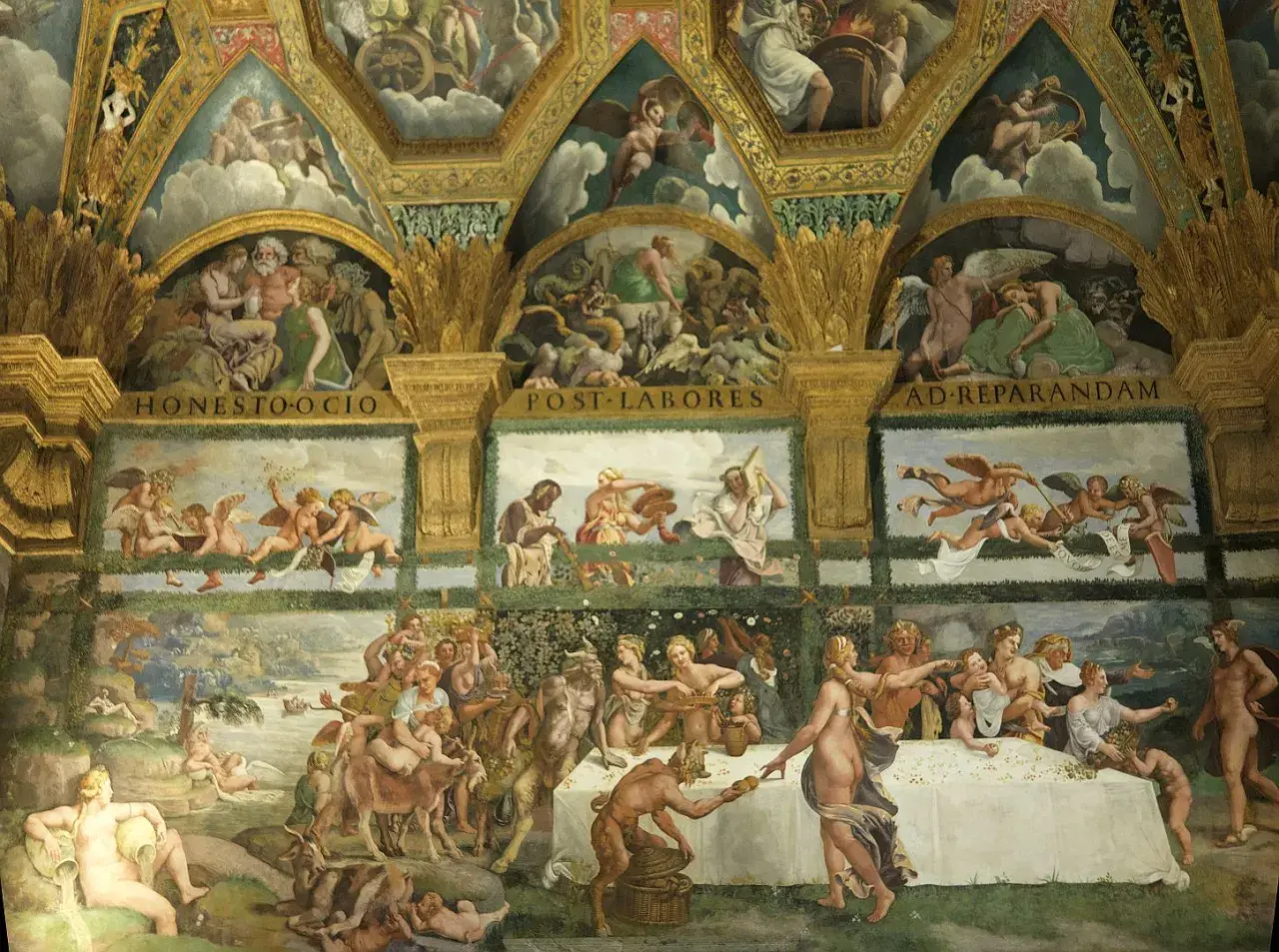
The fall of the giants painting most people mean is Giulio Romano’s fresco cycle in Palazzo Te, and it is much more than a mythological battle scene. It is a carefully staged lesson in pride, collapse, divine punishment, and the instability of power. In this article I break down the myth, the iconography, the symbolism, and the visual tricks that make the room feel alive even in reproduction.
Key facts about the Room of the Giants
- It is a fresco environment, not a single panel painting. The image is built into the room itself.
- The subject is the Gigantomachy. The giants rebel against the Olympian gods and are defeated.
- Giulio Romano uses illusionism to trap the viewer inside the myth. The architecture seems to collapse around you.
- Thunderbolts, broken masonry, clouds, and distorted scale all carry meaning. They turn the scene into a study of divine order versus chaos.
- The work is often read as political as well as mythological. It stages authority, overreach, and punishment in a courtly setting.
- If you are studying or cataloging it, treat it as a room-scale fresco cycle. Cropped reproductions miss the point.
What this work actually is
I read this piece first as a room, not as a picture. Painted in the early 1530s for Federico II Gonzaga at Palazzo Te in Mantua, it fills an entire chamber and depends on the architecture around it. Palazzo Te describes the villa as one of Giulio Romano’s most inventive Mannerist projects, and that matters because the setting is part of the meaning: this is court art built to impress, destabilize, and control the viewer’s experience.
That distinction is important if you are trying to understand the iconography. A fresco behaves differently from an oil painting. The wall is the support, the room is the frame, and the viewer is inside the composition. If you begin with that fact, the symbols stop looking decorative and start looking structural. The next question is the myth the room dramatizes.

The myth behind the collapse
The scene draws on the Gigantomachy, the battle in which the giants rebel against the Olympian gods. In Roman terms the chief avenger is Jupiter; in Greek terms it is Zeus. It is easy to confuse this with the earlier Titanomachy, but Giulio is working with the later struggle against the Giants, and that distinction matters because the Giants are often tied to earth, excess, and defiance from below.
Ovid’s account in Metamorphoses gives artists a compact but powerful framework: the giants try to reach heaven by piling mountain on mountain, only to be struck down. Giulio takes that idea of overreaching and turns it into a single explosive moment. He does not show a calm narrative sequence. He shows defeat in progress, when collapse is already happening and the result is beyond doubt. That timing is what gives the room its force, and it leads directly into the way the image is constructed.
How Giulio Romano turns myth into a total environment
The most radical choice here is spatial. Giulio Romano erases the usual boundaries of the room by painting a continuous panorama across the walls and ceiling. The corners seem to soften or disappear, painted architecture interrupts real architecture, and the viewer is placed almost at ground level, close to the giants rather than safely above them.
I think that is the key to the whole work. In a conventional painting, you look at disaster; here, you stand inside it. This is illusionism, meaning a painted space that deliberately tries to feel physically present. Romano uses that effect to make clouds, bodies, masonry, and broken structures act like one unstable system. The style is distinctly Mannerist in the best sense: not balanced calm, but controlled tension. Once that is clear, the symbols become easier to read.
What looks like spectacle is also a carefully designed argument about force, vulnerability, and the limits of human ambition. That argument becomes clearest when you isolate the major visual signs.
The symbols that carry the meaning
If I strip the iconography down to its essentials, I get a very clear visual grammar. Each element does two jobs at once: it describes the myth and it tells you how to interpret power, failure, and punishment.
| Visual cue | Iconographic role | Symbolic effect |
|---|---|---|
| Thunderbolts | Jupiter or Zeus asserting divine force | Power arrives as instant judgment, not negotiation |
| Collapsing masonry and mountains | The giants’ failed attempt to reach heaven | Overreach becomes visible as physical ruin |
| Oversized bodies and strained poses | The Giants as forceful but doomed rebels | Strength without order becomes monstrous and unstable |
| Clouds, wind, and violent motion | Divine atmosphere and cosmic turmoil | The whole universe seems to participate in the punishment |
| The viewer’s low position | Physical placement inside the battle zone | You feel vulnerability rather than detached observation |
| Painted architecture that blends with the room | Illusionistic framing device | The image expands authority beyond the painted surface |
What matters is the pattern. Upward striving is punished, downward collapse is inevitable, and the room makes that logic feel physical. Iconography gives you the visual vocabulary; symbolism gives you the argument. That is why the fresco does not read as a neutral myth illustration. It reads as power.
Why the room reads as power, not just decoration
I would not force this into a one-to-one political allegory, because the evidence for a single hidden message is not solid enough. But I also would not call it pure decoration. Palazzo Te was a Gonzaga court palace, and a room that stages cosmic punishment in such an overwhelming way inevitably speaks to hierarchy, authority, and the consequences of defiance.
The patron, the court, and the visitor all matter here. The person entering the room is not outside the drama; they are physically placed where vulnerability is most obvious. That is what makes the work feel intimidating as well as beautiful. It suggests that order is maintained from above and that ambition without limits ends in ruin. In that sense, the fresco works as both myth and warning.
This is also why later viewers keep finding contemporary parallels in it. The room invites that response, but its strongest meaning still comes from Renaissance ideas about divine order, courtly power, and the danger of disruption. From there, the practical question becomes how to read the work without flattening it.
How to read reproductions without losing the scale
Most reproductions flatten the work badly, so I recommend reading it in a fixed order. First, locate the room as a whole. Then trace the painted architecture. Only after that should you start identifying figures and actions. If you start with details, you miss the fresco’s main argument.
- Check the medium. This is a fresco environment, not an easel painting.
- Look for the boundary tricks. Rounded corners, false architecture, and continuous scene lines are part of the illusion.
- Follow the motion. Upward striving, impact, and collapse are the room’s three main visual verbs.
- Watch the scale. Giants are painted to overwhelm the body, so cropping destroys the intended effect.
- Separate the myth from the label. “Giants” here means the rebellious Gigantes of classical myth, not simply large human figures.
If you are evaluating a print, a photograph, or a digital reproduction, the biggest mistake is treating it like a normal narrative painting. The room depends on bodily encounter, and the reproduction only works if it preserves that sense of being surrounded. That is the point where interpretation turns into looking, and looking becomes much more precise.
What the fresco still teaches about ambition and fragility
What keeps this work alive is not only its myth but its refusal to let the viewer stay detached. It turns a classical story into a visual trap: you feel the instability before you fully understand it. That is why the room remains so memorable, even in fragments or reproductions.
For me, the most useful takeaway is simple. Read it first as a fresco built into a room, then as a myth of rebellion, and finally as a study in how images can stage authority. Once those three layers are clear, the symbolism stops feeling decorative and starts feeling structural.
If I were studying or describing it further, I would keep those layers separate at first and then bring them back together: the myth explains the action, the iconography explains the image, and the architecture explains the experience.
