
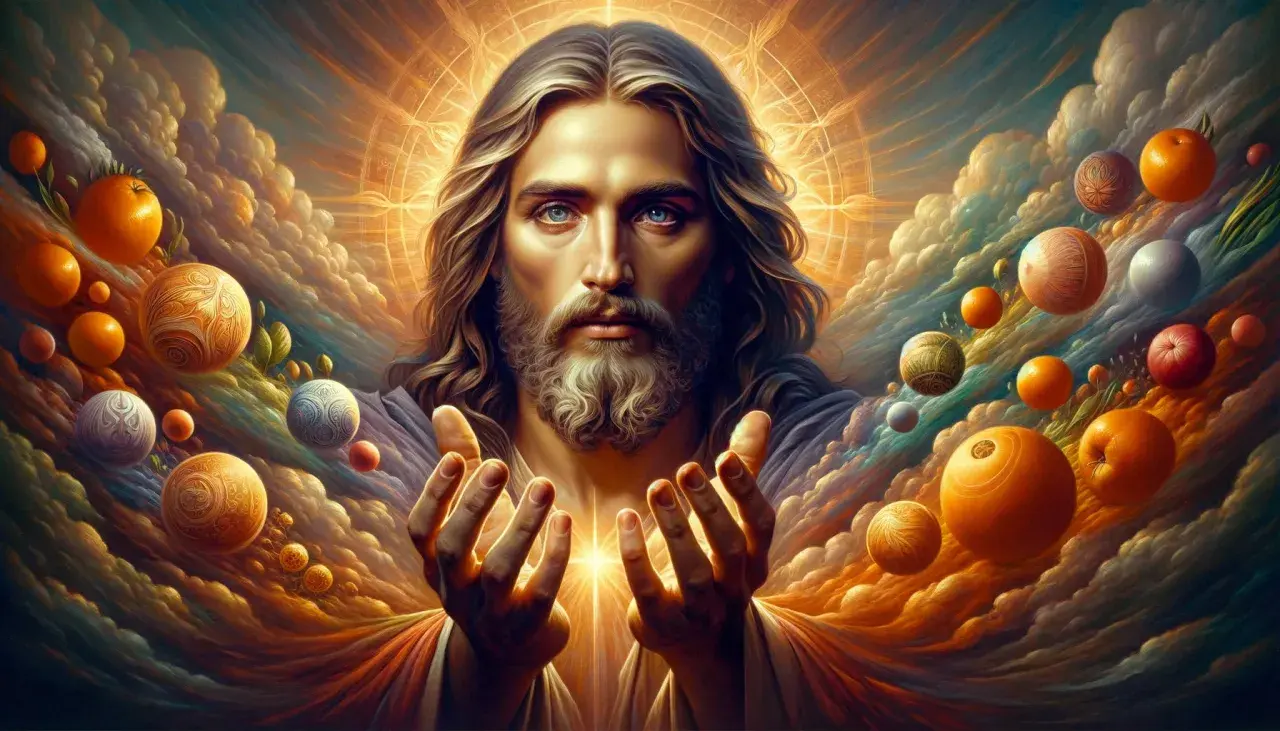
Images of God the Father are never simple portraits. They solve a difficult artistic problem: how to show what Christian theology says is unseen, uncreated, and beyond ordinary likeness. In practice, that means a visual language of clouds, hands, beards, globes, books, thrones, and doves, and this article follows that language from early symbolic signs to the fully formed Renaissance and Baroque Father.
The image moves from indirect sign to doctrinal figure
- Early artists usually preferred the Hand of God, a cloud, or another symbolic sign rather than a full portrait.
- The best-known attributes are not decorative; they encode authority, creation, blessing, and heavenly distance.
- The familiar elderly, bearded Father developed slowly in Western art and was never universal.
- Eastern Orthodox and Western Catholic traditions do not handle the subject in the same way.
- For conservation and authentication, iconographic details can matter as much as style or condition.
Why artists often avoided a literal portrait
The first rule is theological, not stylistic: the Father is not incarnate, so a literal portrait can feel presumptuous. Early Christian and medieval artists therefore reached for indirect signs - a hand emerging from cloud, a ray of light, a voice from heaven, or Christ himself acting as the Logos in Old Testament scenes. That symbolic restraint is not a lack of imagination; it is the invention of a language that lets the invisible act without pretending to be visible in the ordinary sense.
This is also why scenes of creation, the burning bush, the Baptism, or the Annunciation so often sit at the center of the subject. They are moments when divine action has to be made legible, and the artist's job is to turn doctrine into an image a viewer can read at a glance. Once that logic is in place, the symbols become more varied and more specific.
The visual language that made the Father legible
I read these images as a system of signs, not as a single formula. That is why one motif is never enough on its own.
| Motif | Usual meaning | What I check before trusting it |
|---|---|---|
| Hand emerging from a cloud | Divine initiative, approval, or presence without a full portrait | Common in early art, but not a full depiction of the Father |
| Bearded elder | Wisdom, age, patriarchal authority, and sometimes the Ancient of Days | Often Western, but not universal, and sometimes borrowed from Christ |
| Globe or orb | Sovereignty over creation and cosmic rule | Can also appear with Christ, so context matters |
| Book or scroll | Wisdom, law, revelation, or judgment | Not exclusive to the Father |
| Throne or mandorla | Heavenly majesty and sacred distance | The mandorla, an almond-shaped aura, marks a vision as heavenly |
| Dove nearby | The Holy Spirit and Trinitarian context | Identifies the Trinity, not the Father by itself |
| Angels and cherubim | The heavenly court surrounding divine glory | Usually supports the scene rather than identifies the figure alone |
The useful habit is to read the whole composition, not the nearest symbol. A globe without the right setting may belong to Christ; a book may mean wisdom rather than identity; a cloud can be theatrical rather than theological. Iconography works by accumulation, not by one magic attribute. One reason the bearded elder became so persuasive in Western art is that Daniel's image of the Ancient of Days gave artists a textual basis for age, wisdom, and sovereignty, even though that figure is not the same thing as a portrait of God the Father.
How the image moved from hand to patriarch
The history is less a straight line than a slow widening of permission. For centuries, the safest option was a sign rather than a body; by the high Middle Ages, artists began to show a bust or half-length Father emerging from a cloud; by the Renaissance, the Father could sit enthroned, bless the world, or support the crucified Christ in fully developed Trinity scenes.
| Period | Typical form | What changed |
|---|---|---|
| Late antique and early Christian | Hand of God, rays, cloud, or an indirect theophany | Artists signal action without claiming a full portrait |
| Romanesque and Gothic | Bust or half-length elder, often in manuscripts, stained glass, or altarpieces | The Father becomes more person-like and more narratively useful |
| Renaissance | Full figure, often bearded, enthroned, blessing, or holding an orb or book | Theology and perspective give the Father scale and authority |
| Baroque | Teatrical heavens, cherubs, turbulent clouds, and intense color | The image becomes emotionally persuasive and visually overwhelming |
Michelangelo's Sistine Chapel ceiling is the clearest sign of this shift in ambition: God is not a remote label on creation but an active force moving through space. Titian and Rubens push the same idea toward spectacle, while altarpieces such as Barnaba da Modena's and later Italian and Northern works make the Trinity itself the central visual argument. In museum collections at The Met and the National Gallery of Art, you can see how often the Father is placed above the scene rather than inside it, because height itself becomes a sign of sovereignty. That confidence was not shared everywhere, which is why regional tradition matters so much.
Why Eastern and Western traditions split
The biggest mistake is assuming one Christian visual tradition applies everywhere. Eastern Orthodox art generally remains more cautious about a direct anthropomorphic Father, often preferring the Hand of God, the Old Testament Trinity, or other theophanic signs; Latin Western art, especially after the late Middle Ages, more readily embraces the elderly, bearded Father as a devotional and doctrinal figure. Protestant regions often narrow the field again, either by preference or by reforming pressure. The result is not a single rule but a family of visual habits.
| Tradition | Usual approach | Visual effect |
|---|---|---|
| Eastern Orthodox | Indirect signs, selected theophanies, and strong emphasis on the incarnation of Christ | More symbolic, less portrait-like |
| Latin Catholic | Anthropomorphic Father in Trinity, Creation, Coronation, and altarpiece imagery | More narrative and emotionally immediate |
| Reformation-influenced contexts | Cautious or reduced use of divine portraiture | Simpler compositions, often more textual framing |
That difference also helps with reading provenance. A direct Father figure in a work claiming to be Eastern and early is worth a second look; a restrained symbolic treatment in a Counter-Reformation Catholic context can also be perfectly normal, depending on the commission and workshop. In other words, iconography is one of the fastest ways to separate broad tradition from local exception. The best way to see the difference is to look at a few works that fixed the visual vocabulary.
The works that made the iconography familiar
When I want the subject to stop being abstract, I go back to a few anchor works. They are useful because they show different solutions to the same problem: how to make the Father present without flattening divine mystery.
| Work | Iconographic choice | Why it matters |
|---|---|---|
| Barnaba da Modena, Scenes of the Virgin; The Trinity; The Crucifixion | God the Father supports the crucified Son, with the Holy Spirit as a dove | It compresses Trinitarian doctrine into one legible structure |
| The Metropolitan Museum of Art, Madonna and Child Enthroned with Saints | The Father appears in a lunette, holding a globe and blessing | It places cosmic authority above Marian devotion |
| Michelangelo, Sistine Chapel ceiling | The Father appears as a dynamic creator in Genesis scenes | Divine action becomes bodily motion |
| Titian, Assumption of the Virgin | The Father appears as a radiant presence in cloud and light | It links heaven, saints, and human ascent |
| Rubens, Coronation of the Virgin | A monumental heavenly court frames the Father above the Virgin | Baroque scale turns theology into persuasion |
| The National Gallery of Art, The Nativity, with God the Father Surrounded by Angels and Cherubim | The Father is enclosed by a dense heavenly host | It emphasizes vision, elevation, and celestial distance |
What matters in all of them is placement. The Father is rarely just "in the room"; he is above, behind, or beyond the earthly action, and that spatial separation is part of the meaning. In baptism scenes, for example, the Father may be shown as a cloud-borne presence, while the dove and the voice from heaven do most of the immediate doctrinal work. The clouds, angels, and cherubim are not filler. They are the architecture of transcendence.
How I read these images for meaning and condition
When I approach a panel or canvas, I do not start with style alone. I start with three questions: who is actually being shown, what doctrinal job is the image doing, and how much of the original iconographic program has survived cleaning, overpainting, or later repair?
Check the subject before the style
A bearded elder in clouds may be God the Father, but it may also be the Ancient of Days, a Christ figure, or a later restoration that has absorbed original distinctions. Inscription usually settles the issue faster than facial type does, especially in icons where names identify the figure directly. This is why a labeled panel matters so much to authentication.
Look for signs that the image is structurally original
If the upper register seems flatter than the rest of the panel, if the cloud edges are too clean, or if the gilding has been renewed only around the divine figure, I become cautious. In sacred art, condition damage often hits the very elements that carry meaning: halos, rays, inscriptions, and the thin boundaries of clouds. A restored symbol can still be readable, but it should not be mistaken for untouched evidence.
Read Also: Peacock Symbolism in Art - What Does the Peacock Mean?
Use iconographic consistency as a test
In a Catholic altarpiece, a globe, blessing hand, and heavenly court may fit comfortably together. In an Orthodox context, the same full figure may demand more scrutiny, because regional practice often prefers indirect theophany. The safest reading is always the one that matches the work's place, date, workshop habits, and surviving surface history. That is where iconography stops being description and becomes evidence.
The strongest images still balance authority and mystery
The most successful depictions of God the Father do not over-explain. They give just enough form to let the viewer understand the scene, while leaving enough distance for awe. That balance is why the subject has lasted so long: it can be doctrinal, devotional, and visually compelling at the same time.
If I were looking at one work in a gallery, I would ask three simple things. First, is the Father present by hand, by cloud, by symbol, or by full figure? Second, what story is the image solving: creation, blessing, mercy, or Trinitarian unity? Third, does the condition of the object still support that reading, or has time blurred the signs that once made it clear? Those questions keep the viewer honest, and they are usually enough to turn a beautiful image into a readable one.
In that sense, the subject is not just about religious imagery; it is about how art makes the invisible thinkable, and how careful looking can still recover that original visual logic.
