
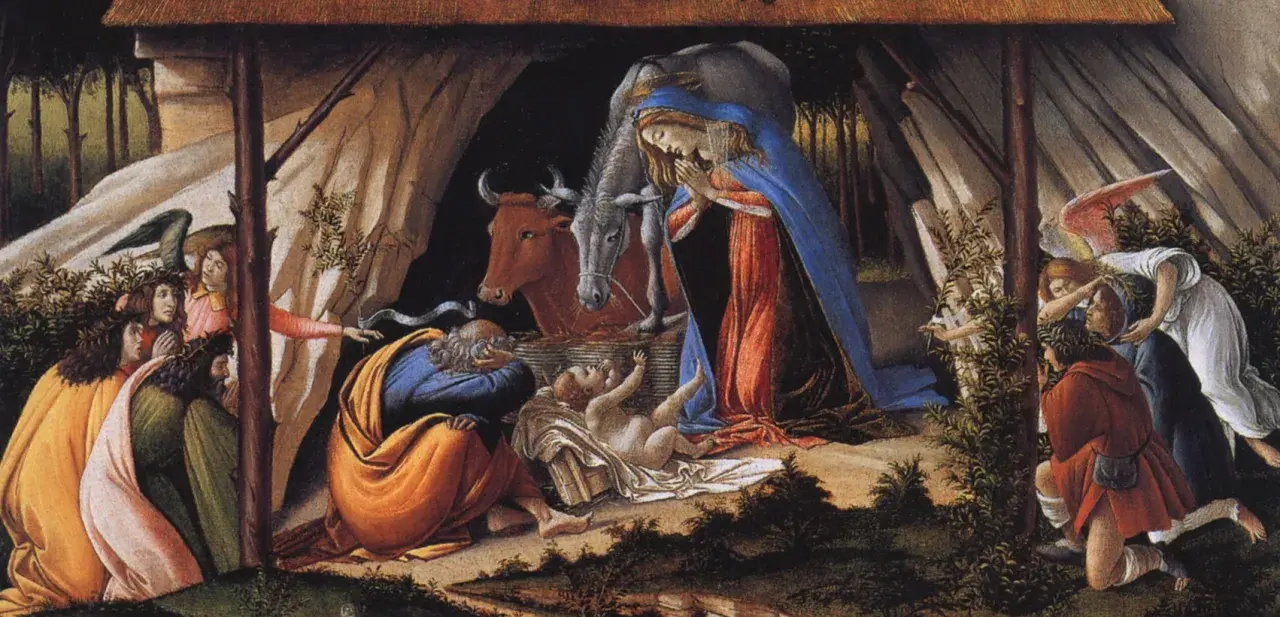
Nativity scenes work because they turn a familiar biblical event into a dense visual language of light, gesture, and meaning. In the best nativity paintings by famous artists, every detail matters: the ruined shelter, the angle of the shepherds’ gaze, the animals in the dark, even the way the infant is lit. This article explains the iconography behind those choices, shows how major painters reshaped the scene, and gives you a practical way to read the symbolism without flattening the art into clichés.
What matters most in a great Nativity scene
- The scene is rarely just one moment. Many paintings blend the birth, the shepherds’ arrival, and the Magi’s worship into a single image.
- Light is the main symbol. It often stands in for divine revelation, especially in Baroque and Dutch painting.
- Animals and ruins are not decorative extras. The ox, donkey, stable, grotto, and broken architecture all carry theological meaning.
- Artists use the same subject differently. Some stress humility, others apocalypse, prophecy, or emotional intimacy.
- Condition affects interpretation. Darkened varnish, losses, and overpainting can hide the very symbols the artist relied on.
- In museum settings, context matters. Once a panel is separated from its altarpiece, you have to read the iconography more actively.
What the Nativity scene usually contains
The Christian Nativity is not a single fixed formula. Artists have long moved between the birth itself, the shepherds’ announcement, and the Adoration of the Magi, and that flexibility is one reason the subject stayed so popular. In Western art, the most common core figures are the Virgin Mary, the infant Christ, Joseph, angels, shepherds, and the ox and donkey that quietly anchor the stable.What makes the subject visually rich is that it can be stripped down or expanded without losing its identity. A painter may emphasize the baby’s vulnerability, the supernatural light around him, or the social contrast between poor shepherds and richly dressed kings. I find that distinction useful: the same story can feel intimate, triumphant, or almost cosmic depending on which episode the artist chooses to highlight.
That is also why these works are not just devotional images. They are compact arguments about incarnation, humility, and salvation, which leads naturally to the symbols that do the heavy lifting.
The symbols that carry the meaning
Once you learn the visual vocabulary, a Nativity painting stops looking generic. The individual motifs are often small, but they do most of the theological work.
| Element | Common meaning | Why it matters |
|---|---|---|
| Light around the infant | Divine presence, revelation, the Incarnation made visible | It tells you where the painting wants your attention first. |
| The star or beam in the sky | Guidance, prophecy fulfilled, heaven intervening in history | It links the earthly scene to a larger cosmic order. |
| The ox and donkey | Traditional witnesses to Christ’s birth, often read as signs of humility | They root the scene in stable, familiar life rather than royal grandeur. |
| Angels with scrolls or banners | Announcement and praise, often echoing “Glory to God in the highest” | They connect the image to liturgy, not just narrative. |
| Shepherds | The poor and ordinary made first witnesses | They shift the scene toward accessibility and mercy. |
| The Magi | The nations, wisdom, and universal kingship | They broaden the event beyond Bethlehem. |
| Ruined architecture or a grotto | The old order passing, or the tension between pagan antiquity and Christianity | It makes the setting symbolic, not merely realistic. |
| Straw, manger, or white cloth | Lowliness, purity, and the fragile humanity of Christ | These materials often do more than show where the baby lies. |
| Mary’s blue and red garments | Purity, royalty, love, and earthly embodiment | Color becomes part of the theology of the image. |
| Peacock or other unusual bird | Immortality or paradise in some Renaissance works | It signals that artists often layered the scene with symbolic extras. |
When a symbol is damaged or repainted, the whole reading can shift. That is why conservation is not a side issue here; it affects interpretation directly. Next, it helps to see how major painters used these same motifs in very different ways.

How famous painters reshaped the scene
Some artists lean into serenity, others into drama. Some keep the setting humble and local, while others load the image with prophecy, courtly detail, or apocalyptic tension. The table below shows how a few major names handled the subject.
| Artist | Work | What stands out | Symbolic effect |
|---|---|---|---|
| Fra Angelico and Fra Filippo Lippi | The Adoration of the Magi | A refined, devotional composition with a peacock perched above the scene and elegant layering of figures | The peacock can suggest immortality, while the ruined or transitional setting points to the old world giving way to the new. |
| Sandro Botticelli | Mystic Nativity | A highly unusual, emotionally charged image with opened heavens, angels, and demons | The birth becomes a cosmic and apocalyptic event, not just a pastoral one. |
| Titian | Holy Family with a Shepherd | Dark atmosphere, close human scale, and a light that seems to come from the infant himself | The scene feels immediate and intimate, with humility expressed through restraint rather than ornament. |
| Caravaggio | Nativity with St. Francis and St. Lawrence | Powerful realism, compressed space, and saints added to a traditional Nativity frame | The image becomes local, bodily, and almost confrontationally human. |
| Rembrandt | The Angel Appearing to the Shepherds | Radiant light, startled figures, and a psychological sense of awe and fear | Revelation is experienced as an event in human consciousness, not just a story in the sky. |
| Piero della Francesca | Nativity | Balanced composition, open landscape, and a quiet, measured mood | The birth reads as ordered and contemplative, almost architectural in its calm. |
What I take from these examples is simple: the subject stays recognizable, but the emotional temperature changes dramatically. That is exactly why looking at a single Nativity painting in isolation can be misleading, and why the next step is to distinguish the related scenes artists keep blending together.
Why some Nativity scenes are really adoration scenes
In practice, many paintings mix the Nativity with the Adoration of the Shepherds or the Adoration of the Magi. That is not a mistake. It reflects how artists compressed time to create a more complete devotional image, especially in altarpieces and panel paintings where one surface had to carry a great deal of meaning.
| Scene type | Primary focus | What it emphasizes | Typical visual cues |
|---|---|---|---|
| Nativity | The birth itself | Incarnation, humility, sacred stillness | Baby, Mary, Joseph, stable or grotto, soft light |
| Adoration of the Shepherds | Ordinary witnesses arriving first | Accessibility, poverty, revelation to the lowly | Shepherds kneeling, animals nearby, angels above |
| Adoration of the Magi | Royal visitors paying homage | Universality, prophecy, the nations recognizing Christ | Rich costumes, gifts of gold, frankincense, and myrrh, procession imagery |
| Hybrid or continuous narrative scenes | Several moments at once | Theological synthesis rather than literal chronology | Shepherds, Magi, angels, and the Holy Family in one crowded image |
That blending matters because it changes the symbolism. Shepherds point to humility and witness from below; kings point to recognition from above. If both appear, the artist is usually trying to show that the newborn Christ belongs to everyone. Once you see that logic, the next question is less about subject matter and more about the painting’s physical life.
What restoration and attribution change in these works
Because many of these paintings are old panel works or heavily restored canvases, what you see today is not always what the artist originally laid down. Darkened varnish can bury the delicate source of light, and overpainting can flatten the contrast that once made the infant seem radiant. In a Nativity scene, that is not a minor technical issue; it can hide the central symbol.
For attribution, I look for three layers of evidence together rather than one alone:
- Provenance, which helps establish where the work has been and whether the history is continuous.
- Technical study, such as infrared reflectography or x-radiography, which can reveal underdrawing, pentimenti, and changes in composition.
- Stylistic coherence, including figure types, brushwork, pigments, and the handling of space and light.
Workshop versions and close copies are common in this subject because devotional demand was high. A Nativity might exist in multiple versions, and not every version is autograph. The practical lesson is that iconography and authorship are connected: if a later hand has altered the sky, the garments, or the architectural ruins, the meaning may have shifted as well. That is one reason conservators and historians have to read the image together.
A sharper way to read the scene in the gallery
When I stand in front of a Nativity painting, I do not start with the label. I start with four questions: where is the light coming from, who is present, what kind of shelter is shown, and whether the artist is asking me to feel awe, tenderness, or theological order. Those questions usually tell me more than the title alone.
- Find the source of light. If the infant is the light source, the painting is making a direct claim about divinity and revelation.
- Identify the witnesses. Shepherds suggest humility and nearness; Magi suggest universality and kingship.
- Read the setting. A grotto, ruin, or improvised stable usually carries symbolic meaning, not just scenic charm.
- Notice what is missing. A reduced cast can be a sign of devotional focus, while a crowded scene may be building a theological argument through abundance.
That is the useful part of studying these works: you stop seeing them as interchangeable Christmas images and start seeing them as carefully constructed statements about belief, history, and human response. Once you know how the symbols work, even a familiar Nativity can feel newly legible.
